
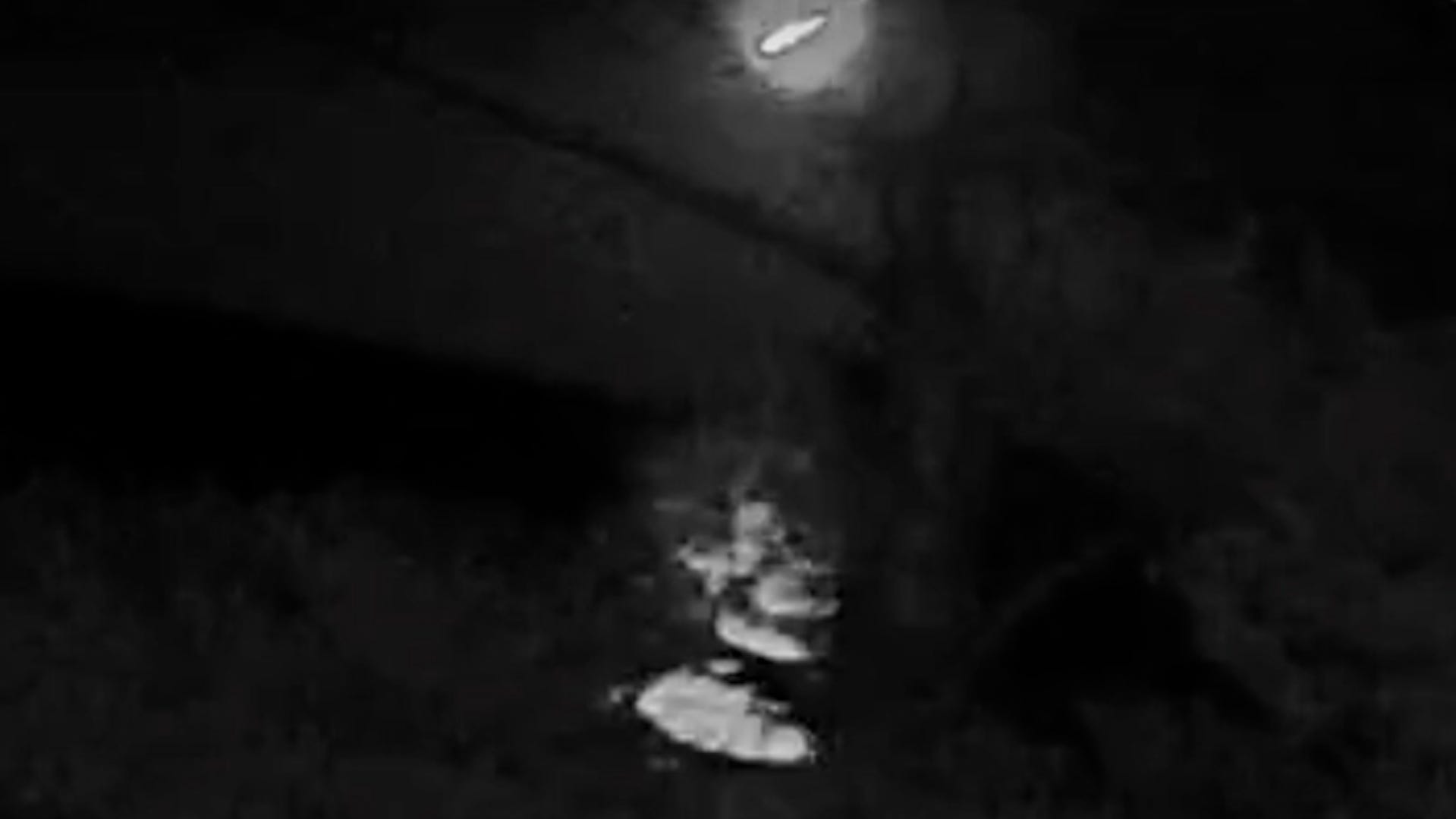

See meteor flying above Lake Superior
A meteor was seen striking across the night sky above Lake Superior on November 3, 2025.
This story has been updated to correct the date of the meteorite sighting.
An unconfirmed meteorite lit up the sky over Michigan Sunday evening, Dec. 7, according to the Michigan Storm Chasers, a group that tracks statewide weather and offers daily forecasts.
The meteor, which broke up and may have fallen to earth, lit up the Michigan sky around 6 p.m. Video recordings of the fireball were shared across social media.
The streaking object was seen across Michigan. Multiple social media users commented, sharing photos and video of a brilliant, greenish object streaking through the sky.
What is a meteorite?
A meteorite is a meteoroid that survives the fall to the Earth’s surface, according to NASA. Meteoroids that don’t strike the earth are known as meteors.
What is a fireball? What is the difference between a fireball and a bolide?
A fireball is another term for a very bright meteor, generally brighter than magnitude minus 4, which is about the same magnitude of the planet Venus in the morning or evening sky, the American Meteorological Society explains. A bolide is a special type of fireball which explodes in a bright terminal flash at its end, often with visible fragmentation.
“Our best estimates of the total incoming meteoroid flux indicate that about 10 to 50 meteorite dropping events occur over the earth each day,” the AMS said. “It should be remembered, however, that two-thirds of these events will occur over ocean, while another quarter or so will occur over very uninhabited land areas, leaving only about 2 to 12 events each day with the potential for discovery by people. Half of these again occur on the night side of the earth, with even less chance of being noticed. Due to the combination of all of these factors, only a handful of witnessed meteorite falls occur Each year.”
Where can you see meteors?
If you’re hoping to spot meteors streaking through Michigan night skies, look for a clear, open area.
Michigan is home to six dark sky state parks, three international dark sky parks and an international dark sky sanctuary.
- The Alpena area has three Dark Sky Preserves: Rockport State Recreation Area, Thompson’s Harbor State Park and Negwegon State Park.
- In Mackinaw City, Headlands International Dark Sky Park, 15675 Headlands Road.
- In Empire, Sleeping Bear Dunes National Lakeshore, 9922 Front St.
- In Munising, Pictured Rocks National Lakeshore.
- In Paradise, the Great Lakes Museum and Whitefish Point Light Station, 18335 N. Whitefish Point Road, and Tahquamenon Falls State Park at 41382 W. M-123.
- In Port Austin, Port Crescent State Park, 1775 Port Austin Road.
- In Clayton, Lake Hudson Recreation Area, 5505 Morey Hwy.
- Keweenaw Dark Sky Park in Keweenaw County and Dr. T.K. Lawless Park in Cass County are international spots. And, finally, the Beaver Island State Wildlife Research Area is an international sanctuary.
- In Carp Lake, Wilderness State Park, 903 Wilderness Park Drive.
Think you found a meteorite? What to do
According to the United States Geological Survey, people who find meteorites should look out for several properties to confirm if its accurate:
- Density: Meteorites are usually quite heavy for their size, since they contain metallic iron and dense minerals.
- Magnetic: Since most meteorites contain metallic iron, a magnet will often stick to them. For “stony” meteorites, a magnet might not stick, but if you hang the magnet by a string, it will be attracted.
- Unusual shape: iron-nickel meteorites are rarely rounded. Instead, they have an irregular shape with unusual pits like finger prints in their surface called “regmaglypts.”
- Fusion crust: stony meteorites typically have a thin crust on their surface where it melted as it passed through the atmosphere.