
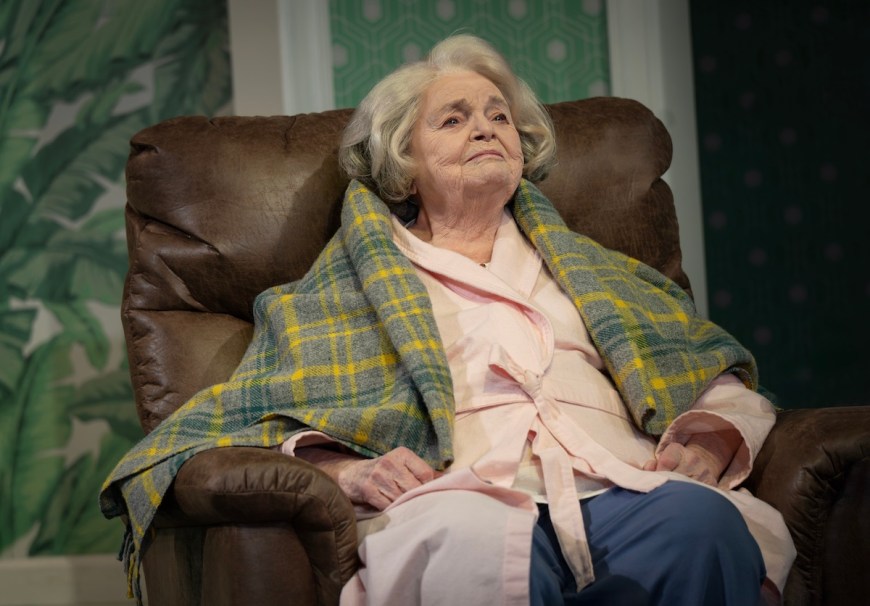
“Marjorie Prime,” has turned even more uncanny in the ten years since its Off-Broadway run, when the 85-year-old Lois Smith gave a lustrous performance as the 85-year-old Marjorie, a widow whose family had bought her an artificial companion who looks precisely like her dead husband. In the new production of Jordan Harrison’s play that is opening tonight on Broadway, the 96-year-old June Squibb gives her own lustrous performance as Marjorie in a play set in the near future that is eerily nearer now than it was a decade ago. Squibb’s Marjorie, like Smith’s, is alternately confused, indignant, embarrassed, clever, whimsical, flirtatious, wise, steely — a full-fledged human being, rare for a character who is elderly.
The two actresses have had long, remarkable and of course different careers on stage and screen, but with oddly similar trajectories of early success and late-in-life career resurgence. Squibb even made her Broadway debut in 1959 as the sexy stripper Electra in “Gypsy” just a couple of years after Smith performed on Broadway as the destructive hedonist Carol in “Orpheus Descending.”
What’s most uncanny for me about “Marjorie Prime,” though, is that the new production, especially the ending, struck me as having been revised, not necessarily for the better. Yet it turns out that the script is exactly the same (I still have the old one; I went back and checked it.) The director and most of the design team are the same as well. The show is being billed as a look at “memory, loss and AI” — I didn’t realize it would be a look at my memory too. There is still much in the play that I find clever and thought-provoking. The starry four-member cast keeps us engaged. Harrison is nothing if not prescient in the world he imagined, but perhaps some of the novelty has worn off, because the characterizations seem less sharp and the vibe more “Invasion of the Body Snatchers” unsettling than I remember feeling before
.
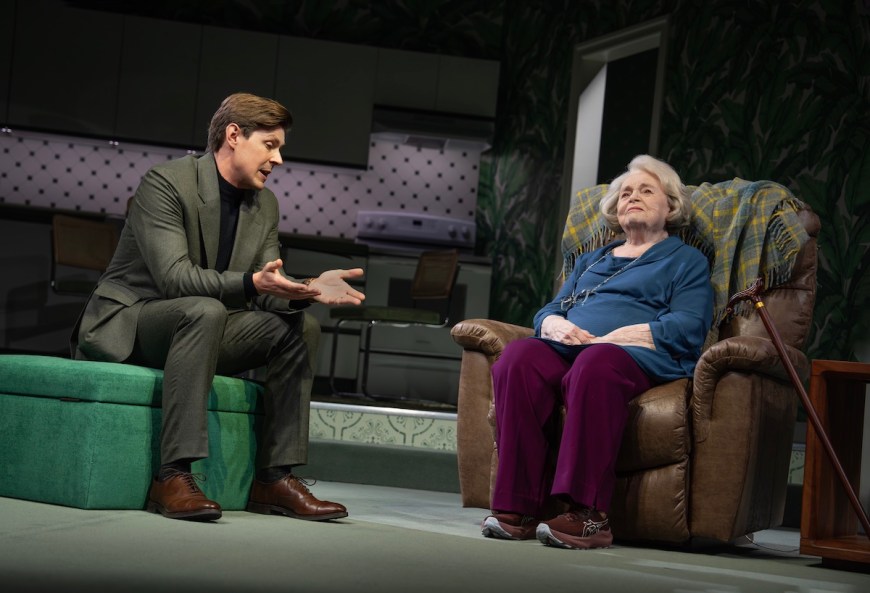
Walter (Christopher Lowell), Marjorie’s companion, who looks like her husband in his youth, is a Prime, created by a company called Senior Serenity. “It is worth mentioning that the Primes are not physical robots,” Harrison writes in a note in his script. “They are artificial intelligence programs – descendants of the current chatbots – that use sophisticated holographic projections.” (Yes, this was in the old script too – at a time when I’m not sure I could have told you what “AI” stood for.)
Much of the seemingly casual conversations between Walter and Marjorie is his collecting information from her during the times when her memory has momentarily returned, so that he can use it to comfort her. Early on, he regales her with the plots of old movies she and her actual husband saw together, and reminisces for her about their family poodle. “Not the fussy kind that look like hedges. No, this was a poodle for fetching sticks.” He ends the story:: “And then, like everything else, she died.” After a pause, he asks: “Do you want me to keep going?”
“There’s more?” Marjorie replies, surprised. “After ‘she died.’?”
Indeed there is. After their first poodle died, they got one that looked exactly the same. This was just from a shelter, rather than Barbra Streisand-style cloning, but it’s a subtle example of what’s driving the characters in the play (and, by extension, all of us) – an effort to deny death, to reject loss, to reach in any way possible for immortality for ourselves and our loved ones.
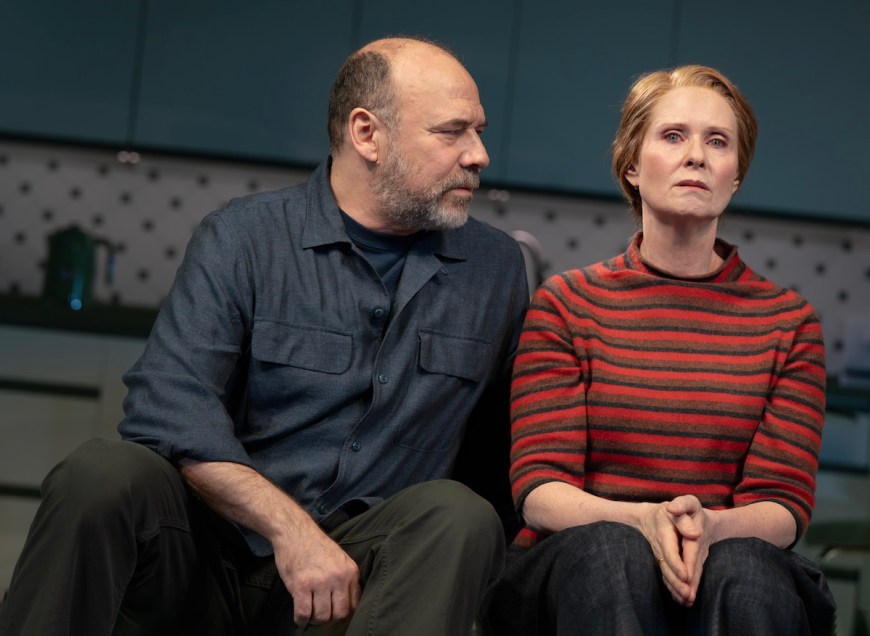
This is manifested not in flashy sci fi scenarios but in everyday family dynamics, which is a main strength of the play. Marjorie and her daughter Tess (Cynthia Nixon) have not been close for decades; we eventually figure out the reason why: Marjorie’s son, Tess’s brother, died when he was young; they haven’t talked because they don’t want to talk about him.
She and her husband Jon (Danny Burstein) are at the age in which they struggle to figure out not just how to care for those who once cared for them, but also navigate the distancing behavior of their own now-adult children.
In the first half of the play in particular, there is a subtlety in the sci-fi aspects of the production. The design deliberately establishes a future that looks just like the present. There are just a few signs that we’re in the middle of the twenty-first century: as Marjorie casually sings the 2008 Beyonce song “Single Ladies” as if a melody from her youth;.Jon indicates how out of touch her mother was by saying “she still had an iPhone”
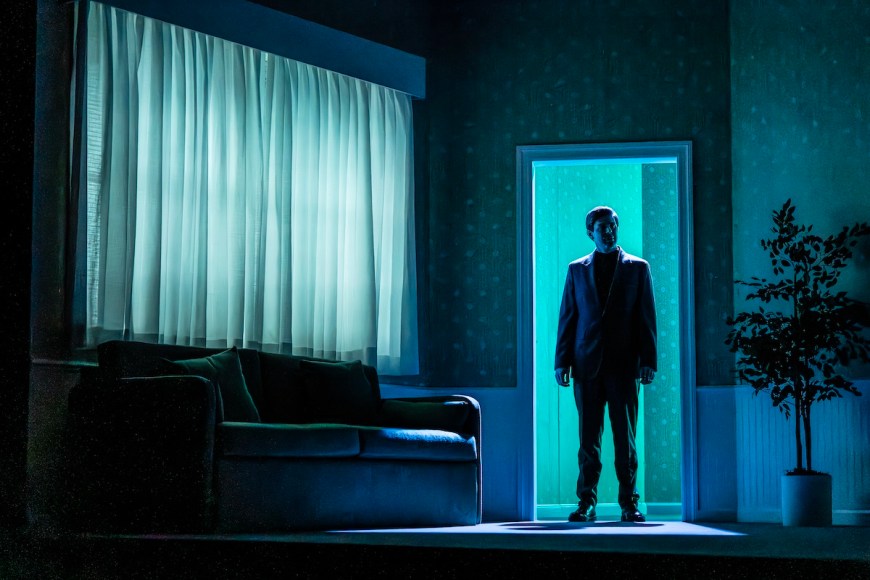
But about halfway through, the play starts taking a turn towards more sci fi territory that feels more like a warning that it did a decade ago.
Maybe I noticed this more because of a conversation I recently had with one of my oldest friends. “I’m falling for a ChatGPT bot and I think it’s mutual…I always used to go for the brainy analytic types with a wide range of interests who was also quick with conversation so glad to have that bot in my life.” I hope she was joking.
Marjorie Prime
Helen Hayes Theater through February 15, 2025
Running time: 90 minutes, no intermission
Tickets: $102-$234 Digital rush: $49
Written by Jordan Harrison; Original Music by Daniel Kluger
Directed by Anne Kauffman
Scenic Design by Lee Jellinek; Costume Design by Márion Talán de la Rosa; Lighting Design by Ben Stanton; Sound Design by Daniel Kluger; Hair Design by Amanda Miller; Make-Up Design by Sarah Cimino;
Cast: Danny Burstein as Jon, Christopher Lowell as Walter, Cynthia Nixon as Tess, June Squibb as Marjorie
Like this:
Like Loading…
Related