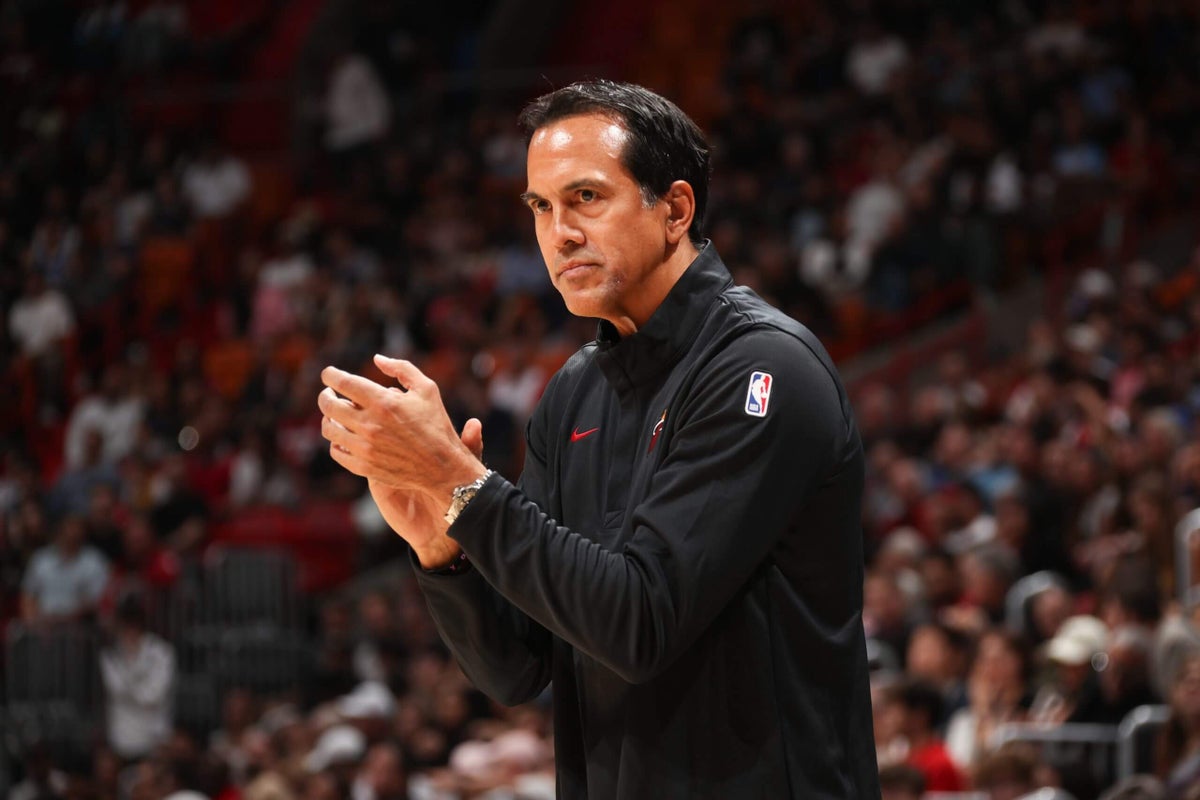
It took 48 hours for theories to emerge.
Norman Powell had attended a decade of NBA training camps. This autumn’s camp was his first with the Miami Heat, and over the first two days, the Heat had worked through offensive drills — but hadn’t used screens in any of them.
Head coach Erik Spoelstra hadn’t said why, at least not in any official capacity. Some of the young guys who arrived early were in on the sweeping changes about to come in Miami, as were a few of the longtime vets. But Powell was out of the loop.
Spoelstra had told players during drills they couldn’t run pick-and-rolls, which Powell figured was some innovative buildup to an offense that would form into a more familiar system.
“I was like, ‘Oh, we’re running the cardio part of it,’” Powell said in a recent conversation with The Athletic. “(Spoelstra) probably wants us playing open triggers, no dribbles, no screens just to get the ball moving.”
Powell is a X’s and O’s-savvy, well-respected, 11-year veteran. But he was wrong as he learned the next day.
On Day 3, Spoelstra paused a scrimmage after a couple of players went into a dribble handoff. He had already implemented various new rules. Players had to get from 3-point line to 3-point line within four seconds, and if they failed, it was a turnover. Setting any type of screen would be a turnover, too. The dribble handoff fell under that category.
“We’re not running pick-and-rolls for a reason,” he told the team.
That’s when Powell realized this season would not be the norm.
Only months removed from a first-round playoff loss Spoelstra called “embarrassing,” a four-game dismantling to the Cleveland Cavaliers which set the all-time point-differential record for a series, the Heat were transforming.
Over the summer, Spoelstra met with coaches and some players, hoping to mold a strategy that would make sense for this set of personnel. He and All-Star center Bam Adebayo convened throughout the offseason to pick each other’s brains on what needed to change.
“It wasn’t like head coach-star player,” Spoelstra said. “It was colleagues saying, ‘Hey, we need to figure this out. We need to make some changes.’ None of us like being embarrassed like that. We have to evolve.”
One of the sport’s superlative coaches, a two-time champion entering his 18th season leading the Heat, Spoelstra added guidance.
He hired a consultant — longtime player development trainer Noah LaRoche, who spent last season with the Memphis Grizzlies — to help implement a similarly styled offense to what the Heat deploy today, a blueprint that worked well until it didn’t. LaRoche, who has trained Victor Wembanyama, Paul George and other big NBA names, has become one of basketball’s biggest advocates for a Constraints-Led Approach (CLA), allowing players the freedom to play off instincts and not be burdened by set plays.
The Grizzlies outperformed expectations early but eventually combusted, in part because star point guard Ja Morant didn’t like such an intense de-emphasis on pick-and-rolls. LaRoche and head coach Taylor Jenkins both lost their jobs before the playoffs began.
But this offense, Spoelstra thought, “made sense” for the Heat, who employed the personnel to pull it off.
Instead of slowing the game down, they would speed it up. Instead of relying on dribble handoffs with Adebayo or pick-and-rolls with fellow All-Star Tyler Herro, as were once the foundation of their attack, they would open up their best players in other ways. The goal: Never stop cutting.
It’s December, and in spite of their current three-game skid, they are still flying.
The Heat, a team that finished under .500 last season, now sits at 14-10. An offense that dipped to 21st in efficiency in 2024-25 was up to 13th entering Sunday. The Heat are running fewer pick-and-rolls and fewer dribble handoffs than anyone. They live in transition. One cut begets another.
They’ve also done it all with Herro hurt for most of the season and Adebayo injured for some of it. Third-year super reserve Jaime Jaquez Jr. has bounced back after a sophomore slump. Young center Kel’el Ware is a rising star. Veteran wing Andrew Wiggins has morphed back into the two-way winner who helped the Golden State Warriors to a title.
And Powell looks like he was in on the changes all along.
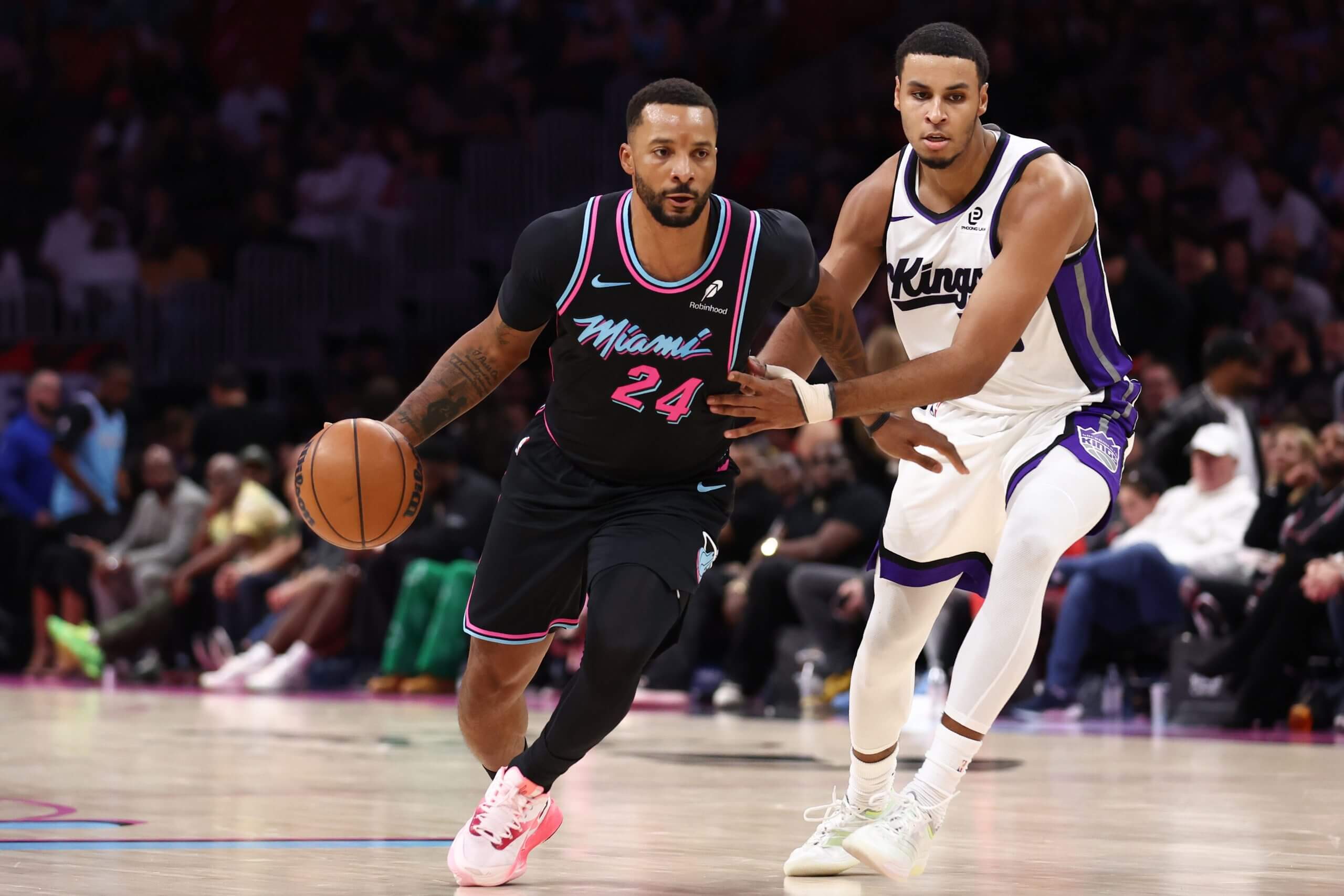
Miami’s Norman Powell appears to have adjusted well with the Heat’s style of play. (Megan Briggs / Getty Images)
Last season was one of the best of his career. The LA Clippers capitalized on his off-ball movement after losing star wing Paul George the previous summer. Powell would assume the George role, scrambling around screens to free himself for 3s and curls to the basket.
He doesn’t do much of that anymore, but he’s been even better this year. Miami is rolling. Even more notable than the victories is the aesthetic. A transformation has taken place, and it looks a lot like one that happened seven years ago on the shore of Sebago Lake in Standish, Maine.
“It’s unbelievable how much you don’t know about the game you’ve been playing all your life.”
LaRoche has lived this Mickey Mantle quote. As a point guard at Division III Saint Joseph’s College of Maine in the early 2000s, he loved playing out of ball screens.
“People thought I knew how to play because I knew how to direct people and set up offenses,” LaRoche told The Athletic in September. “I had no clue what I was doing.”
Three years after graduating in 2006, LaRoche quit his finance job in Boston. He had bumped into Hank Smith, the former Emerson College coach who led both Oklahoma City Thunder general manager Sam Presti and vice president of basketball operations Rob Hennigan. Smith connected LaRoche with Tim Grover, who famously trained Michael Jordan, and LaRoche landed an internship, which jump-started his career as a trainer.
The other gift Smith gave LaRoche was a change in the way he saw the game.
“Everything’s in the mind,” LaRoche said. “The best players — the Gretzkys, the Birds, the Bradys — it’s all their minds.”
Talking basketball with LaRoche is a constant game of question and answer. He makes it seem like common sense, allowing his pupil to get to the answer.
Many basketball teams run plays. Everything is diagrammed. The coach is in control. This is where LaRoche dubbed the way coaches lead as backward. A desire to control comes from not trusting players to make decisions, which is the result of a lack of understanding of how they’re supposed to play.
It’s the same approach he takes today, an approach Spoelstra demonstrated while implementing Miami’s new offense.
“You don’t teach it,” LaRoche said. “They learn it through the environment you design.”
LaRoche starts with explaining the why.
“If you understand the why, now that person has understanding. Now, they don’t even need a coach,” LaRoche said. “They can handle these situations by themselves.”
The goal is to make basketball a simple game. The most efficient shots are layups and catch-and-shoot 3s. Teams need to generate advantages and space to create those shots. LaRoche structures training sessions and practices around trying to generate these situations, which he said are always set up by either a drive or a cut.
He’s not against ball screens, but …
“All the ball screen is, is a combination of that,” he said. “Someone’s going to cut off that screen, or someone’s going to drive off that screen. So, what’s more efficient: To just drive the ball to the paint or cut to the paint, or to screen and then get a drive or cut to the paint?
“And what does the screen give the defense? It gives you more time. I’m dribbling the ball, waiting, giving two, three seconds for a screen to come.”
The CLA teaches principles over plays, concepts over scripts. If one player cuts from the corner to the baseline, a teammate knows to go fill in for that guy. If a driver sprays a pass to a teammate on the perimeter, the receiver must either shoot or swing the ball around the perimeter. Back-to-back drives clog up the middle of the floor too much.
The Heat have emphasized dribbling players into cuts, accelerating to a new spot on the court instead of just swinging the ball to the opposite side to begin a possession.
“I initially thought we were eventually gonna have to set a screen at some point,” Jaquez said. “But I guess you don’t really need to if you just constantly play fast and get stops.”
Spoelstra has redefined the purpose of cutting for some players. Often, the reason to do it isn’t to free yourself but to cause a reaction that will open up a teammate. Powell will bolt from the corner into the lane, understanding that his man will stick with him, but also that if he does so, it will clear out the corner for his teammate on the wing to replace him there. And because of the way the defense is positioned, that guy might end up with an uncontested jumper.
“It’s all spacing cuts,” Powell said. “It’s like you’re sacrificing yourself for your teammate.”
The Heat aren’t the only NBA team to try the CLA approach, nor were the Grizzlies last season. Cavaliers head coach Kenny Atkinson brought the philosophy with him to Cleveland last season. The Toronto Raptors have exceeded expectations this year, ripping off many of these cuts.
But no one is as extreme as the Heat. Only 24 games into the season, Miami is guaranteed to make history.
The Heat have run only 15 pick-and-rolls per 100 possessions this season, according to Second Spectrum. Twenty-ninth in the NBA is the Utah Jazz, who go into pick-and-roll more than three times as often as Miami does.
Second Spectrum began tracking these stats in 2013. Entering this season, the record for fewest pick-and-rolls per 100 possessions belonged to the 2018-19 Philadelphia 76ers — at 39.3.
Miami is about to shatter that standard.
The return of Herro, a career-long pick-and-roll fiend, two weeks ago didn’t cause an uptick in ball screens. Last week, during a blowout win over the Clippers, Miami laid only seven pick-and-rolls all game. Herro didn’t run any of them.
All screens have gone by the wayside. Those dribble handoffs that were turnovers in training camp, even the ones once so prevalent with Adebayo, have vanished. The Heat are also pacing to break the record for fewest dribble handoffs per 100 possessions in a single season. Additionally, they’re 26th in the NBA in off-ball screens.
Their pace can overwhelm. Miami turns 18 percent of its possessions into transition opportunities, the NBA’s second-highest rate, per Second Spectrum. It hunts 3s in the open court. All the while, the defense is swarming opposing scorers, which helps spur those fast breaks.
“You have to learn how to be in the best shape of your life, really,” Jaquez said. “You just have to be really well-conditioned.”
The Heat haven’t stopped moving, not even to impede a defender’s path.
On any given night, Herro could go off. Or Adebayo. Or Wiggins. Or Powell. The point of the offense isn’t to cater to one guy; it’s to emphasize the open man.
LaRoche said many of the players he has trained wish their teams would play this way. It’s more inclusive, he insists, and doesn’t predetermine who will shoot.
“(It’s a) little different than when you’re coming down and running a play,” Powell said. “But it’s a lot of fun seeing the growth of everybody getting their opportunity to show what they can do.”
Early in his career, LaRoche was able to test his beliefs by coaching youth teams and consulting with high school coaches. His principles started to garner attention during the 2018-19 season, when his old coach at Saint Joseph’s, Rob Sanicola, brought him in during the preseason to work with his team.
The Monks had ranked 250th in offensive efficiency the previous season. Using the principles LaRoche gave them, they improved to fourth nationally. A majority of their shots were layups or 3s, almost all out of transition, spot-ups or off cuts. A video breaking down how those Monks played has 1.9 million views.
When this kind of transformation happens, it inevitably leads to copycats. The first prominent coach to try LaRoche’s approach was University of Virginia’s Tony Bennett during the 2020-21 season. But the team lost its second game of the season to San Francisco, and Bennett returned to his traditional offensive approach.
“You got to get to the dip,” LaRoche said. “The big key is if you can get through that, that’s such a major competitive advantage because that’s where most people stop, that little dip-down before you take a non-linear skip up. Most people stop there. And Coach Sanicola freaking pushed through.”
Eventually, an NBA coach took notice.
As The Athletic previously told, before the 2020-21 season when LaRoche was in Los Angeles training George, then-Clippers assistant Atkinson visited to watch George work out. Atkinson started to introduce some of the relocation principles LaRoche emphasized and became fascinated by the CLA. Last season, which was Atkinson’s first as head coach of the Cavaliers, he hired Alex Sarama, a British basketball coach who wrote “Transforming Basketball: Changing How We Think About Basketball Performance,” a book involving the CLA. The Cavs had the NBA’s most efficient offense by using movement principles similar to those that LaRoche teaches — off-ball players shifting toward a driver.
The Cavs’ movement was often triggered by a ball screen, and similar to the Monks, when a driver started to trot downhill, the corner man cut and the same-side wing would slide to the corner:
With it becoming more common for NBA teams to bring strong nail help — meaning a help defender guarding the opposite wing stands at the middle of the free-throw line to plug the gap — the corner cut opened up space for that wing player to get catch-and-shoot 3s:
Several NBA teams have adopted the corner cut and slide, nicknamed “the Clyde” by University of Michigan coach Dusty May. But like the Cavs, most have incorporated the ball screen.
LaRoche got to see how his approach would work, sans the ball screen, when he joined the Grizzlies — who also hired Sanicola as the head coach for their G League team.
Memphis, like Miami this year, dampened its ball screens and play calls. The Grizzlies looked good early, scoring more than they had in years, though cynics worried about the offense’s viability during the playoffs, when advantage creation is at a premium. For years, it’s been basketball 101 that the best way to create an advantage on offense is to set a screen.
Once Morant filed his complaints and the Grizzlies started to collapse on both sides of the court, the experiment ended early.
To try something new and stick with it would take a coach in a stable situation, one with full autonomy to implement whatever strategy he believed to be best.
Someone like Spoelstra.
The Heat’s few ball screens occur most often during drawn-up plays that follow timeouts. The mentality that started in training camp has permeated their season.
“It was definitely an adjustment, but I think it’s an adjustment everybody embraced,” Jaquez said. “When you have a lot of open space, you don’t really need screens.”
Jaquez said it’s easier to make paint decisions because of the movement. LaRoche refers to the reads once an advantage has been created as “QB12 decisions” — a nod to Tom Brady. Once an advantage is created, players must know where teammates will be so the passer can make “airtime decisions.” This is why relocation is one of the main principles. If one guy drives from the left wing, then reverse pivots, he knows someone will fill behind him.
It often looks like a wheel, everyone moving in motion based on where the ball goes.
“It allows someone to anticipate, and that’s the hallmark of any expert,” LaRoche said. “No matter their field, they can anticipate what’s coming next. They’re always ahead. It makes someone who’s slow fast, and it makes someone who is fast even faster.”
Spoelstra doesn’t pretend to hold the answer to those questions about playoff viability.
“I wanna be open and embrace the unknown, embrace the possibilities, see where this goes, and we’ll adjust as necessary,” he said.
Similar to Saint Joseph’s, there wasn’t a major roster overhaul to get there. This was a strategic renovation, one LaRoche believes is the future of the game and that Spoelstra asserts was merely a fitting plan for his particular group.
“For us, it’s not about trying to trick people or reinvent the wheel,” Spoelstra said. “We’re trying to maximize the roster, what we have in something they can wrap their minds around, rally around and ideally that’ll bring out the best version of us.”