Justin Doud/Houston Public Media
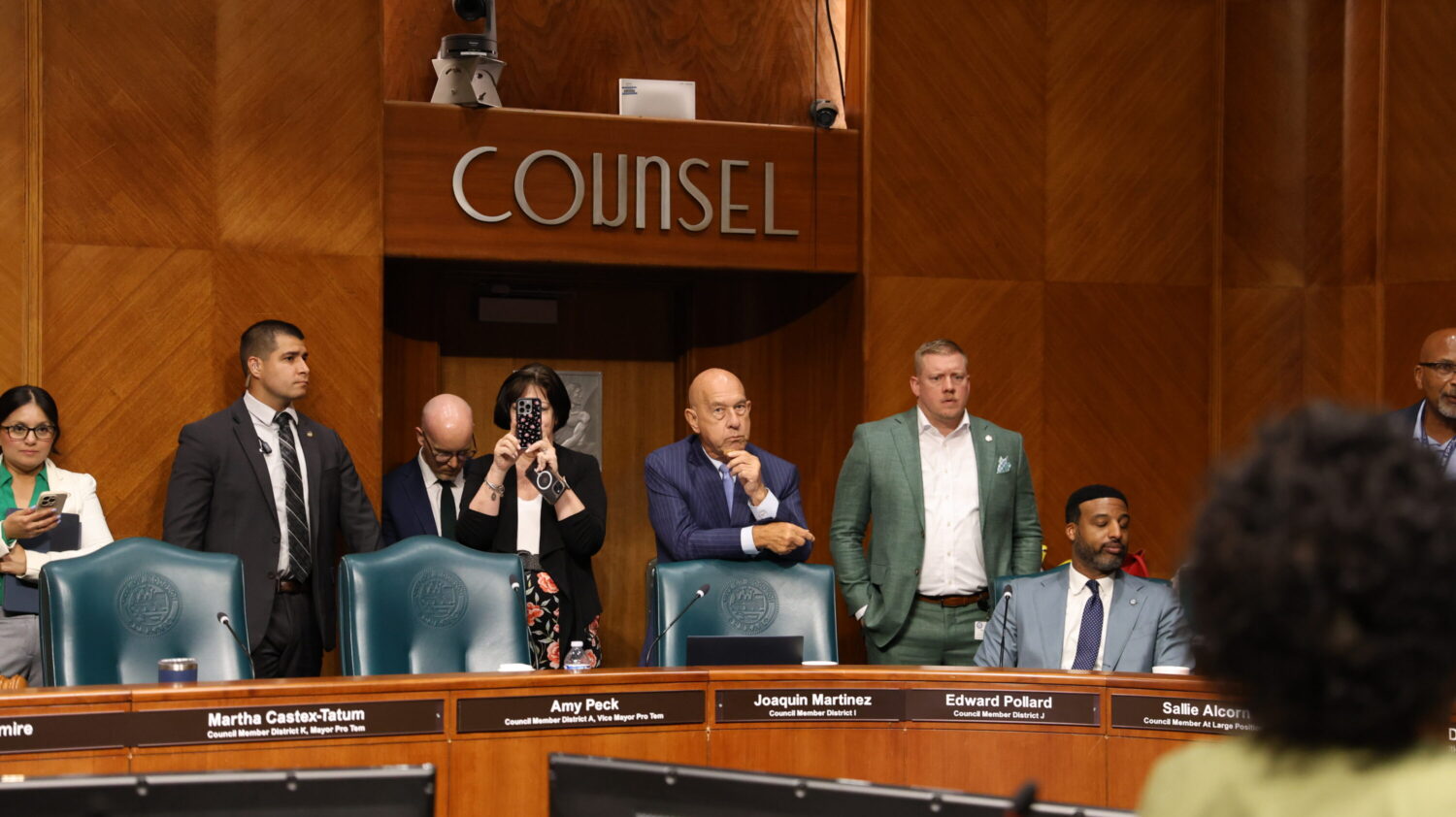
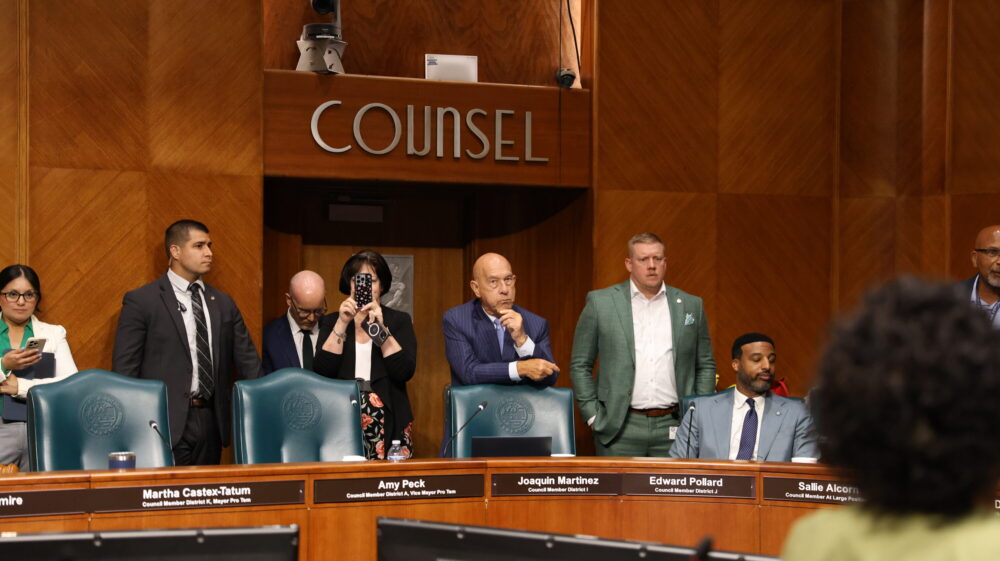
Houston Mayor John Whitmire looks on as protesters disrupt a Houston City Council meeting on Wednesday, June 4, 2025.
As Houston’s financial foundation faces structural instability and infrastructure policies from Mayor John Whitmire’s administration draw criticism, city council members advanced measures to force increased savings and transparency on Tuesday.
The slate of policies, unanimously approved by a joint meeting of the council’s budget and economic development committees, must be approved by the full city council before taking effect.
Increased transparency around infrastructure projects
Sign up for the Hello, Houston! daily newsletter to get local reports like this delivered directly to your inbox.
During the first two years of Whitmire’s time in office, multiple projects have been paused, changed or torn up with little public engagement — including safety improvements to Houston Avenue and a protected bike lane on Austin Street.
Under council member Julian Ramirez’s proposal for increased transparency, the administration would be required to:
- Provide monthly reports on infrastructure projects proposed for delay, cancelation, redesign, removal or alteration if the related costs exceed 10% of the project or more than $100,000
- If three or more council members object to an administration proposal, place the measure on the city council agenda for a vote
- Consider attending public meetings held by council members on proposed changes to infrastructure projects
“The intent of this proposal is not to slow down any work, but to give council members more information during the process so that they can serve their constituents more effectively,” Ramirez said.
The measures were first discussed in June, when the city council approved Whitmire’s five-year, $16.7 billion capital improvement plan. At the time, the proposal was referred to committee for further consideration within 60 days. Nearly 170 days later, it has been approved by the committees.
While some council members expressed concerns about the rules causing project delays, Abbie Kamin argued they are necessary.
“We do want work at the city to continue moving. We want infrastructure and safety for our city,” Kamin said. “This is not intended to inhibit, but again, we are not getting all the answers to questions that we are raising, especially when it comes to the cost of certain projects, the analysis, or when things are happening.”
A spokesperson for Whitmire did not provide comment on the proposal.
Financial resiliency
Kamin also successfully pushed for a separate measure on Tuesday intended to bolster the city’s financial resilience. In June, she called for larger and more frequent cash infusions of the city’s rainy day savings — also known as the budget stabilization fund.
RELATED: At the peak of hurricane season, Houston city finances face resiliency challenges
Previously, the fund held $20 million and was replenished every two years. Under Kamin’s measure, the threshold would increase to $25 million and would require the administration to refill the bucket within 365 days of using those funds.
After becoming depleted from storm-related costs in 2024, the fund currently holds $14 million. Kamin first introduced then withdrew the measure in early June before voting against Whitmire’s $7 billion annual budget.
“Extreme weather events are coming,” Kamin said at the time. “They are more frequent and they are more severe, and whether intentionally or in a state of denial, we are not recognizing the realities of climate change. … We must keep Houstonians safe from the extremes, but there’s nothing in this budget that accounts for that.”
The proposal was approved on Tuesday without extensive discussion. A spokesperson for Whitmire did not provide comment on the measure.
Working group for flood mitigation funds
The city’s spending on streets and drainage is set to increase substantially in the coming years, after Whitmire’s administration settled a lawsuit accusing the city of shortchanging a voter-mandated fund.
Council member Amy Peck’s measure would create a working group to scrutinize the city’s streets and drainage spending.
“Right now the most critical projects are put on a list where they must compete against all the other projects for the limited resources,” Peck said. “We need to take a hard look at the formula to ensure fairness, so funding is more evenly distributed across the city and so that our most severely impacted areas finally get the attention that they deserve.”
Taking into account all sources of funding, including about $150 million per year from the METRO transit authority’s general mobility plan, the streets and drainage fund will receive $490 million this year before increasing each year to a total of $672 million by the 2028 fiscal year.
A spokesperson for Whitmire did not provide comment on the measure, though his administration celebrated the settlement when it was unveiled earlier this year.