The Magical City: George Morrison’s New York
The Metropolitan Museum of Art
July 17, 2025–May 31, 2026
New York
In the heart of the American Wing of the Metropolitan Museum of Art is a small, dense exhibition called The Magical City: George Morrison’s New York. The entrance to the exhibition is cinematic, like a pitch for a biopic. The wall text sets the scene:
In September 1943, George Morrison (1919–2000) boarded a train from Minnesota to New York. After arriving and enrolling in classes at the Art Students League, the young artist walked to Times Square, where he was enraptured by the lights and sounds of what he described as a “magical city.”
As visual aids, there is a paint splattered stool set beside an easel, metal lockers, and an industrial lamp borrowed from the Art Student’s League. Next to these props is a black-and-white photo of Morrison from about 1946. Jazz music plays in the background of the gallery.
George Morrison is not exactly a household name, even for specialists in American art. But this mini-survey show, put together by curator Patricia Marroquin Norby, serves as an excellent introduction to the artist. A great deal of biographical information can be found in the accompanying wall labels, while the tight selection of paintings and drawings are organized in roughly chronological order, giving a good sense of the arc of Morrison’s career. The first room is devoted to figurative paintings of the 1940s and abstract works of the early and mid-1950s. The second room contains larger-scale paintings from the late-1950s and early-1960s, a period in which Morrison was closely associated with the New York school of Action painting and Abstract Expressionism. A small number of paintings made after Morrison left New York are also included in the exhibition. The show also contains a wonderful selection of ephemera that helps contextualize Morrison’s participation in the New York art world, including catalogues and invitation cards for group and solo exhibitions. Under one of the wall labels, there is even a map of lower Manhattan that highlights the apartments Morrison lived in, the galleries he showed at, the bars he frequented, and the framing shop where he worked.
Paintings take center stage in the second room, where a group of large-scale abstract canvases create a crescendo and focal point for the show. The remarkable Aureate Vertical (1958) is an expansive field of vibrant yellow, orange, and red pigment built up with a palette knife, suggestive of sunlight or fire. Untitled (Blue Painting) (1958) is built from shifting blocks of blue, orange, and red—the colors of a bad bruise, moody and awkward. The Red Painting (Franz Kline Painting) (1958) is a dramatic wave of red paint interspersed with menacing vertical scrapes of black. These paintings reveal Morrison’s artistic dialogue with famous Abstract Expressionists such as Clyfford Still, Mark Rothko, and Franz Kline. Morrison’s connection to the Abstract Expressionist painters is certainly part of his mythology, and The Red Painting, for example, was traded to Franz Kline not long before Kline passed away. However, just as much as Morrison was working with Abstract Expressionism, at various times he was equally engaged with Expressionism and Surrealism, often in connection to landscape painting. In an undated text, which is published online by the Minnesota Historical Society, Morrison wrote: “I consider myself a painter above all and I have always continued with my own extension of the traditions of painting—the expressionistic, surreal and abstract interpretation of nature.”1
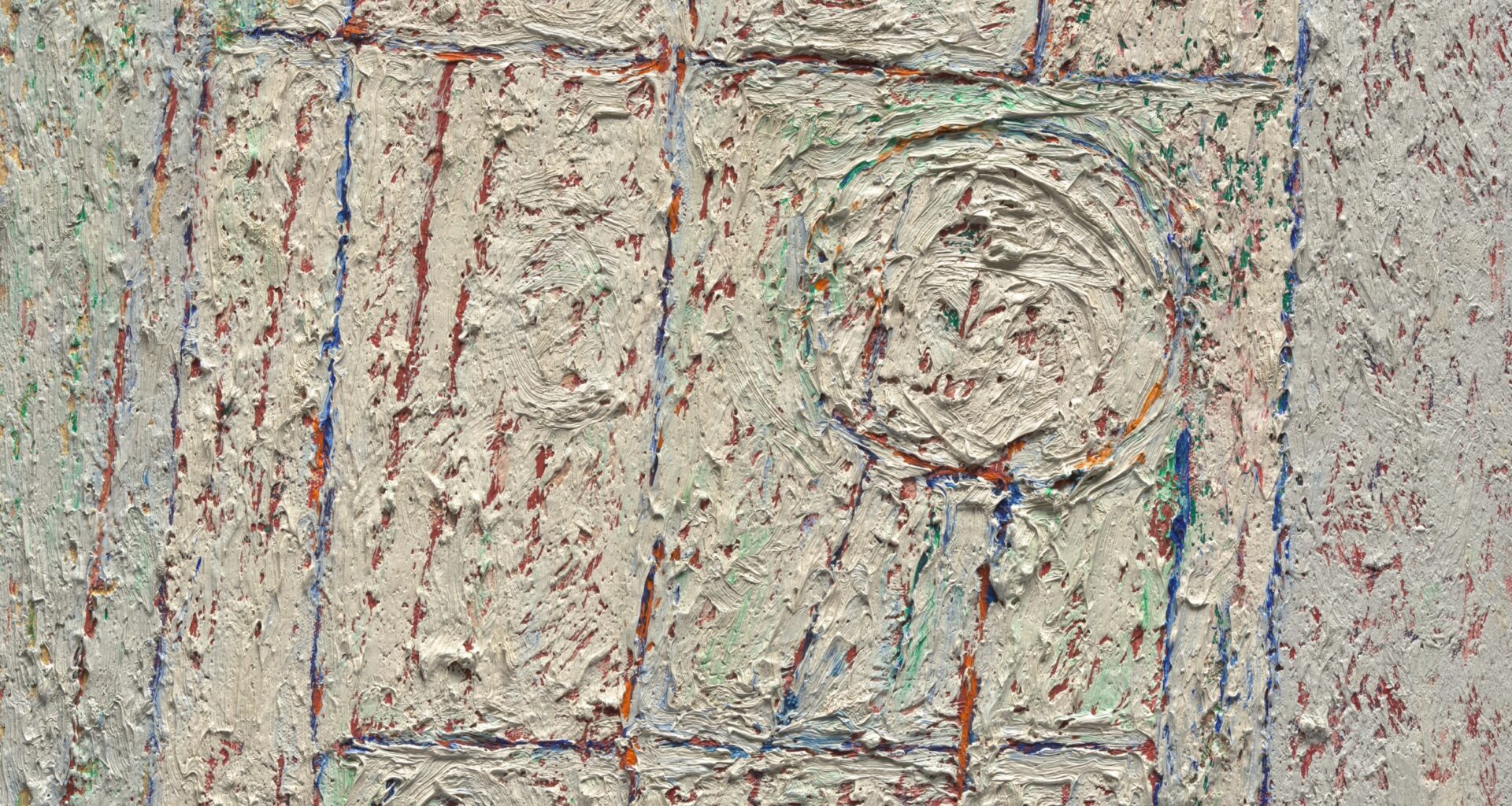
For Morrison, artistic movements were simply part of the toolkit he used while searching for his own, very personal, subject matter. Nature was a key touchstone for him throughout his life, although his work reveals stylistic shifts and turns, as he never truly subscribed to one particular “ism.” We can see a specificity of place in titles like Structural Landscape (Highway) (1952), Untitled (Cap d’Antibes) (1953), The Red Sky (1955), and Landscape, New York (ca. 1957). A coded landscape can likewise be read into the large abstract canvases of the late 1950s and early 1960s, with their dramatic horizontality and sloping forms like the sides of mountains. White Painting (1965), which at first glance seems to be one of the most non-referential paintings, contains a spinning orb that is a sun or moon, as well as cross-hatched lines like trees interrupting a horizon. The compositional tool of the horizon line is found in most landscape painting, and it is a recurring motif in Morrison’s work as well. He wrote that it became “more of an obsession around 1967,” when “it became a symbol of the forces of nature meeting the universe, the ‘edge of the world’; of trying to see beyond the ‘unknown.’”2