Moriah Evans
Every Body Knows
Performa Hub
November 5–16, 2025
New York
“Be careful with giving Moriah a key to the space. She might just move in.”
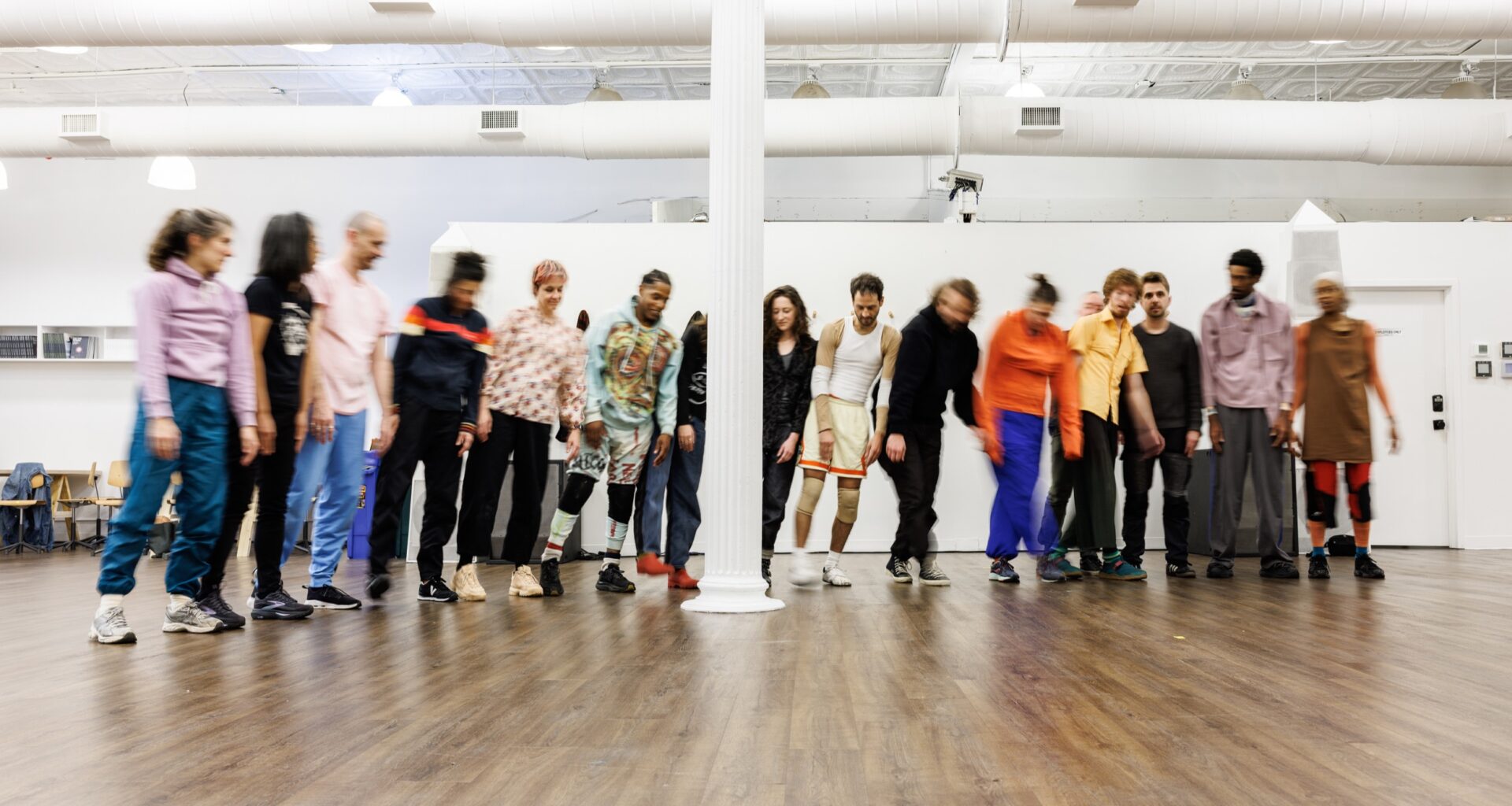
A Performa producer said this to me half-jokingly, referring to Moriah Evans’s time-intensive and all-consuming rehearsal process. When Evans enters a space, she does not simply rehearse; she inhabits the architecture and its full spatial, temporal, and social dimensions. For Every Body Knows, presented as part of the Performa 2025 Biennial Studio section, Evans takes over the Performa Hub in SoHo: a vast storefront she transforms for two weeks into an immersive, open-door studio for dancing, watching, talking, debating, studying, and being together. The project unfolds non-stop from noon to 8 p.m. each day through movement classes, open rehearsals, structured conversations, and deliberately ambiguous “events,” destabilizing the boundaries between research and presentation, rehearsal and performance.
This kind of total inhabitation is typical of Evans’s process. When I danced in her previous project, Remains Persist (Performance Space New York, 2022), someone did give Evans a key to an empty apartment at 411 Kent Avenue in Williamsburg. And she did, in effect, move in. For six months, almost every day, we rehearsed there, unfurling a kind of parallel world. We laid down rolls of white marley flooring, transforming the domestic interior into a provisional dance studio. This architectural reorganization made tangible what Evans’s choreography pursued relentlessly: a dismantling and reassembling of structure at the level of flesh. The body, like the apartment, was treated as an existing architecture to be deconstructed and reorganized.
The studio we built out and inhabited was never just a place to rehearse, but a small-scale laboratory of a world where the body does not have to behave normally as a productive citizen but can, for example, isolate the liver as a paintbrush to “draw” in space. Still, those macro-sociopolitical systems of power were never entirely absent. Once, a neighbor called the police, alarmed by the guttural screaming sounds of our rehearsal. It was a brief but telling intrusion, a reminder of the normative orders of behavior that our collective practice constantly rubbed against.
Moments like that only sharpened the awareness of what was at stake inside the dance. To sustain that delicate yet powerful world of bodily logics required a quasi-religious dancerly commitment. The hours upon hours of rehearsal and repetition were less about perfecting movement vocabularies or mastering choreographic scores than about creating and maintaining the conditions for the dancing bodies to exist otherwise, simply as bodies in their absolute unruliness.
Here lies the dramaturgical problem of Remains Persist: how could choreography hold space for what the body knows, against the compulsive imperative to categorize, contain, and ultimately deaden that knowledge? The work formalized this tension as a collision between two entangled yet irreconcilable systems: the bureaucratic world that traps bodies within the scaffolding of signifiers—like class, race, gender, ability, citizenship, education background—and the world of dancing that lets them slip back into felt senses.
The participants of Remains Persist, myself included, improvisatorially interrogated one another, probing every contour of our identities with questions like: How does your body express gender today? Where does your class position live in the flesh? Simultaneously, we sank into a dancing logic that resisted such extraction. At times, the work resembled a surreal reality TV show, with serious yet absurdly entertaining lines of interrogation pressing us to articulate the truths of our bodies. Yet, beneath the spectacle pulsed something incommensurable and alive, a dancing activity that exceeds willful meaning making. If one world sought to define the body, the other allowed the body to become.