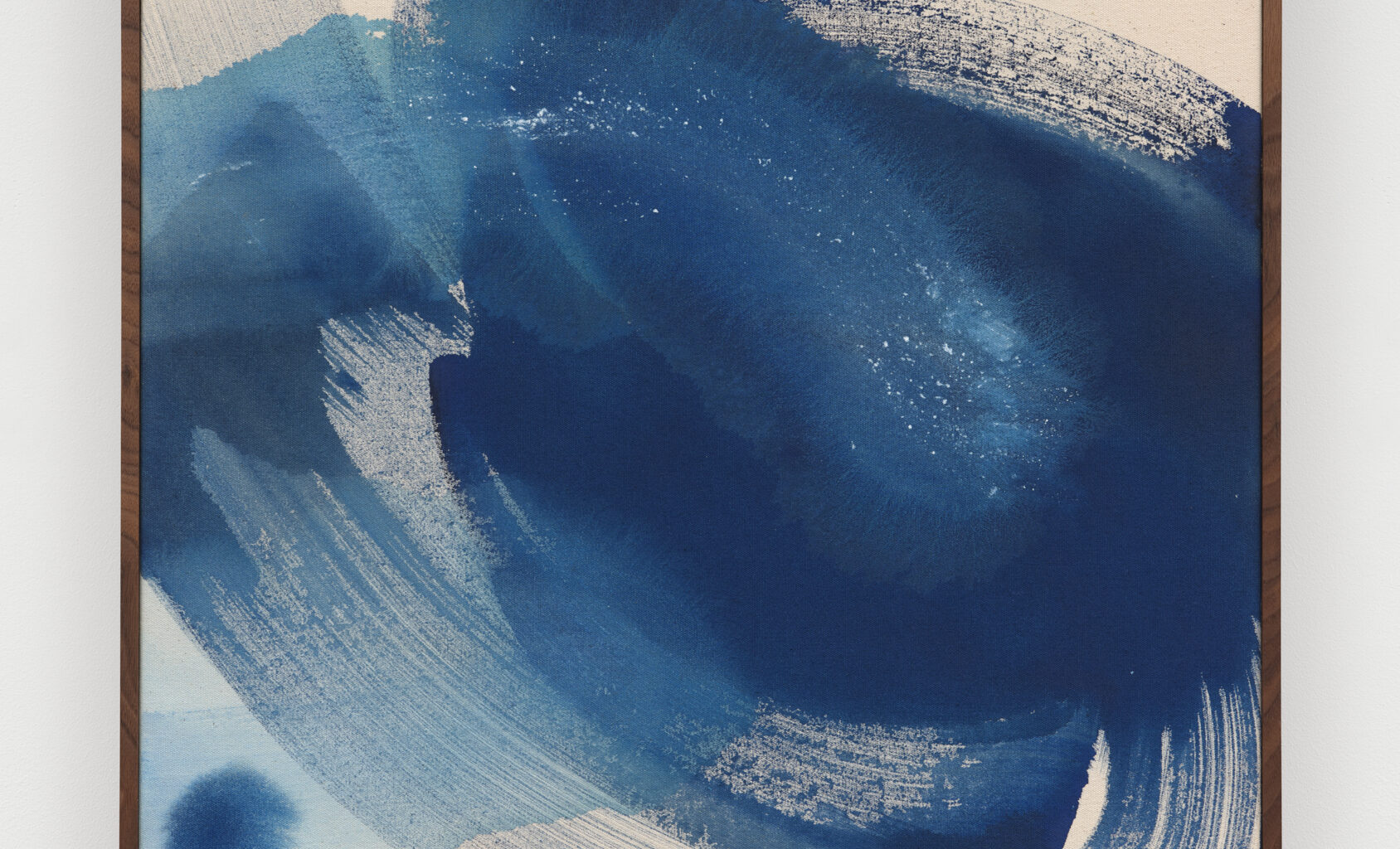
Penumbra
Anat Ebgi
October 31–December 20, 2025
New York
The overwhelming sensation that Sigrid Sandström’s nineteen paintings at Anat Egbi in Tribeca impart is one of movement. In a 2021 exhibition catalogue, Amy Sillman wrote that Sandström’s paintings are “in motion … tumbling around as if they were in celestial dryers.” Indeed, big swipes of acrylic swoosh across the unprimed canvas of Dust Plunge (all works 2025), denim blues puddle and soak in Ravel II, and the white puff of a decidedly cloudlike form floats in Nimbus. It is as if the paintings take compositional cues from diagrams of wave anatomy, alluding both to the aquatic and the atmospheric realms. Spending time in the show was, for me, a process of questioning how and why the works evoke implied actions: to soak, to float, to unfurl, to swell, to billow, to undulate, and, depending where you look, to stay put.
Ultimately, these terms are helpful because they give the paintings a foothold in the world of lived experience without relying on familiar strategies of depiction. The deepest pleasure of Sandström’s paintings comes from giving up the search for what generated them and getting lost instead in their almost philosophical proposals about the fleeting, invisible operations that enliven our world—as well as painting’s capacity to embody them. Among the paintings’ great strengths is this capaciousness, whose limits are marked out by formal choices indicating at least two intersections with the history of abstraction.
The first of these allusions emerges if a viewer comes to understand Sandström’s marks as telling the story of process and a particular painting’s coming-into-being. This has been part and parcel of the history of American abstraction since Helen Frankenthaler’s 1952 stained canvases, and earlier, Jackson Pollock’s drips of 1947. The same has been true in Europe since the 1950s (Sandström was born in Sweden in 1970 and came to New York for art school in 1995), when earlier proximity to the ideas of phenomenological philosopher Maurice Merleau-Ponty began to shape the development of abstract painting. Sandström’s current works seem to operate within this latter trajectory which is about an embodied way of thinking that works through the emergence of form, rather than the lack of a body presumed by mid-century American high modernism.