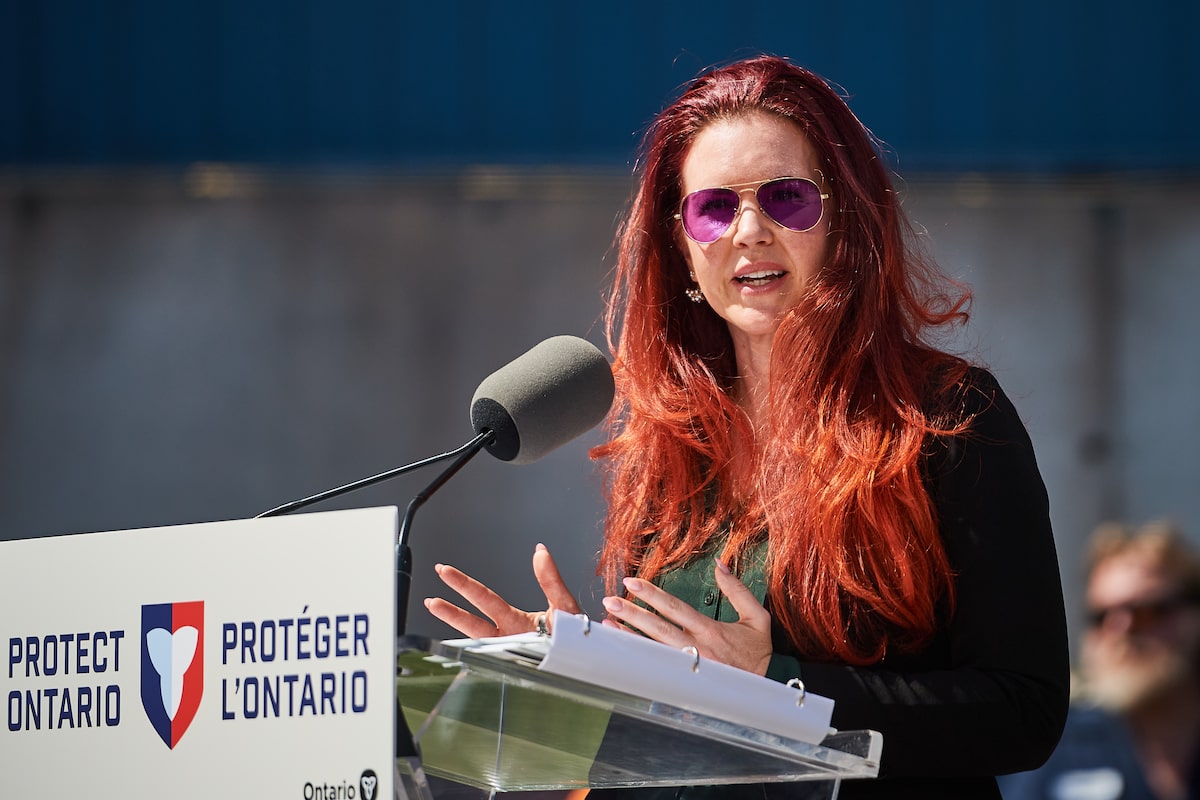
The report on intimate partner violence for the standing committee on justice policy was introduced into the legislature on Tuesday and lists a single author – Progressive Conservative MPP Jess Dixon.Sammy Kogan/The Canadian Press
The Ontario government’s release of a lengthy report on intimate partner violence is mired in controversy, after the opposition claimed that the study was partly generated by artificial intelligence and that some sources cited in the report do not exist.
Members of the Ontario New Democratic Party said in a news release that AI detection programs “flagged the government’s report as likely being largely AI-generated.” The release also said “multiple sources cited did not exist upon closer inspection.”
The 877-page study on intimate partner violence for the standing committee on justice policy was introduced into the legislature on Tuesday. The committee report lists a single author – Progressive Conservative MPP Jess Dixon for Kitchener South-Hespeler.
NDP MPP Kristyn Wong-Tam told The Globe and Mail that it didn’t take much digging to conclude that the citations “lead you to empty links or the content is wrong.” The MPP had co-led the provincial subcommittee on intimate partner violence until the NDP withdrew from the process last month.
The provincial government did not answer The Globe’s questions about sourcing in the report. A spokesperson said the report was not written by AI.
“It was reviewed by academics and legislative staff before publishing,” spokesperson Jana Sklover said in a brief emailed statement.
Ottawa seeks to toughen laws on gender-based violence
The Globe asked for the names of those who reviewed the report; the government did not provide them and did not make anyone available for an interview.
When asked by The Globe on Wednesday about the opposition’s claims regarding questionable citations in the report, Ms. Dixon didn’t directly answer.
“I can’t explain what the opposition had to say,” she said at the Ontario legislature. “Ultimately, I know that from the perspective of victims and survivors and front-line advocates, they don’t understand how this could be a partisan issue, and neither do I.”
She said the work that was done is “based off of hundreds of sources,” and that materials were drawn from the people who testified and gave their expertise.
“[This is] a really important nonpartisan issue that is of huge importance to victims and front-line providers across Ontario,” Ms. Dixon said. “They wanted to be heard. They wanted to have real solutions to the challenges that they’re seeing, and that’s what they got.”
The province established a committee to study intimate partner violence last year after the NDP put forward a bill calling on the government to recognize such crimes as an epidemic.
In late November of this year, the NDP MPPs on that committee announced they would be stepping away – distancing themselves from the impending report and committing to publishing their own “dissenting” version.
Using the list of examples released by the NDP, The Globe found some citations appeared to be incorrect, misattributed or not properly sourced. For example, a Globe opinion piece that was cited in the report was attributed to the wrong writer, and the year of publication was incorrect. In another instance, a paper was cited from the journal Health Economics. A search of the journal’s archives found no papers with that title.
MPP Wong-Tam said their investigation began after noticing that several dates for inquests were incorrect. “If a student in Ontario was to hand in this government report, as is, they would be facing academic discipline.”
Myrna Dawson, a professor with the University of Guelph and the executive director of the Canadian Femicide Observatory for Justice and Accountability, said if the allegation about using AI is true, she would be “disturbed, disappointed – and I would question the integrity of someone who submitted a report using AI on a subject that is so serious, and that was purported to be listening to survivors’ voices and experts’ voices.”
Controversies over AI and citations have unfolded in other provinces. In Newfoundland, a health-care paper by Deloitte Canada for the government was found to have flawed citations, local media reported last month. Deloitte said it is “revising the report to make a small number of citation corrections, which do not impact the report findings,” online publication The Independent reported.
Advocates herald Ottawa’s push on femicide after years of calls for action
The Ontario report was met with other criticism. In their dissenting response, the Liberals said it reflects some of the concerns raised by survivors and experts but falls short on implementation.
“It lacks the essential elements of a successful plan: timelines, accountability, and guaranteed resources.”
Prof. Dawson, who said she had not had time to read the lengthy report in full, questions the value of the document, on top of the many existing studies, reports and recommendations that already exist.
She noted that the end of the report makes mention of the next step being to determine how to move forward. “And I was thinking, in a 1,000 page report, you don’t have ways that you’re going to move forward?”
A count by the Ontario Association of Interval and Transition Houses shows there were 43 femicides – or targeted killings of women – in the province between November, 2024, and November, 2025.
With files from Stephanie Chambers in Toronto