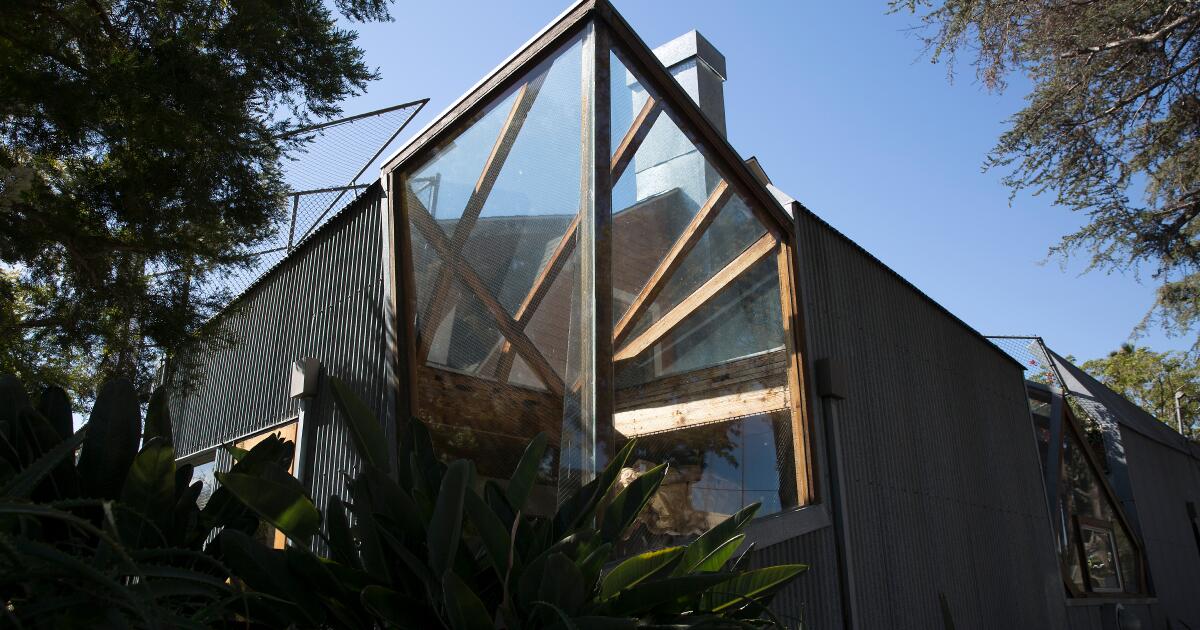
It’s not an exaggeration to say that Los Angeles made Frank Gehry, the celebrated architect of the Walt Disney Concert Hall, Bilbao’s Guggenheim Museum and other sensuously sculptural buildings in cities that paid for Gehry’s brand of statement architecture. Gehry, who died Friday at 96, leaves behind some remarkable buildings but also leaves indistinct what he made of Los Angeles.
Gehry’s prize-winning designs came in the middle of a career that began in 1956 with tract houses and shopping malls, sources of so much of the city’s built environment. In the years before his celebrity, Gehry drafted the ordinariness of Los Angeles while Ed Ruscha, Judy Chicago, Billy Al Bengston, Helen Pashgian and other artists were combining the ballyhoo of advertising, the gleam of aerospace materials and the detritus of postwar consumerism into unruly new forms. Gehry, who hung around with artists, caught what was specifically Angeleno in their methods and attitudes: informality, messiness, technical know-how and the idea that art can begin with the stuff anyone could buy at a hardware store.
In 1964, Gehry began messing around with houses — prosaic bungalows from the 1930s and “minimal, traditional” boxes from the 1940s — and patched together a home for himself and artist friends that purposely unsettled the rigid geometries of the previous generation’s “great men” of architecture. Gehry’s houses looked like nothing else in Los Angeles, but they were in the spirit of the city’s greatest art form: its houses. They made Gehry famous, though six decades later, none of us lives in anything like them. Instead, fame gave Gehry monuments to build.
In a way, he joins architects Frank Lloyd Wright, Rudolf Schindler and Richard Neutra in proposing a radically different way of how to live in Los Angeles, but, even less than theirs, Gehry’s didn’t go very far. His residential projects in Los Angeles number only about 10. The social critic Mike Davis wrote that Gehry’s unrestrained houses were deliberately indifferent to their modest neighborhoods. Gehry’s sophisticated aesthetic of simulated dilapidation and make-do recombination can feel like appropriation from the marginalized places where actual working people live.
Late in his career, Gehry took on two projects that pointed toward a more generously inclusive Los Angeles. The Grand — a mixed residential, retail, hotel and office complex — fills a city block opposite the Disney Concert Hall, whose bright panels elegantly curtsy to the street. The concert hall is Ginger Rogers to what might have been the Grand’s Fred Astaire if the baroque swerves in Gehry’s original drawings and models had been built. Corporate imperatives required a boxy assembly of towers instead, without Gehry’s signature vitality. Worse, looking embarrassed to be among pedestrians, the Grand timidly defers from delivering the street-level urbanity its shops and public spaces were supposed to activate. Changes in downtown’s commercial ecology mean that some of its 164,000 square feet of retail space will become an artificial-intelligence museum and a branch of the University of Michigan. More than half of the space is likely to remain empty. Bloomberg News wondered this year if Los Angeles had gotten a Gehry-designed dead mall.
Gehry’s other plan for a reimagined Los Angeles seeks to reconnect the city to the 51 miles of its disregarded river. Despite controversies about Gehry’s role, the plan was adopted by the county Board of Supervisors in 2022. Some parts are partially funded or in design, but it remains mostly conceptual: platforms on concrete stilts extending like piers over the existing flood control channel. Gehry said he found a kind of grandeur in what the Army Corps of Engineers had made of the Los Angeles River. The Friends of the Los Angeles River, Heal the Bay and the Nature Conservancy saw only more concrete in his proposal. They broke with the county and Gehry and continue to pursue a city plan for 11 miles of the river that emphasizes neighborhood engagement, ecological restoration and resistance to gentrification. The two visions of the river remain unreconciled, in part because Gehry — having become a “great man” of architecture himself — was impatient with his critics and had little regard for the designs that decades of grassroots advocacy had negotiated. In downtown and along the river, the effect of Gehry’s placemaking seems sadly blunted.
Assessments of Gehry’s work insist that he mirrored the character of Los Angeles: garish and flimsy, contradictory and disturbing but also light-filled, with a voluptuous sheen, and always in motion. But that distillation of Los Angeles is a distorting mirror. Los Angeles is momentum, but it’s also repose. It’s something that an earlier generation of less famous architects felt in the texture of the city and sought in designing homes that were characteristic of Los Angeles. The city built by architects Wallace Neff, Paul R. Williams, the Green brothers and many others is all around us, waiting to be newly imagined with equal sympathy.
Frank Gehry understood the play of shapes and surfaces as seen from the street and the composition of interiors that did not intimidate. He may have saved the architecture profession from formal sterility and a bad habit of historical quotation. He gave Los Angeles its necessary monument. If only Gehry had stilled his restless sketching of concepts and begun to abstract and generalize a newer ideal of how to be an Angeleno and how to make a home here. Los Angeles needs a successor who believes that’s possible.
D.J. Waldie’s most recent book is “Elements of Los Angeles: Earth, Water, Air, Fire.”
Insights
L.A. Times Insights delivers AI-generated analysis on Voices content to offer all points of view. Insights does not appear on any news articles.
Viewpoint This article generally aligns with a Center Left point of view. Learn more about this AI-generated analysis Perspectives
The following AI-generated content is powered by Perplexity. The Los Angeles Times editorial staff does not create or edit the content.
Ideas expressed in the piece
- Gehry’s impact on Los Angeles is distinctly separate from the architect’s global celebrity, having contributed more to the city’s international reputation than to the built environment where residents actually live[1][2]
- Although Gehry began a career in Los Angeles designing ordinary commercial buildings like tract houses and shopping malls, the later monumental designs deviated from the city’s architectural vernacular established by earlier generations of designers[3]
- The author suggests that Gehry’s celebrated aesthetic of “simulated dilapidation” and makeshift recombination risked appropriating visual language from working-class neighborhoods without addressing the actual needs of marginalized communities
- The Grand, a mixed-use development in downtown Los Angeles, ultimately compromised its original vision due to corporate imperatives, resulting in a structure lacking the architect’s characteristic sculptural vitality and street-level urbanity[4]
- Gehry’s proposal to reimagine the Los Angeles River through elevated concrete platforms conflicted with grassroots environmental organizations that prioritized ecological restoration and community engagement over additional hardscaping
- The architect’s impatience with critics and dismissal of decades of community advocacy limited the effectiveness of placemaking efforts in downtown Los Angeles and along the riverfront
- Earlier Los Angeles architects like Wallace Neff, Paul R. Williams, and the Green brothers demonstrated a deeper understanding of the city’s character by designing homes that reflected residential values rather than monumental ambitions
- While Gehry may have rescued architecture from formal sterility, the author contends the city would have benefited from an architect willing to explore how residents actually live in Los Angeles rather than constantly pursuing new formal experimentation
Different views on the topic
- Gehry fundamentally transformed the conversation around architecture, establishing new approaches to design complexity and pushing the discipline forward through material experimentation and innovative use of digital modeling technologies[1]
- The Guggenheim Museum Bilbao demonstrated architecture’s power to catalyze urban transformation and economic revitalization, a phenomenon termed the “Bilbao Effect,” which continues to influence how cities view cultural institutions[1][2]
- Gehry’s body of work spanning more than seven decades illustrates sustained commitment to exploring the relationship between geometry, structure, and spatial experience across diverse programs from museums to performance halls[1]
- The Walt Disney Concert Hall represents one of Los Angeles’s greatest civic monuments, with its sculptural stainless-steel surfaces and innovative performance space symbolizing the best of contemporary Los Angeles architecture[3]
- Gehry’s early residential interventions, including the Santa Monica house, were pioneering artistic statements that deliberately challenged postwar architectural conventions and earned recognition as landmarks of twentieth-century design[2][3]
- The architect’s adaptation of aerospace engineering software created unprecedented geometric possibilities and influenced broader industry standards by making previously unbuildable complex forms achievable[1]
- As recipient of the Pritzker Prize and the Presidential Medal of Freedom, Gehry earned recognition as perhaps the most influential architect of the past fifty years, whose work continues to inspire generations of architects and designers worldwide[2][3]