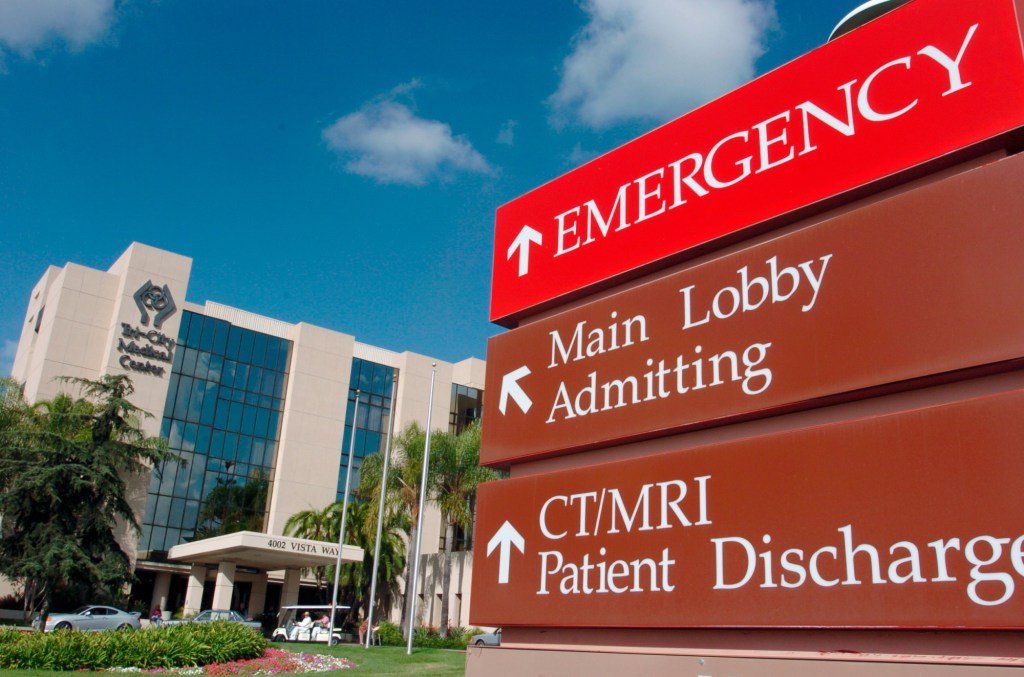
On Thursday afternoon, Tri-City Medical Center directors took their most significant action since the Oceanside hospital opened in 1961, voting unanimously to pursue a 30-year affiliation with Sharp HealthCare if voters ultimately approve the pact in 2026.
It is the second such collaboration among North County medical providers this fall. In late October, Palomar Health directors took similar action, voting to sign a joint powers agreement with UC San Diego Health that, like the Tri-City deal, would have a smaller public hospital district leaning on a larger partner for operating assistance and cash infusions.
These partnerships are designed to help modernize equipment, stabilize medical staffs and increase the public’s use of facilities that have often struggled to fit into a heavily managed health care market, one that favors providers capable of operating holistic networks of care from doctors offices to rehabilitation facilities.
Though board members did not make comments before taking their vote of approval, Chair Tracy Younger said she was a little shocked that the affiliation had finally gone through and both sides would meet in the morning to sign binding documents. Finding a partner for Tri-City, she said after the meeting, has been her top priority for the past five years and was the main reason why she ran for her post.
“It’s just too hard in this environment to operate as a standalone district hospital, especially during these tough economic times,” Younger said. “We have just been very impressed with what Sharp has brought and we’re really happy with the outcome.”
With its own health plan and thousands of affiliated doctors, she said, there is a belief that Sharp can help Tri-City bring in more patients and fill beds that have gone empty.
“As a stand-alone hospital, we’ve just had too much competition without a health plan to help capture patients,” Younger said.
Tri-City’s affiliation is patterned on a very similar lease of Grossmont Hospital in La Mesa, which Sharp has run since 1991. The Grossmont Healthcare District, which still has an elected board of directors, owns the property and appoints representatives to sit on the facility’s private board of directors.
Because Tri-City plans to lease all of its assets to Sharp, voter approval is required. Though Tri-City directors did not vote Thursday to put the deal on a future ballot, directors have said recently that the June 2026 primary is the most likely candidate.
Already presented to the public in several community meetings, the affiliation agreement and a set of supporting documents has Sharp paying the Tri-City board $1 per month to lease its assets. In exchange, Sharp will invest at least $100 million in Tri-City, money that will be used to modernize certain aspects of the North County medical provider’s operations, most immediately its electronic medical records system.
Sharp agrees to keep at least 175 of Tri-City’s 397 licensed beds in use and to pursue “commercially reasonable efforts” to restore the hospital’s shuttered labor and delivery and neonatal intensive care units, which were suspended in 2023 due to a low volume of deliveries. A lease agreement calls out a set of “core services” that must be maintained under state law, including “medical, nursing, surgical, anesthesia, laboratory, radiology, pharmacy, and dietary.” The lease also specifies the continued availability of basic cardiac and neurological services on the Oceanside campus.
Younger said she believes that mothers will again give birth at Tri-City.
“I trust them and leave it up to them, but they are 100% committed to bringing it back,” she said.
The numbers show that there is significant room for Sharp to fill beds at Tri-City.
State utilization and financial reports filed for the 2003-04 budget year documented a total of 16,876 discharges at Tri-City and 217,140 outpatient visits, including all those handled by the hospital’s emergency department. By comparison, the most recent report, filed for the 2023-24 budget year, lists 7,658 discharges and 199,473 outpatient visits, illustrating the overall erosion in patient volume that occurred over a 20-year span.
This has led to capacity going fallow, with Tri-City posting a 41.7% occupancy rate of its available beds in the 2024 budget year compared to 50.8% in 2004. That year, all 397 of Tri-City’s licensed beds were said to be available for use, while that total had fallen to 273 by 2024.
But the financial report presented at Thursday’s meeting indicated that losses have begun to reverse. Dr. Gene Ma, a Tri-City emergency medicine physician who stepped into the CEO role when the hospital’s survival was most in doubt, said that he just received quality scores for the hospital’s medical and surgical unit that are much improved.
“It’s just indicative, I think, of the culture and the people that are so committed to this organization and the community they serve,” Ma said.