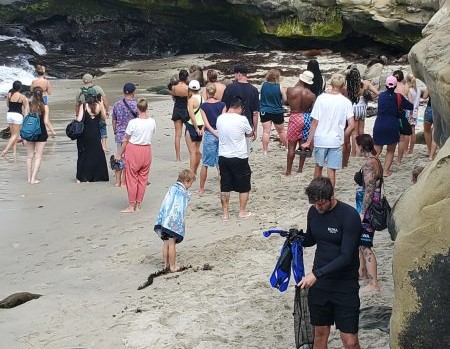
The city of San Diego is considering installing new cameras, building a new viewing deck and developing new signs at La Jolla Cove as methods to help reduce unsafe interactions between people and sea lions there.
City representatives spoke at the California Coastal Commission’s Dec. 10 meeting in Imperial Beach about ongoing measures to keep La Jolla Cove safe and open for people, plus the status of management efforts and what might be implemented in the future. The presentation was an information-only item and the commission took no action.
Andy Field, director of the San Diego Parks & Recreation Department, said “safety of people and marine wildlife remain our focus at The Cove” and that the city’s goal is to keep The Cove open to the public.
Steps already taken
Field said the presence of shoreline park rangers has increased in recent months in the area and that their hours will rotate seasonally. Rangers often are posted at the landing that overlooks The Cove and sit at tables to provide information to visitors.
“Eight park rangers are assigned [to the area] now, alongside 10 volunteers,” Field said. “Monday through Thursday, you will see one park ranger that rotates every two hours to maintain continuous coverage of The Cove and the point. Friday through Sunday, as well as holidays, you will see two park rangers rotating every four hours.”
That is in addition to volunteers who sit at the information tables.
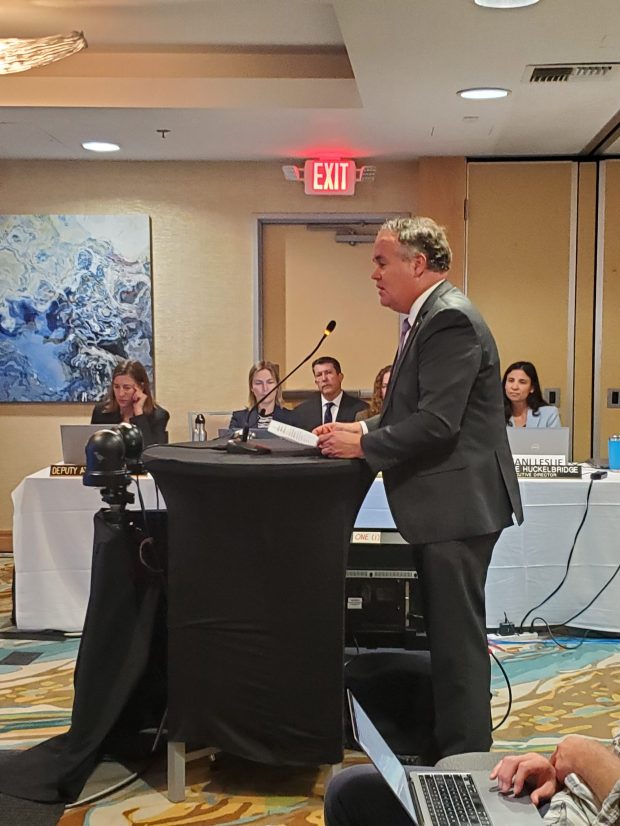 San Diego Parks & Recreation Department Director Andy Field addresses the California Coastal Commission about La Jolla Cove on Dec. 10. (Ashley Mackin-Solomon)
Park rangers recently began broadcasting hourly messages through a bullhorn to alert Cove-goers to keep their distance from the sea lions, Field said. That message may be repeated if rangers see people getting too close.
If a person continues to get too close after multiple advisories, the message will warn that the offender’s actions will be documented and forwarded to local law enforcement. Hand gestures also are used if the person doesn’t understand English.
“Rangers have indicated that these warnings have started to change behaviors in The Cove and resulted in additional compliance,” Field said.
The city also recently conducted a “sign audit” on the number and efficacy of signs at the two main entrances to The Cove and is considering condensing them into multiple messages contained to one sign.
“It consolidates the key information … in the individual signs and makes them clear,” Field said. “The sign audit looked at the clarity and level of regulations but also tried to decrease redundancy and increase that clarity. We also moved toward more imagery and pictographs for those that may not be able to understand the sign from a distance.”
Possible next steps
Field shared several other ideas the city is considering to further improve safety in the area, acknowledging that they require more resources than what is currently available.
Many of the proposals echoed suggestions submitted by the La Jolla Cove Access Working Group, formed in September 2024. After a handful of meetings, the group forwarded a five-point plan in June that contained possible solutions to keep sea lions and people apart.
The plan includes improved signs; a script in various languages to give to tour buses explaining how people can view the sea lions safely; a clearly marked area for pinniped viewing; authorization for rangers to issue fines and/or to place cones or tape as visual deterrents; and a system designed to keep sea lions away, such as an acoustic device that emits low-frequency sounds to discourage them from going on land.
Those steps would be in addition to education efforts by volunteer docents who patrol the area for the Sierra Club Seal Society.
When the working group met July 30 with San Diego City Council President Joe LaCava to discuss the five-point plan, the sign proposal was seen as “reasonable,” while the others were deemed more difficult.
Taking some of those recommendations into consideration, Field told the Coastal Commission that the city is looking into installing cameras and a new viewing deck at La Jolla Cove. He did not provide details about when those features might be implemented.
Additionally, Field said plans are taking shape for rangers to speak to tour bus operators as they arrive and possibly developing a handout flier for buses that drop off tourists who might not be familiar with local rules.
Since there are no dedicated places for tour buses to drop off people at The Cove, Field said “We’re hoping to develop a more formal drop-off process with a designated location in the future.”
Public comments
More than a dozen public speakers gave comments after Field’s presentation.
Seal Society representatives said signage would not be an effective way to keep people and sea lions apart.
“Signage alone will not significantly abate the ongoing dangers to the public and the harassment of the sea lions,” said Sierra Club member Nathan Brenner, who recommended the signage be simplified and made part of a multi-pronged approach.
He further suggested that rangers be on the beach itself rather than the landings above to best reach people on the sand.
The Seal Society was given three minutes for its presentation, while local beach access advocates and representatives of the La Jolla Cove Access Working Group were allowed two minutes each.
Beach access advocates like Kurt Hoffman said encouraging sea lions to haul out elsewhere is the only viable option.
“This organization needs to make a bold and radical move toward deterrents,” Hoffman said. “Deterrents are the only way to protect the environment and protect the interaction issues that [other groups] are concerned about.”
La Jollan Bill Robbins noted that many recommendations call for people to stay 50 yards from sea lions but that La Jolla Cove is only 47 yards across.
“So that won’t work,” Robbins said. “Let’s get that together.”
Commissioners’ comments
During Coastal Commission comments, Vice Chairwoman Caryl Hart raised concerns about the gates leading to the beach being open round-the-clock, noting that people will visit after city rangers or lifeguards are no longer onsite.
She also supported the installation of cameras, saying “a few cameras … could be very effective” and that “I would love to see parks in the city move forward with cameras in the area.” ♦