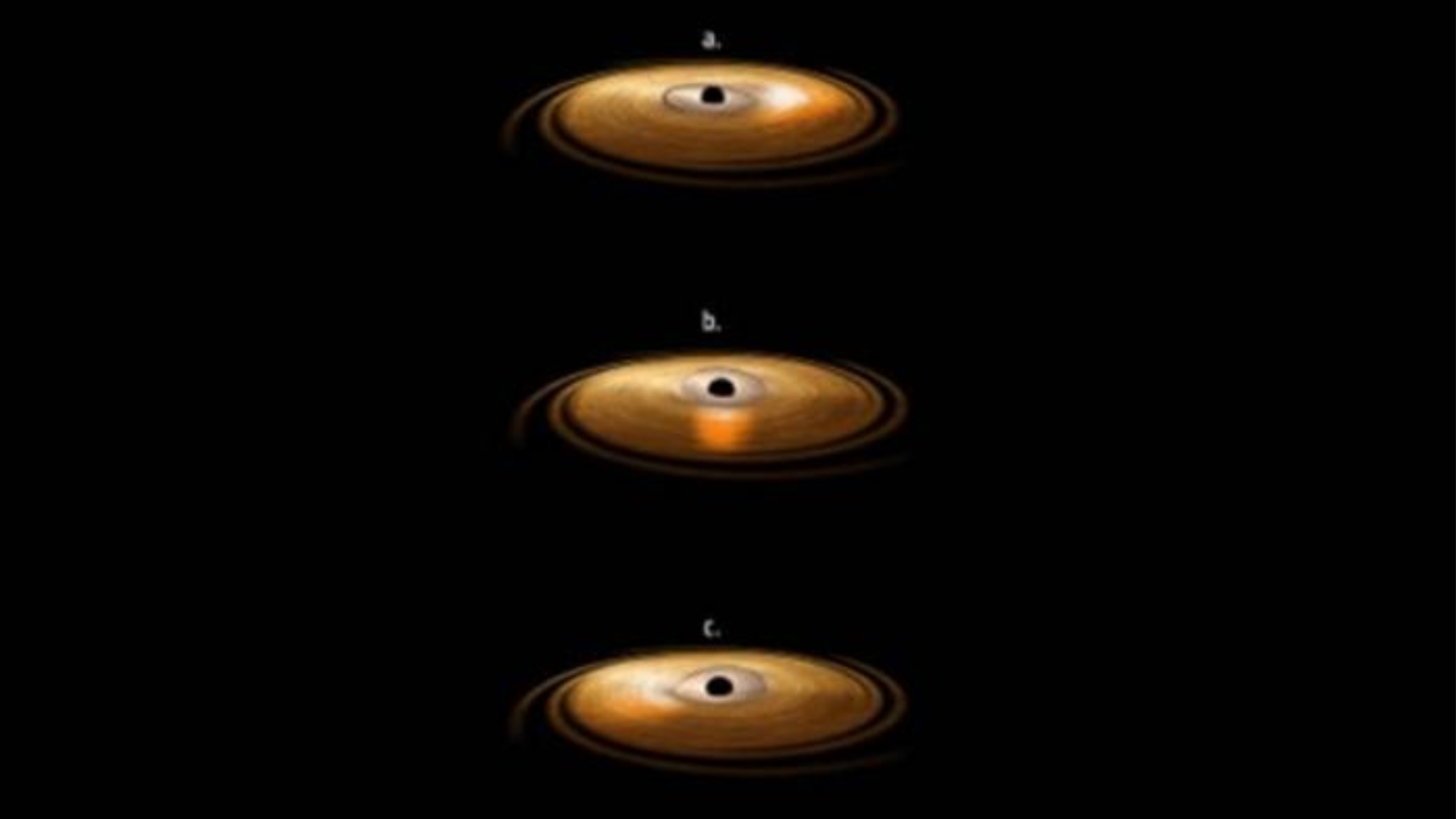
Astronomers have observed a star wobbling in its orbit around a ravenous supermassive black hole that is ripping it apart and feasting on its stellar material. The observation is evidence of a rare and elusive phenomenon called the “Lense-Thirring precession” or “frame dragging,” in which a rapidly spinning black hole drags the very fabric of space and time around with its motion.
This swirling of spacetime first emerged from Albert Einstein‘s 1915 theory of general relativity, which predicted that objects with mass “warp” the fabric of space and time (united as a single entity called spacetime) and that gravity arises from this geometric effect. The greater the mass of the object, the larger its impact on spacetime and thus the greater its gravitational influence. In 1918, the concept of massive, rotating objects dragging spacetime along with it was then solidified using general relativity by Austrian physicists Josef Lense and Hans Thirring.
You may like
“Our study shows the most compelling evidence yet of Lense-Thirring precession — a black hole dragging space time along with it in much the same way that a spinning top might drag the water around it in a whirlpool,” team member Cosimo Inserra of Cardiff University in the UK, said in a statement. “This is a real gift for physicists as we confirm predictions made more than a century ago. Not only that, but these observations also tell us more about the nature of TDEs – when a star is shredded by the immense gravitational forces exerted by a black hole.”
Watch the wobble
The team set about investigating Lense-Thirring precession by studying the TDE designated AT2020afhd using X-ray data collected by a NASA spacecraft, the Neil Gehrels Swift Observatory (Swift), and radio-wave observations from the Earth-based Karl G. Jansky Very Large Array (VLA).
A TDE occurs when a star wanders too close to a supermassive black hole, and the immense gravitational influence of that cosmic titan, which can be as massive as billions of suns, generates tidal forces within the star that squeeze it horizontally while simultaneously stretching it vertically. This process, called spaghettification, creates a strand of stellar pasta that twists around the black hole like a noodle around a fork, forming a flattened cloud called an accretion disk.
Matter from the accretion disk is gradually fed to the black hole, but these galaxy-dominating titans are notoriously messy eaters, with some material channeled from the poles of the black holes by powerful magnetic fields. From there, this matter is blasted out as twin near-light-speed jets of plasma.
Both the accretion disk of these TDE-perpetrating black holes and the jets they erupt radiate brightly across the electromagnetic spectrum, and because these emissions originate from immediately outside the black hole, they should be impacted by Lense-Thirring precession. This effect translates to a “wobble” in the orbit of matter in the accretion disk around the supermassive black hole.Indeed, while observing AT2020afhd, the team saw rhythmic changes in both X-rays and radio waves coming from this TDE that implied the accretion disk and jet were wobbling in unison, with this motion repeating every 20 Earth-days.
“Unlike previous TDEs studied, which have steady radio signals, the signal for AT2020afhd showed short-term changes, which we were unable to attribute to the energy release from the black hole and its surrounding components,” Inserra continued. “This further confirmed the dragging effect in our minds and offers scientists a new method for probing black holes.”
Modelling the data from Swift and the VLA, the team was able to confirm these variations were the result of frame-dragging. Further analysis of these results could help scientists better understand the physics behind the Lense-Thirring effect.
“By showing that a black hole can drag space time and create this frame-dragging effect, we are also beginning to understand the mechanics of the process,” Inserra said. “So, in the same way a charged object creates a magnetic field when it rotates, we’re seeing how a massive spinning object – in this case a black hole – generates a gravitomagnetic field that influences the motion of stars and other cosmic objects nearby.
“It’s a reminder to us, especially during the festive season as we gaze up at the night sky in wonder, that we have within our grasp the opportunity to identify ever more extraordinary objects in all the variations and flavours that nature has produced.”
The team’s research was published on Wednesday (Dec. 10) in the journal Science Advances.