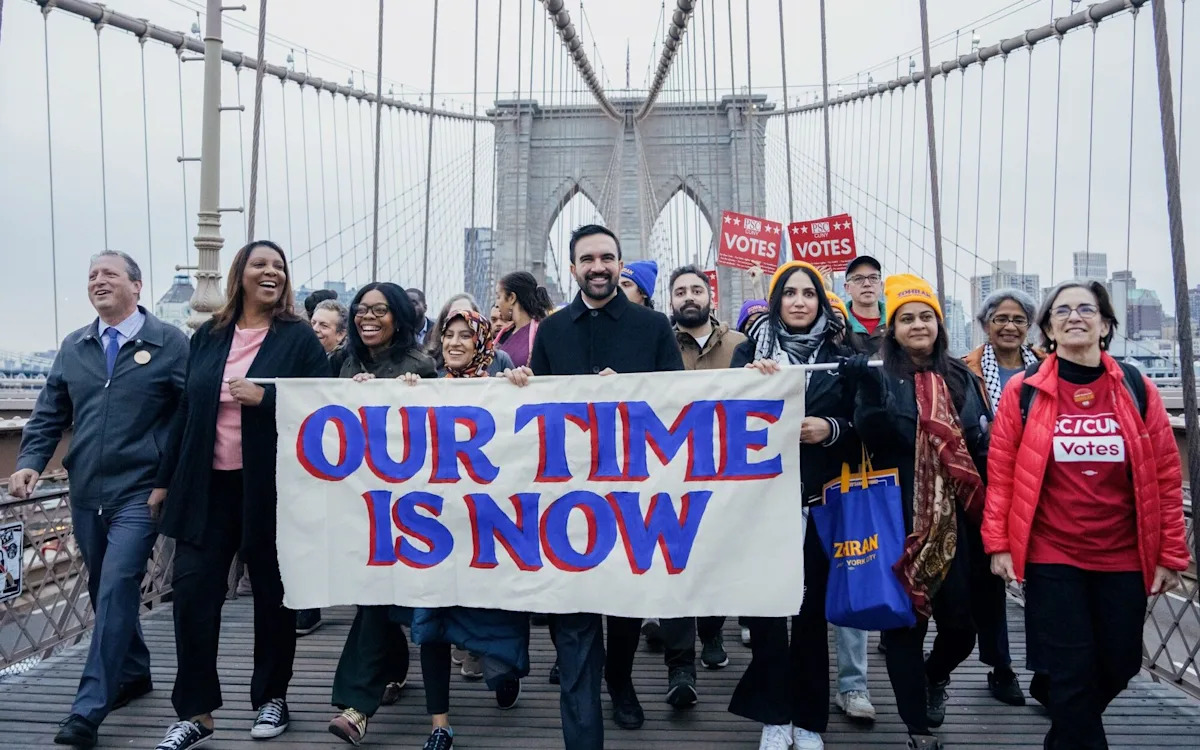
The election of Zohran Mamdani as mayor of New York – alongside the victory of similarly hard-Left candidates in other mayoral races – has left some predicting that urban America will inevitably fall into a “doom loop” of decline, with an exodus of the super-rich leaving cities in the control of a resentful lower class. Yet in reality, the socialist takeover is less a win for the working class. If anything, it leaves the haute bourgeoisie even more the masters of places like Gotham than before.
Contrary to many predictions, surging sales of luxury apartments indicate that New York will remain home to the ultra-rich – those with more than $50m (£37m) in assets. In fact, the evidence of the past few years is that, even as the overall population of the city has declined, the number of the super-rich has been growing. Rents, outside those under control, have continued to rise. Even if a few of the ultra-rich leave, New York is likely to remain comfortably the most popular city for the group, ahead of rivals such as Hong Kong, Los Angeles, Chicago, San Francisco, and London.
With their massive fortunes, these rich folk, 21,000 in New York alone, are also reshaping the urban landscape. Increasingly, global cities like New York, London, Paris, Tokyo, and Miami are functioning less as centres of economic activity for the masses, and more as showcases for luxury brands such as LVMH, which continue to invest heavily in such markets. Even once powerful business landmarks like the Rockefeller Centre are actively reinventing themselves as destinations for recreation, tourism, and the arts.
Mamdani’s election also does not appear to have stopped developers and speculators from looking to transform former office buildings – places of employment – into yet more luxurious apartments. This reflects long-established national patterns. New US office construction has plummeted since the 1990s, while the number of residential high-rises has continued to surge.
This transition makes sense given that office vacancies, largely due to persistently high levels of remote work, remain elevated. Although less pathetic than many downtowns, New York offices are far emptier than they used to be, with midtown office occupancy at around 65 to 70 per cent of pre-pandemic levels. The rise of artificial intelligence is likely to make things worse.
Today, New York, once the world’s unchallenged financial capital, is shifting into an “amenity city” with a priority for building casinos and other tourist-oriented development. Despite the much ballyhooed construction of JP Morgan’s new tower in midtown Manhattan, finance jobs have declined as a proportion of total city employment, with many roles headed to places like Dallas and Miami.
These shifts will change the world of many native New Yorkers. They are also likely to be exacerbated by the election of Mamdani. Working class and middle class families are already leaving cities. Socialist policies, which almost guarantee poor-performing schools and lax law enforcement, impact the hoi polloi far more than the elite bourgeois or young single professionals.
Some may think that Mamdani’s policies will turn the world’s capitalist capital into a First World version of Havana. But given the US federal system, Mamdani can’t expropriate fortunes by edict from Gracie Mansion, however he might like to do so. Instead, his biggest victims are likely to be among the lower social orders, not least the mostly minority owners of bodegas and small businesses. His rent control freeze, notes the perceptive analyst Nicole Gelinas, is likely to hit hardest small property owners, who own 30 to 50 per cent of all rent control units but may not be able to handle Mamdani’s proposed freezes.
Worse yet, Mamdani and his socialist cadre do not seem concerned about improving working class communities by creating better jobs; the emphasis is almost totally on free goodies, not people being empowered to improve themselves. As the analyst Martin Gurri has suggested, unlike past socialists, whether in Stalin’s Russia or among Sweden’s social democrats, today’s variety regards economic growth with “remarkable indifference”, a tough stance in an economy where good jobs are already headed elsewhere.
Despite all this, New York will not turn into the next Third World hellscape. It is more likely to end up like London. Under Labour, that city has become more global but can hardly seem British anymore, with many recent immigrants apparently reluctant to integrate into society. It also hosts post-national financial and cultural elites who often seem to mock the sensibilities of the British population.
In other words, London today seems less like the capital of the UK, and more like a refuge for people and capital from the rest of the world. Tourists drive much of the economy, including wealthy free spenders from distant locales.
This seems like the likely road for New York. Rather than following its commercial focus, a legacy stretching back to Dutch times, New York’s economy will become oriented to serving the rich, their offspring and tourists. In the new order, the city becomes what the University of Chicago’s Terry Nichols Clark has described as an “entertainment machine ”. The tourism industry also serves the new configuration by becoming a key employer of a largely poor, often immigrant, workforce.
Lost in the process is the notion of the city as an engine of upward mobility. The true mission of great cities, noted the late Jane Jacobs, “is transforming many poor people into middle class people… Cities don’t lure a middle class. They create it.”
Great cities with history and culture, like New York and London, may remain alluring for the young, the wealthy and for those immigrants who have yet to adapt to their adopted country. But with the road to opportunity blocked by their own policies, the socialists may end up leaving their cities ever more bourgeois, albeit under a red flag.
Joel Kotkin is presidential fellow in urban futures at Chapman University and senior research fellow at the Civitas Institute at the University of Texas