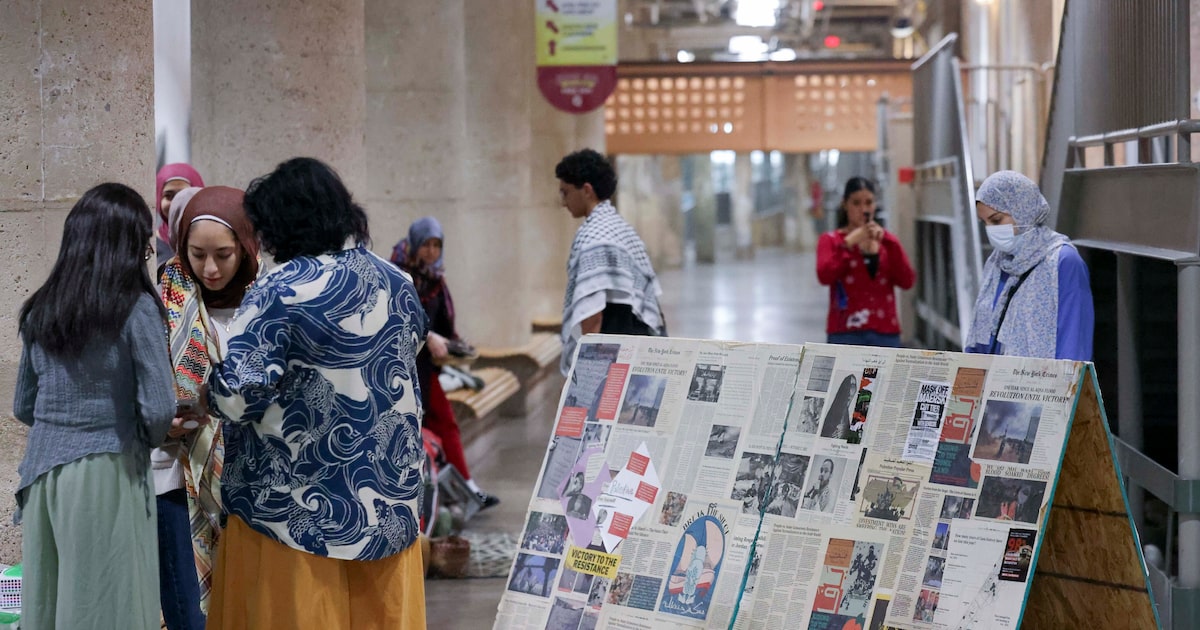
Niveen Bawab clutched a folder of tattered photographs, a faded image of her grandparents’ wedding in Jordan in the 1960s, childhood photos of her father tucked between a screen print and a stamp for the Palestinian Youth Movement.
Stephanie Drenka, co-founder of the Dallas Asian American Historical Society, carefully scanned each print, uploading them into a file for Bawab to keep.
A small office space in downtown Dallas, called the Museum of Asian Texans since it opened earlier this year, became a bustling community archiving workshop Saturday as community members gathered to learn how to preserve their Palestinian history and the importance of remembering their families’ pasts.
“We’re recognizing that if we don’t tell our stories, then our stories won’t be heard,” said Nidaa Lafi, a member of the Palestinian Youth Movement.
Breaking News
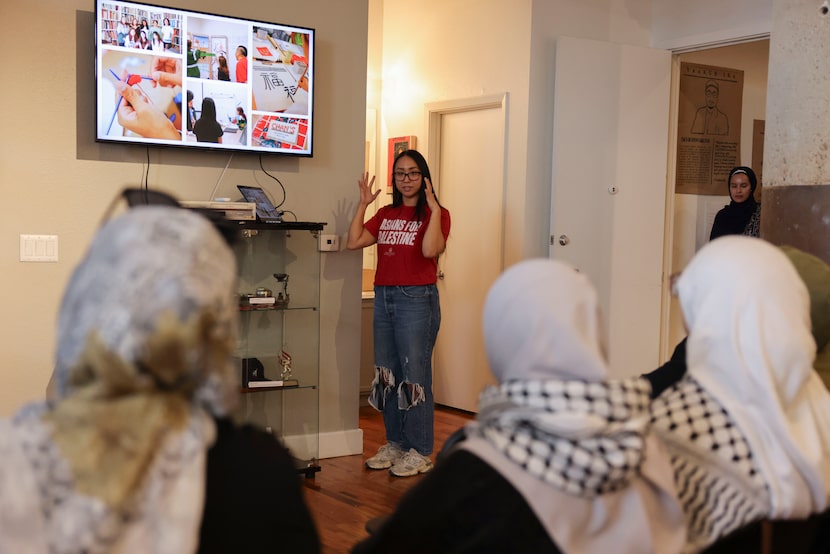
Stephanie Drenka, co-founder of the Dallas Asian American Historical Society, spoke during “Threads of Our Homeland,” an interactive workshop to preserve and archive historical artifacts by the Dallas Asian American Historical Society and Palestinian Youth Movement Dallas, on Dec. 13 at the Museum of Asian Texans in Dallas.
Shafkat Anowar / Staff Photographer
“Threads of Our Homeland,” hosted jointly by the DAAHS and the PYM, brought dozens to the museum space to photograph family heirlooms, digitize family photos and document their history.
“Throughout our history, we have seen culture learned, shared and transmitted across generations. Culture is the essence of a community,” said Ebba Anayah, member of the PYM in Dallas, at Saturday’s workshop. “We see our culture and history being stripped away from us. … We are here today to resist that.”
Following a Hamas-led attack in 2023 on southern Israel, Israel’s two-year campaign has killed more than 70,650 Palestinians, roughly half of them women and children, according to the territory’s Health Ministry, The Associated Press reports. Much of Gaza has been destroyed, and most of the population of over 2 million has been displaced, according to the AP.
Related

Attendees brought clothing passed down from Palestinian family members, posters and T-shirts from protests, newspaper clippings detailing significant events and family immigration documents — items from Palestine or shaped by the Palestinian diaspora.
“The reason why [we] are so adamant about archiving our own histories is because we know that a lot of it is either actively being erased or has been already erased,” Bawab said.
On folding tables and chairs holding pamphlets, stickers, archival boxes and books, attendees shared stories from their past and ate savory pies from Ramallah Bakery in Richardson. Some wrote letters to Yaa’kub Ira Vijandre, a fixture at Dallas-area pro-Palestine protests who faces deportation, and other community members detained by ICE.
Related
“For us, preserving our culture, preserving our history, preserving our stories, is part of our fight for liberation,” Lafi said.
Community archiving is “the participation of the community in documenting and making accessible their history on their own terms,” Drenka said.
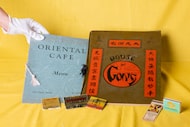
She saw the value of community archiving in her own life. A Korean adoptee, she began collecting documents and items from her past and from those in the Asian American community in Dallas to help tell their history. A collection that began with a menu and matchbook became an exhibition detailing local Asian American history through the legacy of Chinese restaurateurs.
Related
Even a tiny artifact like a matchbook can have a “lasting impact on the history and the narrative,” Drenka said to attendees Saturday.
Samra Ali and her daughter attended the workshop from Plano. At first, she wasn’t sure if her history should be preserved. But Drenka’s words inspired her to consider how she wants her past to be remembered.
“Everybody wants to be remembered after they’re gone,” said Samra Ali, who is from Pakistan. “Whatever I could offer may just allow someone else to feel how I felt today. I felt connected to Dallas. … Once you’re here, Dallas belongs to you, and it belongs to me as much as it belongs to anyone else.”