
Walnut Brain’s earliest rumblings
All you need to make a diddley bow is a piece of wood, a bottle, a nail and a string. The crude instrument has strong roots in the earliest iterations of blues music. And it contributes to the outsider flavor of their sound.
In 2024, after a few attempts at learning how to play instruments, Josan asked herself, “What if I just make myself an instrument and figure out how to play it?” So she built one from a single guitar string stretched across two cans.
“So, a one-string instrument is essentially my first instrument,” she said.
Scraping and banging on the string with a mix of bows, sticks, jars, and using a battery as a slide, she began by “just trying to make something new,” she explained.
They ran into problems with her first iteration. After banging on the string for a couple minutes, the cans would shift and the tone would change, making it too hard for Heise to play along. In its next generation, the instrument included a tuning peg borrowed from a guitar.
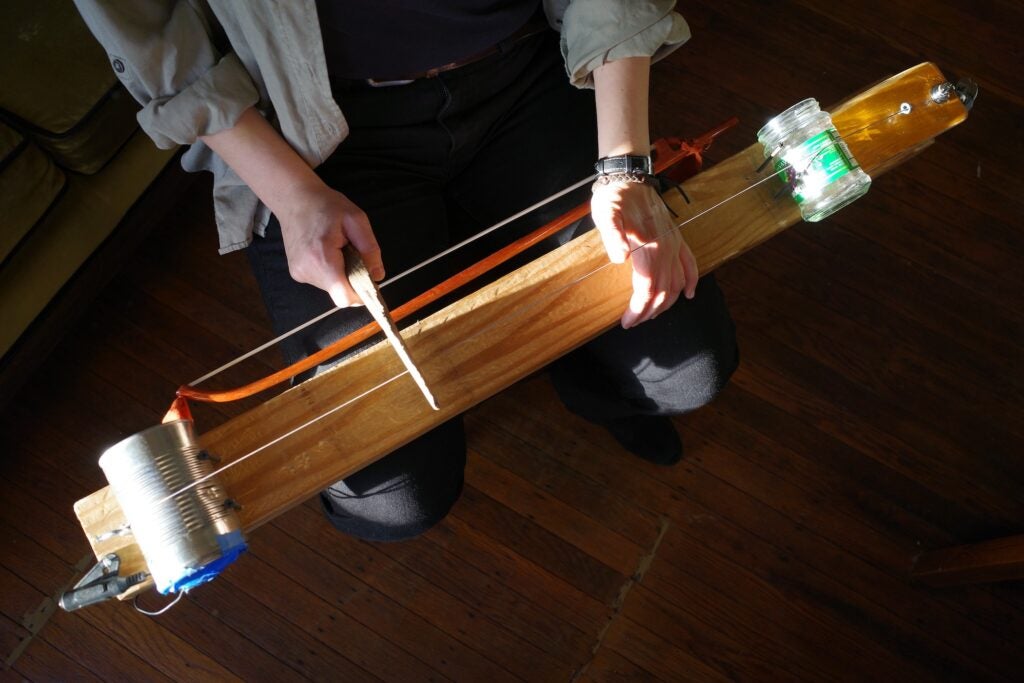 Walnut Brain’s Alina Josan playing her hand-built diddley bow. (Courtesy of Walnut Brain)
Improvisation and repetition form the backbone of Walnut Brain’s music. They avoid structure on purpose. They both credit the legendary avant-garde musician and philosopher Henry Flynt, especially his “Back Porch Hillbilly Blues” and “Violin Strobe,” with shaping their taste for long hypnotic stretches.
“I’ll kind of, like, bend the string,” Josan said. “And I’ve figured out that I have a whole little bag of tricks of things to do. But again, I’m not professionally trained, so I don’t really know how to explain what I’m doing. I just have to remember how I achieved a certain sound.”
Heise no longer tunes his guitar conventionally. He said he was bored with “playing the same things,” so to keep the music exciting for himself, he uses “random alternate tunings” as a way to get different sounds.
After Josan establishes a rhythm, whatever it might be, Heise joins in on his electric guitar. He said he gravitates toward rhythms and beats, even in their most esoteric experimental music.
“A lot of our jams start a little loose, and then at some point we lock in together,” he said.
Josan said she loves the moment when they snap into sync.
“It’s really fun when I notice we’re locked in,” she said.
The duo will record with Emily Robb in December. They say they’re excited — and curious to hear what their improvisation will sound like in someone else’s environment.
They recently marked the anniversary of Walnut Brain’s creation by once again heading to a cabin with their gear and recording equipment. The nascent duo have the potential to reach an untold number of new fans, but they approach the thought of their future with a touch of humility. “It’s fun to play music together,” Josan says. “It’s really cool if other people like it.”