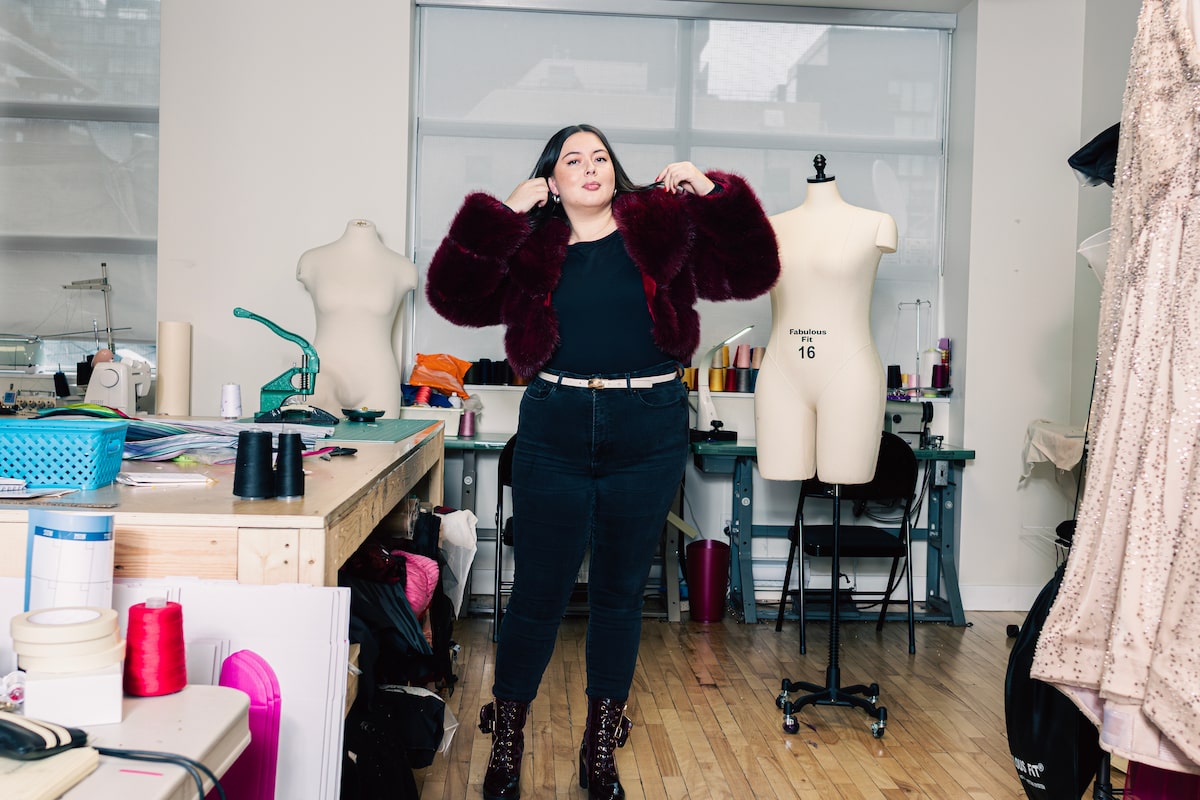
Fashion designer Lesley Hampton stresses the importance of staying committed to personal and cultural values, even amid economic uncertainty.Jalani Morgan/The Globe and Mail
Lesley Hampton fell in love with clothing at ten years old while watching Jeanne Beker host Fashion Television on Saturday evenings at her family’s home in Newfoundland. She was so enamoured with the stylish world she saw on the screen, she even set up a small sewing machine in front of the TV.
“It was so cool to have that Canadian angle within the international fashion scene,” she says. “That being said, you only saw one body type, you only saw one skin colour, so [a career in fashion] was always a dream of mine, but it didn’t really seem like it could be reality.”
The now 31-year-old Anishinaabe designer has come a long way since then – and she’s working to bring the fashion world along with her via her own eponymous label.
From the very first time she showcased her work, Ms. Hampton has pushed back against the idea that the world of fashion belongs to thin, white bodies. Her runway debut opened with an Anishinaabe jingle dancer gracing the catwalk. In the ten years since, she’s dressed celebrities like Lily Gladstone, Sandra Oh and Lizzo. This past summer her label was featured at a pop-up event at luxury retailer Holt Renfrew.
Indigenous entrepreneurs are powerful contributors to the Canadian economy; according to the Canadian Chamber of Commerce, Indigenous people are launching new businesses at five times the rate of non-Indigenous people. These entrepreneurs tend to be younger, gender diverse and more likely to be early adopters of new technology than their non-Indigenous peers. But, since they’ve often had to establish careers in opposition to the way so-called “mainstream” businesses run – whether that’s in regards to the company culture they create or the way they access funding and attract employees – they also have to run their businesses differently.
That’s true of Ms. Hampton, and it’s also an apt description of Nicole Borque-Bouchier, who is the CEO and co-owner, alongside her husband David, of Bouchier, a Fort McKay-based contracting and facility services firm that’s 100 per cent Indigenous-owned and 38 per cent staffed by Indigenous employees. This past summer, the 27-year-old company was recognized with the Canadian Council for Indigenous Business’ first Indigenous Business of the Year Award.
However, Ms. Borque-Bouchier’s early years of entrepreneurship came with a major challenge, and one that continues to affect Indigenous founders today: attracting the kind of talent the firm needed to succeed.
“We weren’t seen as a viable company – we were new, we were Indigenous. So, we adopted a ‘grow your own’ mentality,” she says. “Dave and I are completely self-taught. We’ve learned everything by ourselves from the ground up. So we started thinking, well, let’s get behind the people that we work with and see where they want to go and grow.”
Ms. Hampton’s business ethos is as much about design as it is about responsibly navigating common fashion industry challenges, including sustainability and overconsumption.Jalani Morgan/The Globe and Mail
For the most part, Ms. Borque-Bouchier says, the innovative strategy has been a success: “It really inspires people to understand what they’re capable of.”
Ms. Hampton agrees that industry or systemic roadblocks uniquely affect Indigenous entrepreneurs, and similarly sees them as an opportunity to stand out as an entrepreneur. With its challenges around environmental sustainability and overconsumption, the fashion industry offers plenty of trials for young designers. To counter this, Ms. Hampton works to ensure that her pieces find their way to people who genuinely value the item, instead of simply taking up space in a closet.
“We focus on small-batch production or pre-sales when it comes to our work,” she says. “We do that so that we don’t have an overstocked product that ends up in landfills or that gets discounted to a ridiculous price where people might just grab it and not actually think about the garment they’re purchasing. I don’t really see many Indigenous designers not having that ethos.”
As far as trends to watch in 2026, both women agree it’s a continued focus on community. They both see leadership and investment in their communities as a duty that doesn’t stop with them – it extends to their teams and is carried on by the next generation of innovators.
“Many of the Indigenous people who work for us come from very small northern communities, and more often than not, they’re the role models there,” Ms. Borque-Bouchier says. “Having an organization that supports them, an organization that helps develop them, means they’ve been able to take that skill set back to their community.”
While Canadian business owners across the country face similar obstacles, for some Indigenous entrepreneurs, there’s a difference in attitude and approach. “It’s about relationships and about being long-term, not transactional,” Ms. Borque-Bouchier says. “Because we’ve been here forever. This is our traditional territory. For generations to come, we will be here. So we take a long-term view on how we do everything.”
That doesn’t mean ignoring the here and now, of course. According to a recent report from the London School of Business, economic and political turbulence will only continue to shape the business landscape, and both entrepreneurs anticipate this will affect their peers, too.
But, Ms. Hampton notes, this also means not getting lost in the hustle and maintaining her commitment to personal and cultural values of diversity, quality craftsmanship, ethical manufacturing and community give-back.
“We have younger models who want to work with us and when we’re able to work with them on a lookbook or a runway show, it’s a reminder of why I’m doing what I’m doing. It’s those moments of creating opportunity and paving the way for new talents to thrive,” she says.
One in a regular series of stories. To read more, visit our Indigenous Enterprises section. If you have suggestions for future stories, reach out to IE@globeandmail.com.