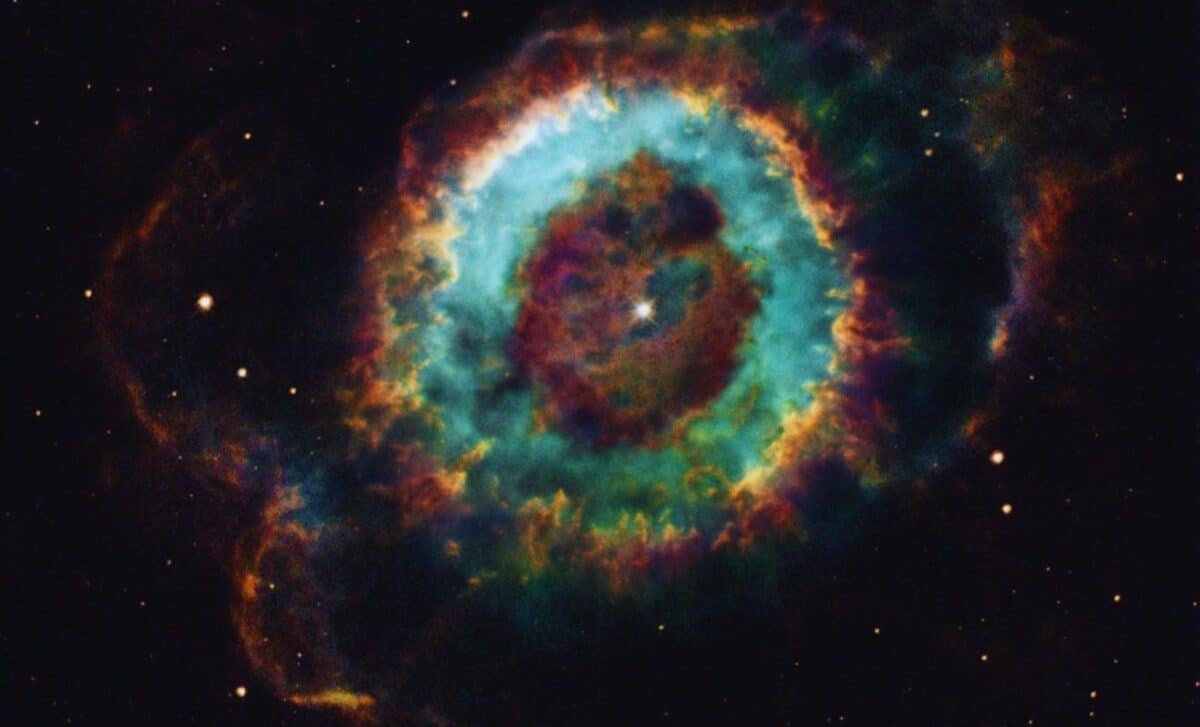
NASA’s Hubble Space Telescope has unveiled a mesmerizing image of NGC 6369, a planetary nebula known as the “Little Ghost Nebula.” Located about 2,000 to 5,000 light-years from Earth, this glowing cloud is the result of a dying star shedding its outer layers into space. The nebula’s eerie appearance has captivated both amateur astronomers and scientists alike.
The nebula, which is situated in the direction of the Ophiuchus constellation, provides an extraordinary opportunity to study the process of stellar death. As stars like our Sun approach the end of their lives, they expand into red giants, shedding their outer layers to form planetary nebulae. According to NASA, the image taken by Hubble allows scientists to study these complex, short-lived phenomena in unprecedented detail.
The “Little Ghost Nebula”
The nebula NGC 6369 is often called the “Little Ghost Nebula” due to its eerie, cloud-like appearance surrounding a faint, dying central star. The star’s outer layers were expelled into space, forming this faintly glowing cloud of gas. Based on NASA’s findings, such planetary nebulae are a common, albeit short-lived, phenomenon in the life cycle of stars similar in mass to our Sun. These nebulae, named for their round shape that resembles planets when viewed through a small telescope, mark the end of a star’s red giant phase.
This particular nebula is situated in the direction of the Ophiuchus constellation and lies between 2,000 and 5,000 light-years from Earth. The Hubble Space Telescope’s detailed images capture the complex structure of the nebula, providing astronomers with a clearer view of the materials ejected during this final stage of stellar evolution. The faintly glowing gases surrounding the star offer a glimpse of what will eventually happen to our own Sun in roughly five billion years.
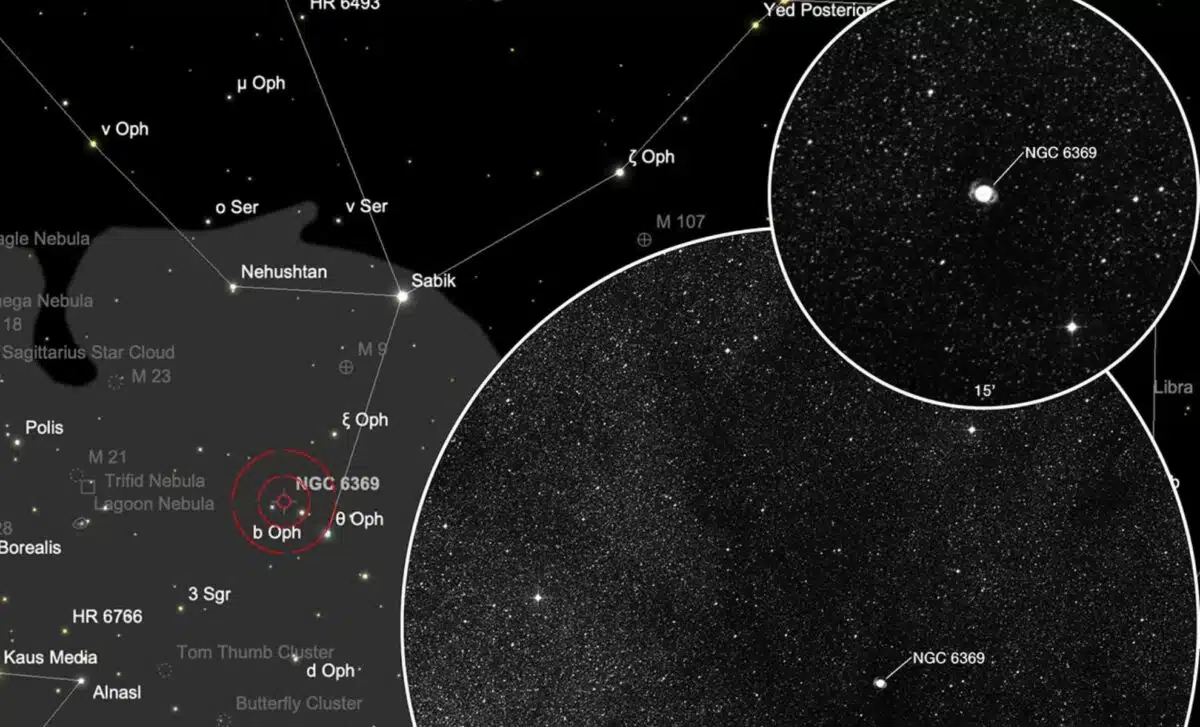 A sky map showing the location of the Little Ghost Nebula (NGC 6369) in the constellation Ophiuchus. Credit: DeepSkyCorner.
Hubble’s Imaging Capabilities
Hubble’s contribution to studying planetary nebulae like NGC 6369 is invaluable. The telescope’s high-resolution capabilities, particularly the Wide Field Planetary Camera 2 (WFPC2), have allowed astronomers to capture images of this nebula with far more clarity than ground-based telescopes could achieve. As stated by The U.S. Space Agency:
“The doughnut-shaped blue-green ring represents light from ionized oxygen atoms that have lost two electrons (blue) and from hydrogen atoms that have lost their single electrons (green). Red marks emission from nitrogen atoms that have lost only one electron.”
Besides the blue-green ring, the nebula also shows red emissions, which represent nitrogen atoms that have lost electrons. This detailed imaging gives scientists a deeper understanding of the ionization processes that occur in the final stages of a star’s life. The clarity of the Hubble images makes it possible to study these interactions and the behavior of the surrounding gas with unprecedented detail.
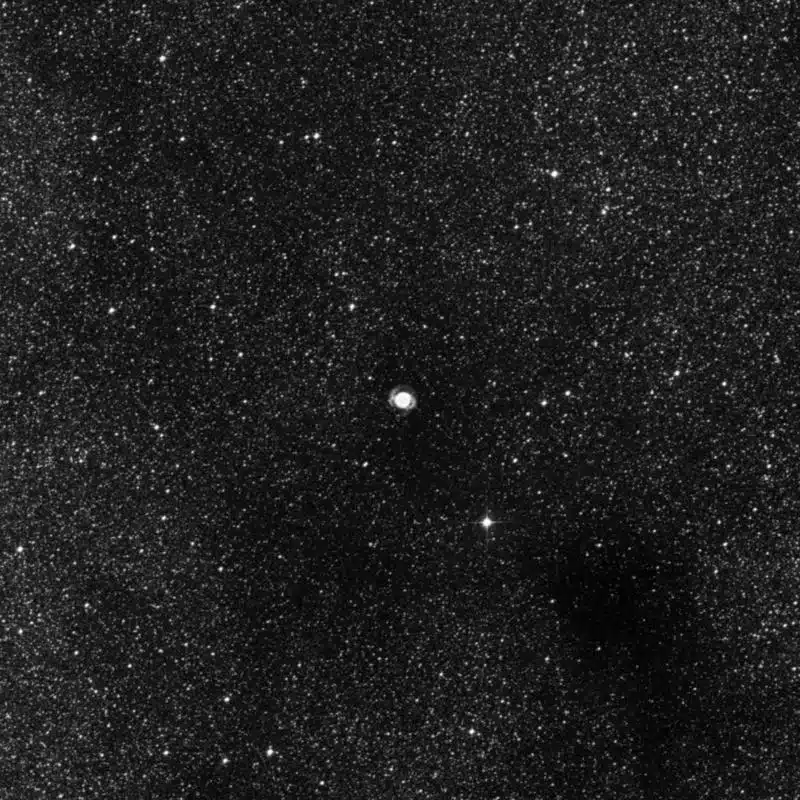 This image of NGC 6369 marks its apparent size with green lines representing the major and minor axes. Credit: TheSkyLive
The Future of Our Sun
As noted in the release published by The American Space Program, stars like the Sun will undergo a similar transformation when they reach the end of their lifespans.
“Our own Sun may eject a similar nebula, but not for another 5 billion years. The gas will expand away from the star at about 15 miles per second, dissipating into interstellar space after some 10,000 years. After that, the remnant stellar ember in the center will gradually cool off for billions of years as a tiny white dwarf star, and eventually wink out.”
This transformation is still billions of years away, but understanding the process provides insight into the future of our solar system.