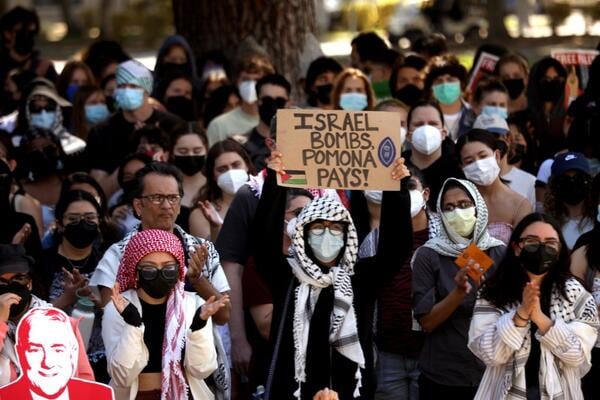
Students from Pomona College and other Claremont Colleges took part in pro-Palestinian protests.
Genaro Molina | Contributor | Los Angeles Times
Both Pomona College and the University of California settled antisemitism allegations last week.
Pomona’s agreement resolves an antisemitism complaint filed with the Education Department’s Office for Civil Rights in April 2024, amid intense pro-Palestinian protests on the California campus. In the 27-page deal, the private college “acknowledges that many Jewish students experience anti-Zionism as an attack on their Jewish identity, ethnicity, religion, and/or ancestry, which means these students experience anti-Zionism as antisemitism, and the College commits to protect them from such conduct that rises to the level of harassment and discrimination.”
Among many other things, Pomona promised to add to its trainings and frequently asked questions a warning that “‘Zionist’ is often used as a codeword for ‘Jew,’ and depending on the factual circumstances, may be evidence of antisemitic intent.” It will also warn against “invoking Holocaust imagery or symbols to harass or discriminate” or saying things such as “Zionists control the media.”
In addition, the college promised programming, including on “the Zionist component of Jewish identity.” In its own investigations of antisemitism complaints it also promises to consider the controversial International Holocaust Remembrance Alliance (IHRA) definition of antisemitism, which says antisemitism “might include the targeting of the state of Israel.”
Further, according to the settlement, Pomona is banning masked protests and will appoint a “Civil Rights and/or Title VI Coordinator.” Title VI is a federal law banning discrimination based on shared ancestry.
G. Gabrielle Starr, Pomona’s president, told Inside Higher Ed Friday that “we really wanted to prioritize coming to a meaningful solution that worked for our students and our campus.” Asked how the settlement might restrict anti-Zionist language, Starr said there are moments when that language is “purely political,” and moments when it involves hate against Jews.
“Speech in any free society is always going to be contested,” Starr said. She said, “we always have to have conversations about where the limits of speech actually are.”
But Laura Beltz, policy reform director for the Foundation for Individual Rights and Expression (FIRE), expressed concern that the settlement requires Pomona to push for changes to demonstration policies that would affect all the Claremont Colleges and “may infringe on free speech, depending on how they are adopted.” She particularly noted proposed requirements for advance approvals even for protests that include just a few people, and a proposed mandate that “protests meeting some unspecified threshold of attendees” take place in certain campus locations.
Regarding using the IHRA definition, Beltz said, “FIRE has long warned of the potential of this broad definition and its list of examples to chill speech.”
Also last week, the University of California settled a lawsuit that Yael Nativ, a former visiting faculty member at UC Berkeley, filed in August. Nativ had alleged national origin discrimination, saying a department chair declined her application to continue teaching because she’s Israeli.
Berkeley’s Office for the Prevention of Harassment and Discrimination had already concluded Nativ was discriminated against. To settle the suit, UC agreed to pay her $60,000, and her attorneys $56,000, and to allow her to teach her course, with pay, in 2026 or 2027. Berkeley chancellor Rich Lyons also promised to apologize to her personally.
“She is owed the apology I will provide on behalf of our campus,” Lyons said in a statement. “We look forward to welcoming Dr. Nativ back to Berkeley to teach again.”
Both complaints were filed by organizations including the Louis D. Brandeis Center for Human Rights Under Law, which filed a swath of Title VI complaints after Oct. 7, 2023.