
Congressman Brendan Boyle is co-sponsoring federal legislation to reverse part of President Donald Trump’s so-called “Big Beautiful Bill” and restore billions of dollars for Philadelphia’s Chinatown Stitch and other defunded transportation projects around the country.
The Stitch project would cap a section of the Vine Street Expressway between 10th and 13th streets and build a park there inspired by Chinese cultural traditions. It aims to partially undo the disruption of the neighborhood caused by the widening of Vine Street in the 1950s and construction of the highway in the 1980s.
The Biden administration had awarded the project two grants, totaling $162 million, but most of the funding was clawed back by the reconciliation bill Trump signed in July. On Monday, Boyle visited the Crane Community Center, next to the expressway, to meet with city and state transportation officials and discuss ways to move the project forward.
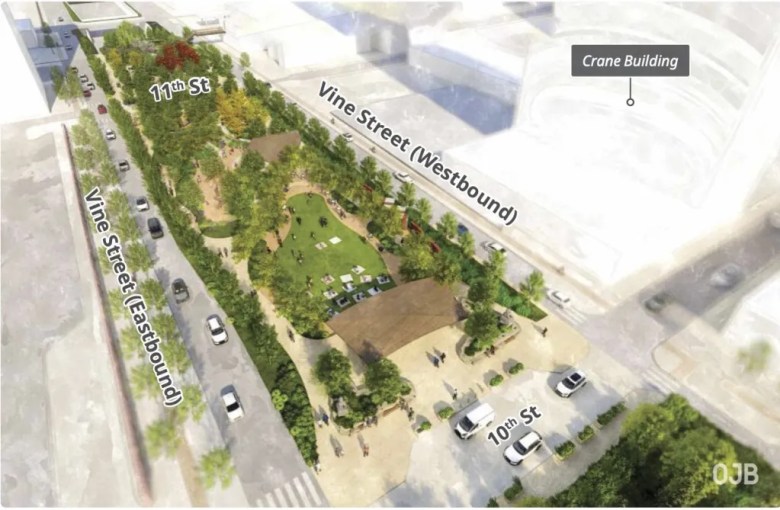 A park is planned for the Chinatown Stitch cap over the Vine Street Expressway. (City of Philadelphia)
He said afterward that he’s sponsoring the REPAIR Act (Restoring Essential Public Access and Improving Resilient Infrastructure Program Act) to provide full funding for the Stitch and other projects across the country,
“We are here to say we are not giving up on this project. This community has been fighting literally for decades in order to reconnect it, and we’re not stopping now,” he said. “I feel more confident than ever that we have a plan to move forward with the funds that already exist, to get us through, so that way we can repair at the federal level the funds that were taken away from us.”
The proposed federal legislation would spend $3 billion a year from 2027 to 2031 on transportation and infrastructure work. That would include about $3 billion worth of projects that were rescinded by the reconciliation bill, Boyle said.
Decades of ups and downs
Community leaders have long aspired to cap the portion of the below-grade I-676/Vine Street Expressway that cuts across the north end of the neighborhood.
The roadway’s construction required the demolition of many homes and businesses, forces schoolchildren and other residents to regularly cross several lanes of traffic on Vine Street, and has stunted Chinatown’s northward expansion, they say.
“This is a river that cuts through our community and divides it, and because this community deserves and needs it, we want to see this project happen, to reconnect our community,” John Chin, executive director of the Philadelphia Chinatown Development Corporation (PCDC), said at Monday’s press conference. “But also, there’s economic opportunity and development along with this project, and that’s really important for Chinatown.”
The cap finally seemed poised to become a reality with the passage in 2021 of the federal Bipartisan Infrastructure Law, also known as the Infrastructure Investment and Jobs Act, in 2021.
The law included the Reconnecting Communities Pilot program, which was created specifically to fix problems created by highway construction that cut off communities from economic opportunity.
In 2022, Philadelphia received a $4 million federal grant for planning and engineering work on the Stitch, and in 2024 won a $159 million grant from the U.S. Department of Transportation’s $3.2 billion Neighborhood Access and Equity Program (NAEP), city officials said.
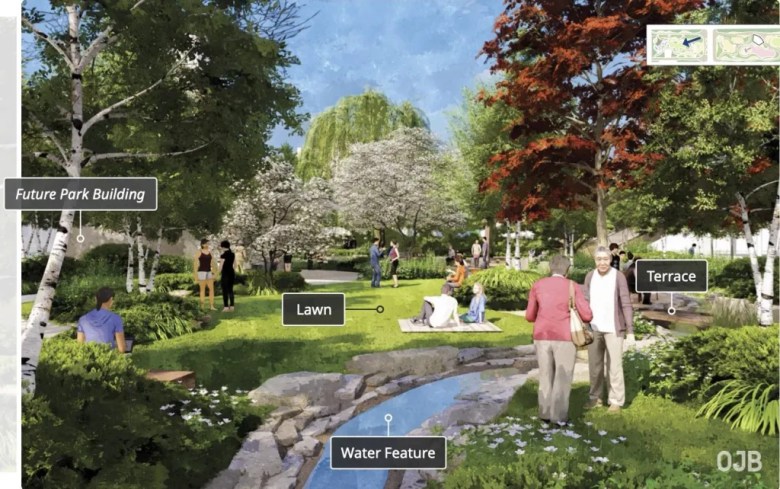 The western section of the planned Chinatown Stitch park over the Vine Street Expressway would include trees, a lawn, and a water feature. (City of Philadelphia)
This past August, designers commissioned by the city’s Office of Transportation and Infrastructure Systems (OTIS) presented a design for a two-block section of the proposed highway cap, spanning from just east of 10th Street to a bit east of 12th Street.
Design renderings showed a lush park with trees and landscaping, a lawn with a covered plaza, a playground, a small stream, a “moon gate” and garden inspired by Chinese traditions, a food kiosk and restrooms.
By then, however, Trump had signed the federal reconciliation bill, which rescinded $9.4 billion in previously approved spending, including for NAEP and other infrastructure projects, Medicaid, Affordable Care Act subsidies, food aid and a slew of other programs.
“We have our ups and downs. We were ecstatic when the money was approved for the Chinatown Stitch project. We were devastated when the money disappeared,” Chin said. “So we are always persistent.”
The city held on to $12 million of the infrastructure law funding that had already been obligated, or legally committed, to the project. That’s being used for engineering design and other preparatory work, and will be stretched to last through February 2027, Boyle said.
Bipartisan support claimed
This week congressional Democrats introduced the Restoring Essential Public Access and Improving Resilient Infrastructure (REPAIR) Act, with Boyle as a lead co-sponsor. It would restore $3 billion for NAEP, and overall would budget $3 billion annually for five years for road and infrastructure projects around the country, he said.
While Democratic and Republican legislators have been unable to agree on other funding fixes, such as a restoration of Affordable Care Act subsidies, Boyle recalled the broad support for the original infrastructure law and said he thought the REPAIR Act has a real chance of becoming law.
“I was there at the White House South Lawn. We had Republican speakers as well as Democratic speakers. We had more than a two-thirds vote in the United States Senate, including the then-Republican Senate Leader Mitch McConnell,” he said. “So we have shown already, just in recent years, that support for infrastructure can be bipartisan.”
Boyle met Monday morning with Chin, state Sen. Nikil Saval, Councilmember Mark Squilla, deputy managing director for OTIS Michael Carroll, a PennDOT official and others to assess the status of the Chinatown Stitch and explore unspecified “additional funding sources,” he said.
“This is a project that has input from the people who live in the community and what it means to them, and OTIS has been steadfast in their mission to make sure this project happens, even when the money was pulled away,” Squilla said after the meeting.
“We’re hoping that by the time we’re ready to go and our planning process is done — and the money that’s funded gets us to a certain position — that this act will be passed, and therefore the funding will be regenerated so this project can move forward,” he said.