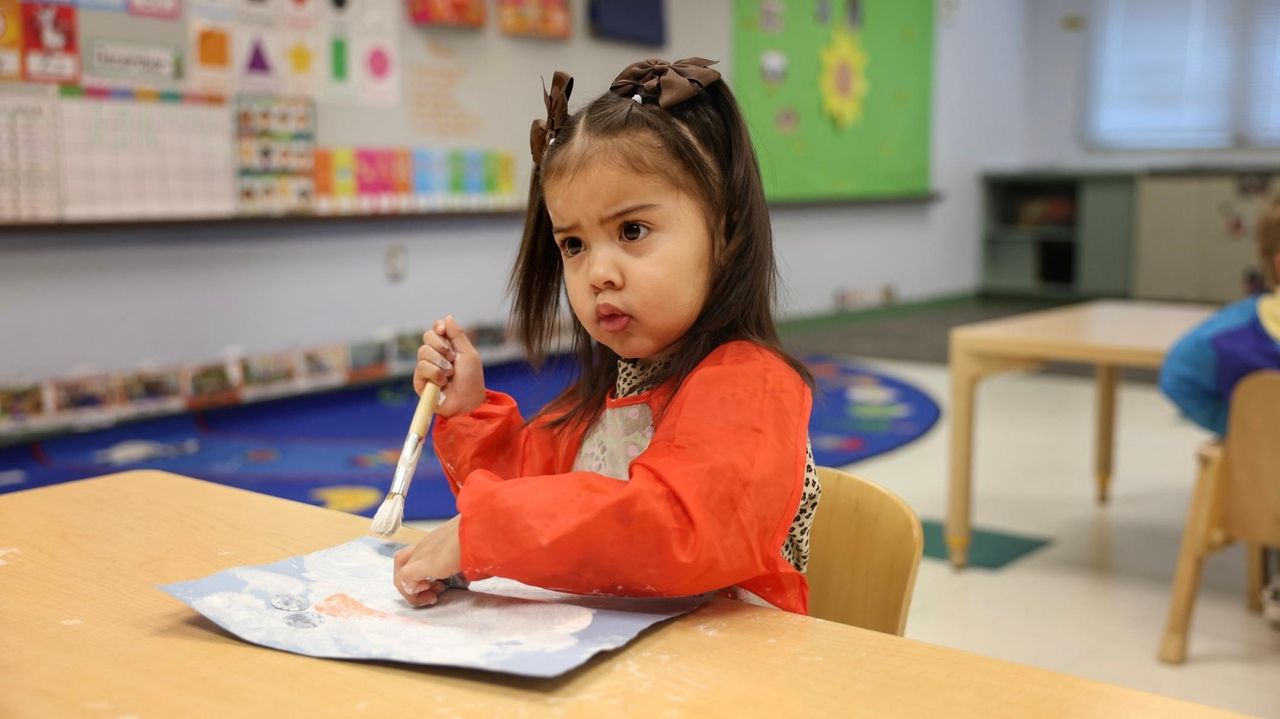
On a recent, chilly Tuesday afternoon, 2-year-old Mikaela Perez was putting white paint to construction paper, intensely focused on the snowman project she and her friends were working on after nap time.
“I did it myself!” Mikaela declared after breaking her concentration, her big, brown eyes beaming with excitement. A few minutes later, she and the rest of the group, 18 months to 3 years old, were off to wash their hands for snack time.
The typical day at Harbor Child Care in Mineolaplays out at early childhood centers throughout the region at a median annual cost of $20,000 per child and rising. Access to such high-quality care for all — or universal child care — is increasingly becoming a centerpiece of the affordability conversation elected officials are having across the country. The issue has taken center stage in New York City, where Mayor-elect Zohran Mamdani made it a cornerstone of his campaign platform.
Expanding such child care been a priority of Gov. Kathy Hochul, a Democrat, who along with the legislature boosted funding for state subsidies in the last four years. As Mamdani is set to take office Jan. 1 and Hochul ramps up her reelection bid in 2026, the system that serves the youngest residents — and drains the wallets of their parents — is poised to move higher on the list of funding priorities in the city and state.
On Long Island, child care experts and advocates say barriers like shortages of trained workers, the high cost of real estate and communities where there are “child care deserts” would need to be aggressively addressed before any universal plan can become a reality. If New York City were to pull off the plan — similar to what the idea of full-day, universal pre-K was over a decade ago — neighboring Nassau and Suffolk might have no choice but to follow suit by calling for a statewide rollout or launch discussions on how to compete with the city, they contend.
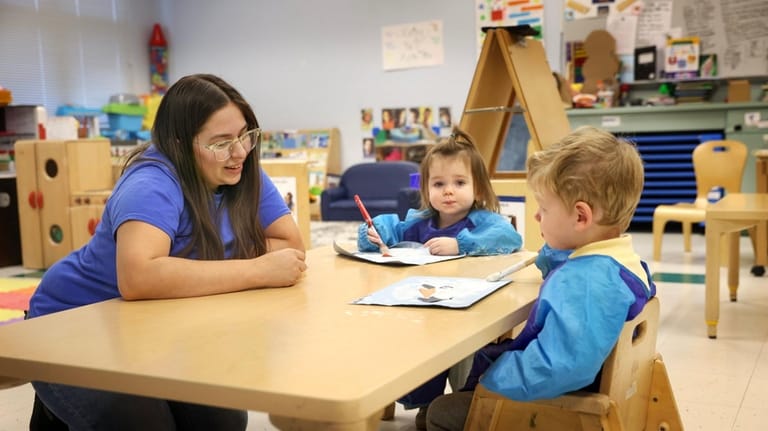
Head teacher Kim Rodriguez works on an art project with students Emilia Stanford, 23-months, center, and Christian Roberts, 28-months. The two youngsters are enrolled in the toddler program at Harbor Child Care in Mineola on Tuesday, Dec. 9, 2025. Credit: Newsday/John Paraskevas
“This should be a system that’s part of the public good,” said Jennifer Rojas, executive director of the Child Care Council of Suffolk County, a nonprofit that acts as a clearinghouse of information for parents and providers on local programs and training of workers. “It doesn’t just help the families who use it but it actually helps everybody. It’s helping employers; it’s helping the economy.”
Evaluating costs
Mamdani and others cite a plan to overhaul the system by the Empire State Campaign for Child Care, a coalition of 50 organizations that came together in the summer of 2017 when a state budget proposal threatened cuts to child care subsidies. Their six-year phase-in aims to make child care accessible to all families and builds on the reports of the state’s Child Care Availability Task Force, an arm of the Office of Children and Families.
The approach immediately raises the wages of child care workers, provides more funding to clear waitlists of the families eligible for state subsidies and protects middle-income families from rate hikes, according to the 50-page report published about a year ago.
The price tag in New York City is $6 billion for children 6 weeks old through pre-K; $15 billion when scaled up for the entire state, according to estimates from the Mamdani campaign. While Hochul and leaders of the State Legislature have publicly supported it, there has been no public agreement on the funding mechanism, although Mamdani has zeroed in on raising taxes on the wealthiest New Yorkers and corporations to pay for his initiatives. To raise some of those taxes would require state approval.
According to the state task force’s 2024 report, center-based infant care, at $21,826 annually, is 155% higher than the annual in-state tuition in New York’s public four-year universities and is an average of 18% of a married couple’s household income and an average of 63% of a single-parent family’s household income.
“Access to affordable, equitable, and high-quality child care is critical for parental participation in the workforce,” said the report, which went to both chambers of the State Legislature.
Currently, a family of four with a household income of up to $113,567 is eligible for subsidies through the state’s Child Care Assistance Program. The subsidies reduce the out-of-pocket cost for families on a sliding scale. Nearly half the counties in the state have run out of funds, according to recent news reports and confirmed by providers.
In Nassau and Suffolk, the assistance is disbursed through the county social service departments where eligible applicants outnumber available funds. Even with $400 million more allocated in the state’s 2025-26 budget, bringing the total to $1.8 billion, families on Long Island are closed out of enrolling in the program. Those just above the income threshold struggle to pay for what providers call the “true cost of care.”
Addressing ‘child care deserts’
The child care infrastructure is still recovering from the COVID-19 pandemic, which wreaked havoc on the sector forcing providers to close their doors. Even as parents returned to work, many continued on a hybrid schedule or opted to keep their children home, experts say.
Like other areas of the state, there are communities on Long Island with a scarcity of child care providers, often referred to as “child care deserts,” defined as pockets where U.S. Census figures show more than 50 children under the age of 5 where there are either no child care options or not enough licensed spots to accommodate them.
In New York, 64% of all residents live in a child care desert, according to an online, searchable map by the Center for American Progress, an independent policy institute. On Long Island, central Suffolk County appears to have the most pockets lacking child care providers, according to the map.
In Suffolk County, there were 792 child care programs in 2020 and 807 in 2024, a change of 2% over four years. In Nassau County, there were 1,012 child care programs in 2020 and 1,164 in 2025, a change of 15% over five years, according to a data set by the Children’s Agenda, a Rochester-based nonprofit group that tracks the availability of licensed child care facilities across the state.
Smita Daniel, executive director of the Child Care Council of Nassau County, said she believes families would likely delay a move to the suburbs or use an address in New York City should Mamdani successfully implement a universal child care plan there.
“If they’re offering something free in the city, the first tendency would be to move there or to stay there because this is a huge amount you would be otherwise paying for your children,” Daniel said. “I do see how this would impact Nassau. As it is, we can’t compete with the free programs for 3- and 4-year-olds.”
Both Daniel and Rojas say paying child care workers more is an essential first step to expanding the system. Most child care workers are earning wages that put them at or below the poverty line, they say. Training programs such as a 120-hour certificate to become a child development associate would need to be expanded. Farmingdale State College has among the only CDA programs where credits count toward a degree.
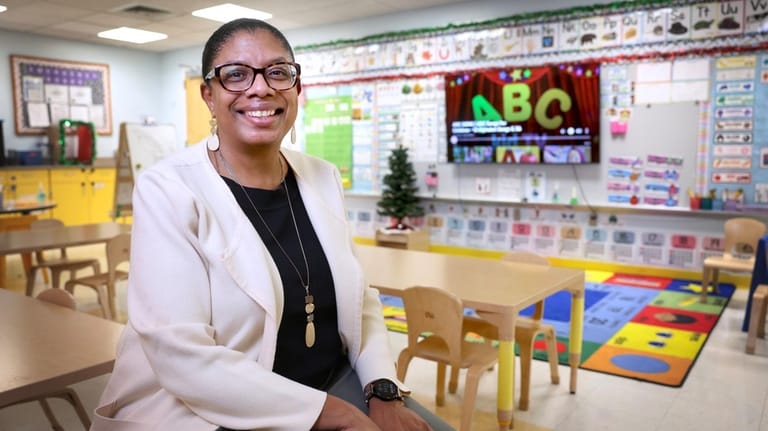
Florence Prophete-Barbour, executive director of Harbor Child Care, is shown in one of the classrooms at its Mineola location on Tuesday, Dec. 9, 2025. The non-profit cares for children from birth to 5-years-old.
Florence Prophete-Barbour, executive director of Harbor Child Care, which has six locations across Nassau, said she and many in her field rise through the ranks from assisting in infant and toddler care to becoming a head teacher and a director of a center.
Many of those who were in her care are now in their 30s, she said.
“Early childhood education really encompasses so many value-driven aspects: the caring and loving for children, the caring and loving for those who take care of our children as they are the backbone of what we do everyday and the opportunity to be an impactful source for our youngest learners,” Prophete-Barbour said.
“I think we are the only profession that when children go to the bathroom, we celebrate. We are like ‘yay!’ so it truly is passion work.”

Candice Ferrette covers Nassau County government and politics on Long Island. She has been a reporter at Newsday since 2011.