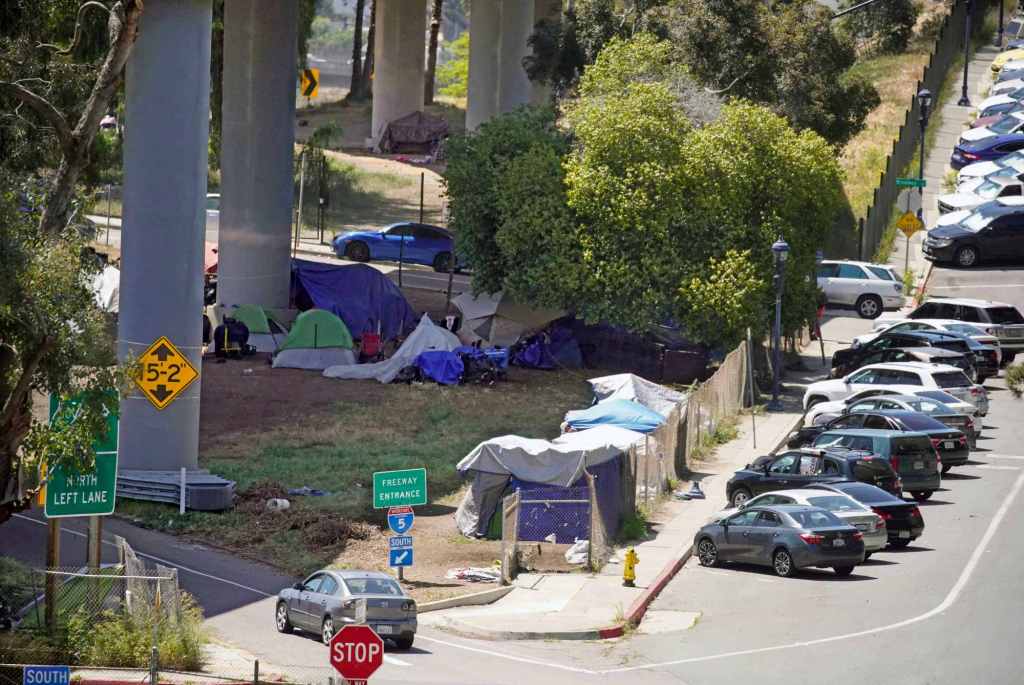
It seems there’s hardly anything good to say about reducing homelessness in San Diego these days.
Keep that word “hardly” in mind for a minute.
San Diego’s perpetually stressed rental voucher program faces rent increases for recipients, some of whom are at risk of becoming homeless. Some cities may no longer add people to their years-long voucher waiting lists.
Greater state and local cooperation to clear out encampments on freeway-adjacent property was cheered by some officials. But the subsequent surge in shelter requests was mostly met with a no-room-at-the-inn response at the packed facilities, as reported by Blake Nelson of The San Diego Union-Tribune.
The safe parking program in Encinitas that gives homeless people a place to sleep in their cars may shut down at the end of this month amid a funding dispute.
The prospective rent increases planned by the San Diego Housing Commission are moving forward in anticipation of sweeping Trump administration cuts in homeless and housing programs that have yet to take effect. The other problems are largely independent of those coming reductions.
Meanwhile, the number of people falling into homelessness for the first time continues to outpace those gaining housing and exiting homelessness, according to the latest monthly figures from the Regional Task Force on Homelessness.
The trend needs to be reversed in a big way to make substantial progress.
But there are some positive developments amid the gloom that shouldn’t be overlooked, and perhaps there’s fingers-crossed hope the trends can stay on track despite pending funding cuts.
For one thing, housing of formerly homeless veterans continues in greater numbers than those becoming homeless, according to the task force.
And while the overall number of first-time homeless residents still tops those exiting homelessness, the gap is shrinking, according to Lisa Halverstadt of the Voice of San Diego, citing task force data.
There was a 13 percent year-over-year drop in people falling into homelessness and a 17 percent uptick in people moving into homes, between October 2024 and September. Still, the task force said 13,622 people sought homeless services for the first time during that period.
This October, 1,015 people became homeless, while 1,021 secured housing — a positive gain of 33 people. Last month, however, the balance slid toward homelessness again by 30 people.
San Diego officials overseeing housing and homelessness programs said the narrowing of that gap was not a lucky accident but the result of targeted investments and strategies.
Ryan Clumpner, vice chair of the San Diego Housing Commission, suggested the state and local Homekey initiative enacted during the pandemic, the addition of permanent supportive housing units and prevention or diversion grants factored into the trend.
“You can see and track how these big investments did what they were intended to do,” he said.
To really get somewhere, though, programs like those need to be continued and expanded, yet retrenchment looms.
Homekey, essentially, was a program that helped with the purchase of typically long-stay hotels with kitchen facilities that homeless people could move into quickly. Permanent supportive housing provided units with on-site services, including assistance for people with substance use and mental health issues.
Prevention or diversion programs generally provide a small, one-time grant — sometimes called a “shallow subsidy” — that can make the difference in keeping people in their homes or, if homeless, get housing more quickly. For example, the money could be used to cover unpaid bills, repair a car vital for work or pay a rental deposit.
The diversion strategy “has been really, really effective,” task force CEO Tamera Kohler told Halverstadt. “And we’re gonna continue to put more funding into that.”
Funding for those and other programs to help homeless people are being targeted for cuts. The county and city of San Diego face substantial budget shortfalls that will become greater with the federal reductions. However, the city did back off, for now, on plans to cut some of the housing commission’s homelessness prevention funding.
There is pretty much universal agreement that prevention programs, and those that move people out of homelessness quickly, are the least expensive, most cost-effective way to address homelessness, which can also relieve stress on overburdened shelters. Rent subsidies are part of that preventive mix.
Yet such programs are threatened by cuts in federal programs, such as Continuum of Care, which funds a broad array of services and housing to reduce homelessness.
San Diego County was expected to receive more than $40 million for housing and homeless services.
Twenty states, including California, have sued the federal government over the Continuum of Care cut, which caps permanent housing funds and shifts money to temporary housing with services. If the cuts go through, more than 170,000 people nationwide could be displaced or put at risk of homelessness, according to the National Alliance to End Homelessness.
On the flip side, more money could be made available for shelters with expanded services under the administration’s policy change.
San Diego and the rest of California also are burdened with the high cost of housing, which means even the lowest level of unsubsidized housing is out of reach for many.
There’s been an uptick of housing development locally in recent years which, combined with a soft market, has tamped down rents and for-sale housing prices. But the backlog of needed housing remains great, and the prices are still so high that there has been little trickle-down movement to where market-rate housing has changed the homelessness equation.
San Diego’s efforts on homelessness may enter a triage mode as officials scramble for prevention funding and resources for other programs. The proposed rent increases for voucher holders will no doubt be a stretch for some, but they are structured so people can still stay put.
Ideally, homelessness programs are intended to significantly reduce the number of those without housing, if not end homelessness.
The region may have to focus on trying to manage the pain and keep as many people in their homes as possible.