
Of all the mad mothers in 2025 movies, If I Had Legs I’d Kick You’s Linda is the one that will haunt me.
Photo: A24
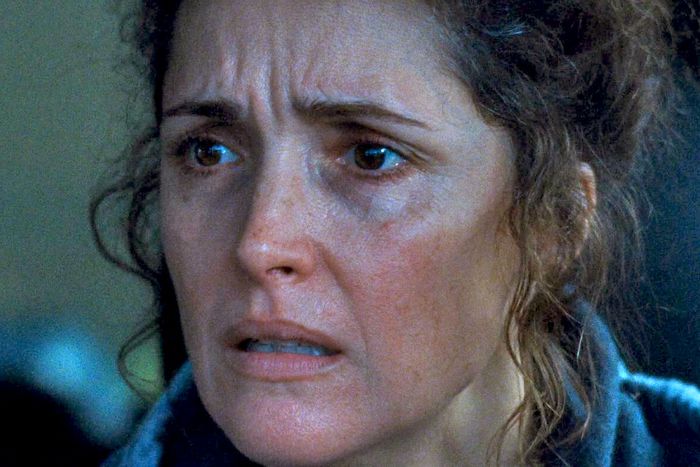
It takes less than 30 seconds of bearing witness to Rose Byrne’s smile stretched so thin it’s a grimace and eyes alight with exhaustion to understand that her leading character in If I Had Legs I’d Kick You, Linda, is a woman about to break. Byrne’s face is the film’s primary terrain, presented in shaky and intimate close-ups. In contrast, director Mary Bronstein doesn’t show the face of Linda’s young daughter, who is living with a pediatric feeding disorder and a tube in her abdomen, until the end of the movie. Instead, we hear the daughter’s voice; we see her searching hands occasionally. We’re meant to understand her in Linda’s twitches and expressions, in how a mother responds to a vessel of demands and anxiety prone to fits and catastrophizing.
But in the opening scene, Linda’s daughter is highlighting her mother’s issues, not her own. “Mommy is … stretchable,” the unnamed child says to an unseen therapist. Byrne’s brows immediately furrow, her face a map of emotional land mines. With every protest — she’s not this way, she doesn’t need one-on-one therapy — it becomes evident how quickly this woman is unraveling. The film chronicles the unending, all-consuming stress that comes with caring for a child with unique medical needs, effectively as a single parent (her husband is a presence on the phone who doesn’t appear until the film’s tail end, either). Is Linda as malleable as her daughter describes, or is she spread so thin she’s become brittle? If you lean in close enough, the cracks are all there.
If I Had Legs I’d Kick You is, spiritually and energetically, a taxing film. It relies on Byrne’s performance so much that not much exists beyond it, save for shaky metaphors like the gaping hole that rips open in the ceiling of Linda’s apartment right after that therapy session. The sludge and water spewing forth mirrors the instability of her psychic state. The narrative wears down the viewer with the repetition inherent to Linda’s life, not only as a mother of a child who requires daily medical supervision and care but as a therapist herself — the last one on earth you would trust with your innermost thoughts, given she can’t parse her own.
There have been several notable mad mothers in American film this year, including Teyana Taylor’s swaggering revolutionary in One Battle After Another and Jessie Buckley’s witchy, grief-stricken wife of Shakespeare in Hamnet. Each of their stories illuminates different rigors of postpartum life and what it takes to keep a family together or blow it apart entirely. But none stressed me with such zeal as Byrne’s Linda, a woman so consistently pushed to the edge with no safety net to speak of. If I Had Legs I’d Kick You ultimately ends up being a grueling character piece so sharply realized I’d prefer never to watch it again. I’ve heard it characterized as a mother’s rendition of Uncut Gems, but that’s too reductive. Linda’s life is constructed of problems not of her own creation but foisted upon her. The anxiety is rooted in the mundane rather than the arch and limns how such mental strife makes others illegible to you. Every character is understood through the haze of Linda’s all-consuming emotional state.
What is the exact opposite of slapstick comedy? If slapstick comedy uses the body as an elastic tool to heighten the farcical elements of a moment, transforming even the most prosaic exchange, what Byrne is doing is its antithesis. She moves as if carrying concrete weights on her back. Her physicality is heavy and rigid, bringing a kind of terror to the story that turns every boring instance of parental upheaval into something cosmically profound. Every gesture, breath, line delivery is heaving with the labor of just trying to get through one day to the next. It isn’t just a dramatic role, but anti-comedy: a performance so darkly focused on the stress of Linda’s life that it warps back around to humor. You have to laugh in order to stop yourself from ripping your hair out.
Linda’s life has a certain rhythm: parental groups for ill children, composed only of mothers; tense negotiations with the female doctor that cares for her daughter; arguing with the hospital parking attendant at drop-off; sullenly buying wine from a Gen-Z terror (Ivy Wolk); residing at a motel to escape the gaping hole in her apartment; sucking down cigarettes, alone in the dead of night, as if nicotine is the only thing propelling her forward; striking up a mildly antagonistic but vaguely flirtatious rapport with motel fixture James (A$AP Rocky); tending to the medical machines aiding her daughter that buzz throughout the night; codependent conversations with the grim-faced therapist at her practice played with unblinking conviction by Conan O’Brien; bartering with her child to eat something, anything, in order to gain weight. This is not a story about personal growth or familial betterment. This is inescapable churn. Bronstein, who herself parents an ill child, asks provocative questions that admittedly suit my lifelong disinterest in having children. Many, many people love their children and also suspect they are failures at the mammoth obligations of parenthood. Maybe they didn’t actively want children so much as they were encouraged to look at a child as a necessary marker of adulthood. But what if there is no respite? What if your child is a black hole of neediness? What if the moments of sweet connection are few and far between? What if you find motherhood completely exhausting?
The anti-comedy of Byrne’s performance reaches a peak with a hamster sequence. About 40 minutes into the film, Linda makes the fatal mistake of bartering with her daughter outside the treatment facility. Linda agrees to get a much-desired hamster if her daughter will just do as she’s asked, go in, get treated. Another parent walks the daughter inside as a torrent of car horns increase the pressure of the scene. It isn’t surprising that once the hamster is in hand, the mood worsens. Held in a box with various holes, Linda’s daughter is first elated then panicked by the presence of the pet, who takes her refusal to close the box as an opportunity to dash. “He’s supposed to love me. I can’t … He’s getting out. He hates us! We’re going to die,” the young girl exclaims.
Linda’s efforts to grab the hamster in the passenger seat of her car and forcefully put it in the box are thwarted when a vehicle rams into her bumper. “Take it with you! Take it with you! I hate my hamster!” the child screams as Linda barrels from her car to confront the driver, the hamster box held close to her chest. Between Linda, sweating, perpetually holding back tears, saying, “You scared her half to death, you dick!” and asking for the man’s information, the hamster runs into traffic and is flattened into red goo. The scene has the glint of macabre humor. Byrne’s every nerve is at attention and on fire. If I had to describe the performance in a single word, it would be taut. Every strained muscle in her neck and face are apparent. And everything curdles in the wake of this strenuous effort.
Cinema has always loved its mad mother. She is a character of particular use in the genre of horror, where she is rendered symbolic more than embodied. Still, the most powerful actresses have taken this archetypal role and created a picture of Technicolor womanhood out of it, whether in Hereditary, Rosemary’s Baby, or the more recent independent film Kindred. This year, the most piquant examples of the mad mother arrived in dramas of various hues and temperaments. In One Battle After Another, Perfidia Beverly Hills ( Taylor) is a briefly held but dynamic vision of postpartum depression that doesn’t offer easy platitudes. She demonstrates the one thing all mothers are punished for: selfishness. Jennifer Lawrence is meant to be the anchor of Lynne Ramsay’s moody Die My Love. She plays Grace, a scantily defined woman who was once a writer and lived in New York with her husband Jackson (Robert Pattinson) but was transplanted to his familial land of Montana, where they had a child in short order. There, the feral irreverence that once made her alluring becomes inconvenient, and Lawrence plays a series of tics in search of a character. Jessie Buckley’s Agnes, the wife to William Shakespeare and a tragic mother figure, is the most labored, ostentatiously constructed performance I’ve watched this year. Together, they make up a contemporary canon of complex motherhood — what it asks of a woman, and what, if anything, she can gain from it.
If I Had Legs I’d Kick You doesn’t grant Linda catharsis. She doesn’t become kinder or softer; she doesn’t have the support to make such a change. Instead Linda devolves, becoming more pugnacious and thin-skinned and pissed off. In a scene with O’Brien, Byrne’s eyes open wide as she pleads with him, her colleague and therapist, “Tell me what to do!” He blithely responds to her clawing, sweat-soaked desire with a recommendation for a good night’s sleep. “Are you listening to me? Can you hear me? I am asking you what I am supposed to do!” The tense interactions she has with other characters reach a zenith when she takes out her daughter’s feeding tube on her own. Her perennially absent husband returns soon after with questions for which Linda has only uncomfortable answers. She runs from the interrogation and the fallout at the motel and finds herself on a cold beach in the dead of night. It is only then that Bronstein’s camera drinks in the daughter’s face, alive with curiosity and kindness that her embittered voice never carried.
Heaving on the shore after nearly being taken under the rapacious waves, Byrne is released from a moribund procession of sound and light. “I’ll be better. I promise,” Linda says to her daughter. A single tear falls from her left eye into the sand cradling her below. Her face is no longer straining to remain composed. She isn’t wearing an unconvincing grin like she did in the first scene, one that betrays the great pain resting just beneath the surface of things. Instead, her face is searching, longing for her words to have weight. The moment is both fragile and desperate. More hope than true promise, a shaky faith upon which parenting is based.
Related