A recent groundbreaking discovery by China’s Chang’e-6 mission has unveiled a surprising find on the far side of the Moon, offering a unique glimpse into the Moon’s ancient past. According to a new study published in Proceedings of the National Academy of Sciences, this discovery could reshape our understanding of the early Solar System and the origins of water on Earth.
The Chang’e-6 Mission and the Discovery
China’s Chang’e-6 mission, a significant step in lunar exploration, has delivered the first-ever samples from the far side of the Moon. Among the nearly 4 pounds of lunar soil and rock collected, researchers have found fragments of an astonishing type of meteorite dust. These tiny grains have been identified as CI chondrites, a rare class of meteorite rich in water and volatile elements that usually disintegrate or vaporize upon impact with celestial bodies.
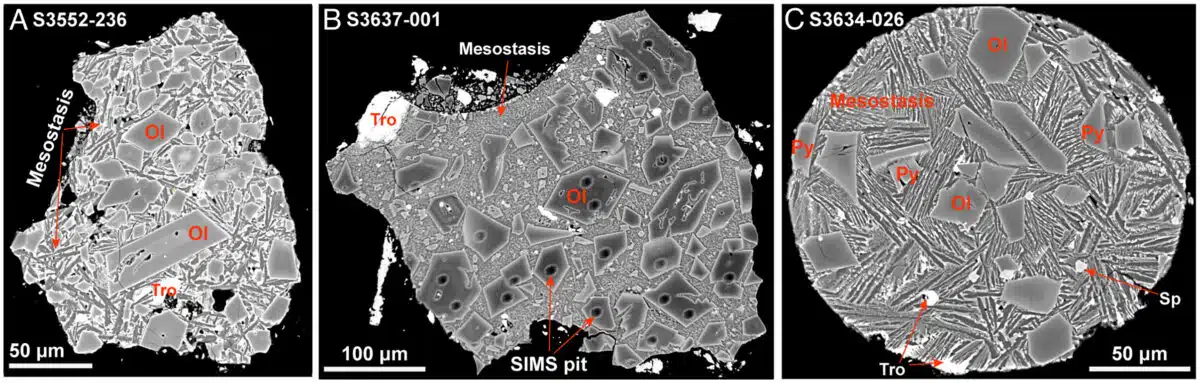 Representative backscattered electron images of the olivine porphyritic clasts in CE-6 lunar samples. (A and B) Clasts S3552-236 and S3637-001 showing a porphyric-olivine texture. The mesostasis of S3552-236 is composed of plagioclase and quenched pyroxene and that of S3637-001 appears as devitrified glass. (C) Spherical clast S3634-026 with a porphyritic olivine–pyroxene texture. Abbreviations: Ol, olivine; Py, pyroxene; Tro, troilite; Sp, spinel.
What makes this discovery, published in Proceedings of the National Academy of Sciences, particularly remarkable is the fragility of CI chondrites. These meteorites are typically soft and porous, and as such, they often break apart or evaporate when traveling through a planet’s atmosphere or during high-speed impacts. The fact that these tiny particles have survived intact on the Moon suggests that ancient asteroids, which were rich in water and carbon, bombarded the Moon and Earth more frequently than previous meteorite collections indicated.
The Role of CI Chondrites in Solar System Evolution
CI chondrites are a special kind of space rock. They are considered chemically primitive, preserving a mixture of elements that resemble the original building blocks of the Solar System. These meteorites are rich in water, carbon, and other volatiles—substances that are crucial for the development of life. The discovery of CI chondrites on the Moon strengthens the hypothesis that asteroids containing such materials contributed to the formation of water on Earth.
Scientists believe that these fragile meteorites could have played a pivotal role in Earth’s early water supply. When they struck the Moon and Earth, they would have deposited water-rich material, potentially influencing the early atmosphere and hydrosphere of both bodies. This connection is vital because it shows that the early Solar System was a more dynamic and interconnected place than previously thought, with asteroids regularly delivering vital materials across different celestial bodies.
As Earth’s closest neighbor, the Moon serves as an ideal archive of the ancient impacts that shaped both our planets. The preservation of CI chondrites in the lunar regolith, especially in the Moon’s far side, provides a time capsule, giving scientists the opportunity to study the early stages of the Solar System and gain new insights into how water, organic compounds, and other essential ingredients for life arrived on Earth.
Impact of the Chang’e-6 Findings on Lunar Studies
The Chang’e-6 mission has expanded our understanding of the Moon in ways that were previously unimaginable. By exploring the far side of the Moon, a region that is largely shielded from Earth-based observation, this mission has opened new frontiers in lunar studies. The Moon’s far side, with its vast craters and ancient rocks, is thought to expose materials that have remained largely unchanged since the formation of the Solar System.
One of the most significant aspects of this discovery is the presence of impact melt textures in the CI chondrite fragments. These textures suggest that the material underwent extreme heat during the impact event, possibly even becoming liquid for a short time before quickly cooling. Such findings are vital because they offer direct evidence of the impact processes that took place in the early Solar System, providing a clearer picture of the conditions that existed when Earth and the Moon were still forming.
By analyzing these meteorite fragments, scientists can now study how asteroids delivered water and other volatiles to planetary bodies, contributing to the habitability of Earth and other planets. This understanding will help inform future space missions, particularly those focused on resource exploration and the search for life on other planets.