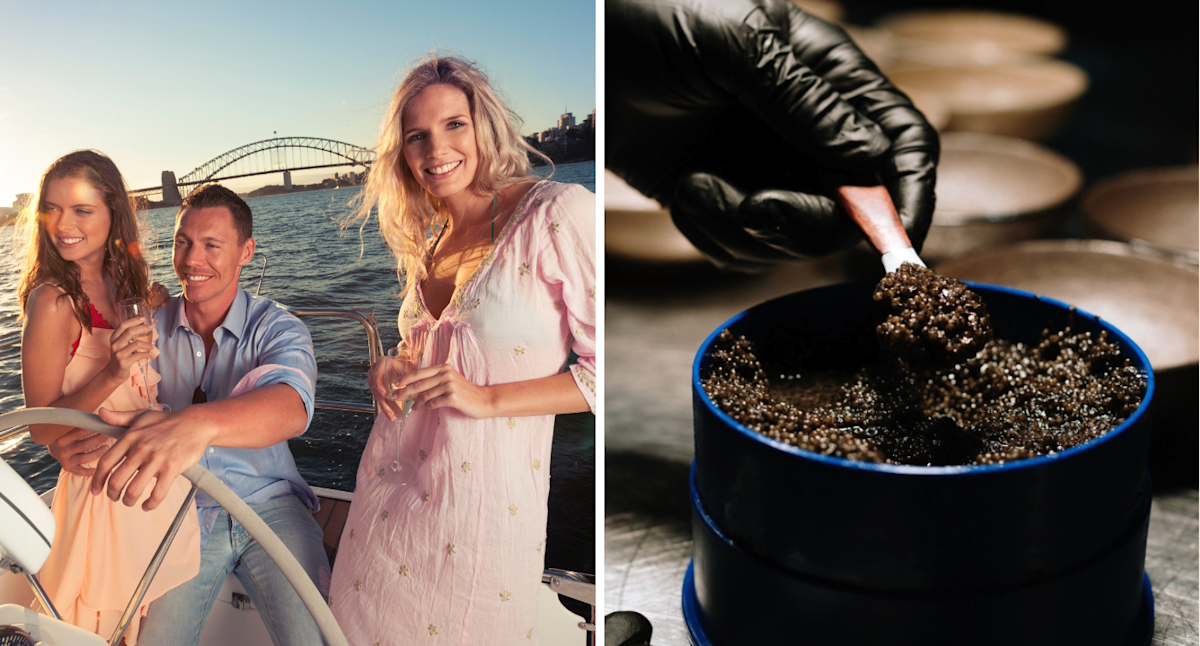
 Wealth gains explain why some Aussies are spending up on caviar. (Source: Getty/Fleur)
Australians have just been through the biggest six months of liquid wealth-building in the nation’s history.
We racked up financial assets like never before between March and September 2025. As the next chart shows, we stacked cash, grew our super, and bought equities like it was going out of style.
No wonder Australia’s consumption is rising. We are loaded. Incomes are rising gently, compared to prices. But financial wealth is booming.
ABS national accounts data shows Aussies have had the biggest six month of liquid wealth gain in history. (Source: Jason Murphy)
“Private domestic demand growth has picked up a little more rapidly than previously forecast …household income and wealth are increasingly supportive of stronger consumption,” said RBA Deputy Governor Andrew Hauser in a November speech.
The latest few measures of household spending have been surprisingly good, and this data might hint at why. Australians are richer than ever.
On a per capita basis, we have added almost $20,000 in financial wealth each in six months.
RELATED
A major part of why? The AI boom (or bubble, if you prefer). Our superannuation put on around $360 billion in the six months from March to September. While the Australian markets have certainly done well in that period, they couldn’t match the nearly 20 per cent gain in the NASDAQ.
Australian superannuation funds have major exposure to US markets these days, simply because our super balances are so great they have outgrown local markets – we have more in super than the market capitalisation of the ASX. So our funds invest in foreign stocks and super balances rise when foreign markets rise. Which we have seen in dramatic fashion over 2025, epitomised by the chipmaker Nvidia emerging to become the globe’s first $5 trillion company.
None of the individual categories in the financial assets category grew at record levels. There have been six-month periods in the past where super balances rose by more. Equivalent periods where we added more cash. And times we built more assets in our stock-trading accounts. But never before have they all accumulated so strongly at the same time.
Cash is, for me, the surprise one. Australians added $60 billion in cash and deposits in the six months from March to September. That’s historically unusual: higher interest rates on deposits are no doubt making cash look like a better option than in the past.
Full disclosure: This analysis is not adjusted for inflation! Part of what we are looking at is that a million dollars just isn’t worth quite as much as it used to be. Nevertheless, the recent growth is outstanding.
Story Continues
As we all know, Australian wealth is largely in housing. We own trillions worth. The analysis so far excludes housing.
The reason? Well, housing is not a liquid asset – it takes time to sell. And what’s more, if you sell it, you still need a place to live – which means buying or renting, usually in the same market you just sold into.
If we do include housing in the analysis, we can see that Australia’s wealth has risen by more in two prior six-month periods, back in 2021.
When you include housing, you can see there was also impressive growth in the current period. (Source: Jason Murphy)
The current period certainly shows impressive growth for the nation’s housing wealth. It’s up by a cheeky $500 billion. That’s half a trillion in additional wealth over the last six months, on top of the $500 billion or so in gains in financial assets. The important thing to be aware of with real estate gains is how geographically uneven that growth has been.
House price gains have been uneven. (Source: Cotality)
Housing prices in Sydney and Melbourne have all but flatlined, as the chart above shows. Meaning the impressive wealth gain we note in the national statistics is mostly found in Perth and Brisbane. If you live in Cottesloe and champagne corks keep flying over your back fence, this is why.
For example, House prices in the Perth suburb of Mandogalup rose 33 per cent to $945,000 over the last 12 months, according to data from Cotality, while Brisbane City saw values rise 25 per cent. By contrast, the inner Melbourne pocket of Princes Hill was the nation’s worst-performing suburb with a fall of 6.3 per cent over the last 12 months.
It is well-known that housing wealth transforms into consumption spending. If you’re starting a business selling Lamborghinis, or opening a new restaurant with a focus on lobster, I’d strongly suggest Brisbane or Perth. Indeed, Perth caviar bar Fleur now sells a five-gram “bump” of caviar for $40. Given what we are seeing in the data, there’s probably space for a competitor charging $50 for the same thing.
Get the latest Yahoo Finance news – follow us on Facebook, LinkedIn and Instagram.