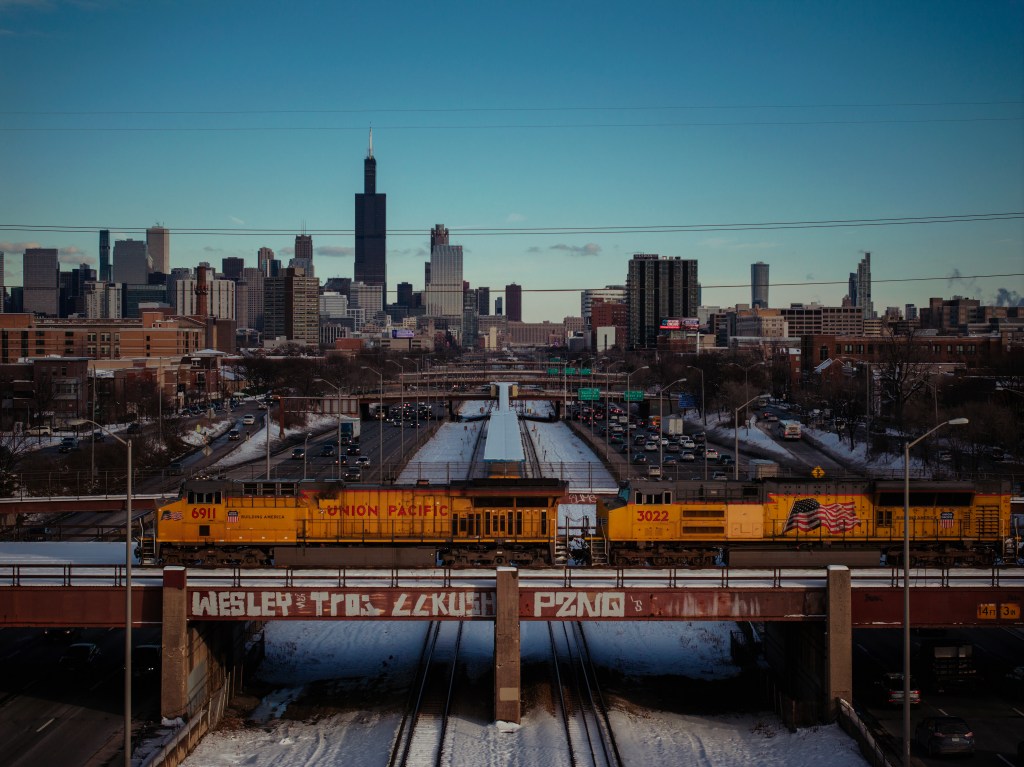
To make money on its proposed cross-country railroad, Union Pacific plans to double the number of trains on a 2-mile stretch of track on Chicago’s West Side where workers still throw switches by hand and trains crawl across century-old bridges at less than 15 miles per hour.
The railroad plans to add 12 trains per day on these dilapidated tracks, which run along Rockwell Avenue through North Lawndale and West Town.
After reaching Lake Street on the north, the additional trains will turn west and run 13 miles to a Union Pacific rail yard in Melrose Park.
They’ll have to thread their way through 58 passenger trains and up to 24 freight trains, which, according to Metra and Chicago Metropolitan Agency for Planning data, are running on these same tracks each weekday now.
Union Pacific outlined these and many similar changes nationwide in a 6,692-page application on Friday for federal approval of its proposed $85 billion merger with Norfolk Southern. If regulators say yes, the investor-owned railroad would carry nearly half of all U.S. rail freight.
The proposed traffic increases, and the additional trucks they’ll pump onto some of the already-congested and polluted streets and highways nearby, are setting off alarm bells in Chicago and surrounding suburbs.
“Adding 12 trains is a lot,” said Earl Wacker, a former CSX executive who now works with RINA North America, an environmental consultancy with offices in Chicago. “It’s going to have a pretty significant impact unless they add more capacity.”
According to the Union Pacific application, four of the additional trains will continue west past Melrose Park through the heart of DuPage and Kane counties. They’ll join the 58 Metra trains and up to 60 freight trains running on those lines each weekday now.
“I’m a capitalist, and I don’t mind people making money. But when the residents have to bear the brunt of the costs, I have a problem with that,” said state Sen. Seth Lewis, R-Bartlett.
“We all know there will be tremendous impacts locally with increased freight traffic and train lengths exceeding a mile long,” he said.
Kristen South, a Union Pacific spokesperson, declined to specify how many trains are currently running on these Chicago and Melrose Park tracks. But “localized impacts will be offset by the benefits of the merger,” she said in an email.
For example, in its application, Union Pacific proposed a series of additional cross-country trains that will either bypass Chicago or run straight through the city without stopping to exchange freight.
These new trains will reduce freight costs for shippers in Chicago and around the country, according to the application. They’ll cut the number of individual shipping containers moved by truck among Chicago’s rail yards by 350 per day, or about 10%.
The application, submitted to the federal Surface Transportation Board, will kick off not just coast-to-coast regulatory debates, but also soul-searching in Chicago about whether the city’s nearly two-century reign as the country’s preeminent freight crossroads will continue.
“There might be a slight diminution of Chicago as sort of the hub of everything,” said Tony Hatch, an independent railroad analyst in New York. “This could affect the number of logistics jobs in Chicagoland. It could also mean less congestion than we expected.”
Currently, 18,000 drivers regularly haul containers among Chicago-area rail yards, according to Jason Hilsenbeck, president of LoadMatch, a Naperville company that helps drivers find freight to haul. Because of a prolonged freight slump, only about two-thirds of these drivers are working full time now, he said.
Chicago emerged as the country’s leading freight hub beginning in 1848. But railroads always found it easier and cheaper to hand their freight off to each other in and around the city than to build transcontinental railroads that actually passed through Chicago.
In some yards, they exchange groups of railcars. Elsewhere, they hand off individual shipping containers, tank cars and boxcars to each other and to different railroads.
Jim Vena, Union Pacific’s chief executive, says railroads must eliminate such inefficiencies, particularly in Chicago, if they’re to have any hope of improving volume, market share and market capitalization, which have been stagnant for years.
“The merger between Union Pacific and Norfolk Southern is more than just a business deal,” Vena said during Friday’s announcement. “It’s a pivotal opportunity to strengthen America’s competitiveness, deliver exceptional service for our customers, enhance the safety of freight transportation and safeguard jobs for America.”
According to Larry Gross, an independent analyst in Denver, container trains captured just 10.9% of truck-size freight shipments longer than 500 miles in the U.S. in the third quarter, down from 12.5% in 2018.
Vena hopes to unclog Chicago in part by bypassing the city entirely.
For example, he’s proposing a new expedited intermodal or container train running from Los Angeles to Croxton, New Jersey, in 95 hours. That’s 17 hours less than the current service, which stops in Chicago to transfer containers across town from Union Pacific to Norfolk Southern by truck.
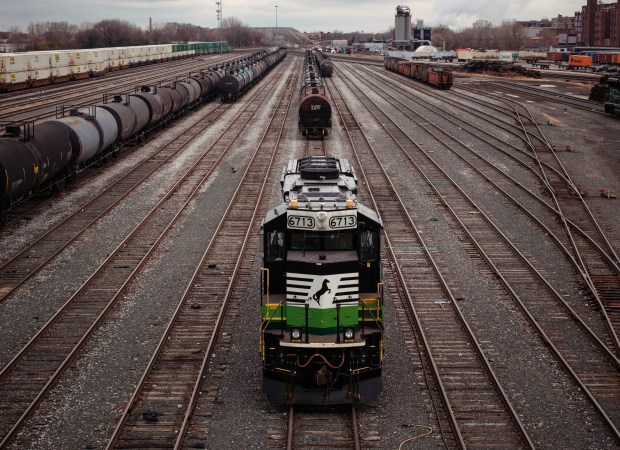 A Nortfolk Southern freight engine waits to connect with a train at the Norfolk Southern Ashland Yard, where segments of freight trains are exchanged between rail companies on Nov. 25, 2025. Chicago remains the center of the nation’s rail traffic. (E. Jason Wambsgans/Chicago Tribune)
Using tracks newly acquired from Norfolk Southern, the train would run through Kansas City and Springfield to reach Fort Wayne, Indiana, according to the application. But it won’t come close to Chicago.
Union Pacific is also proposing a series of expedited intermodal and boxcar-type trains that stop in Chicago only for crew changes, but not to swap freight.
For example, the railroad is proposing a new train to run from Lathrop, California, to Croxton in 83 hours. The train would stop in the Chicago suburb of Northlake only long enough to receive its new crew. In the application, Union Pacific says that’s 30 hours less than the same trip by truck. But the railroad counts only transit time between its own terminals, and not the additional time needed for local delivery of the freight.
But the stop will require split-second timing that has often eluded Union Pacific. Currently, only 70% to 95% of Northlake’s trains leave the yard on time, according to the application.
Continued delays could spell trouble for the 2-mile-long Lathrop-to-Croxton train. That’s because, when the train leaves Northlake, it will have to share track space with the dozens of daily Metra and freight trains already running through Melrose Park, and with pedestrians who sometimes seek shortcuts across the tracks.
Union Pacific is now in federal court battling the Surface Transportation Board over how much access to these tracks should cost. The railroad insists it’s not obligated to allow Metra to use the tracks at all after prior contracts expired. The STB ordered the railroad to do so anyway in September, saying it was protecting the public interest.
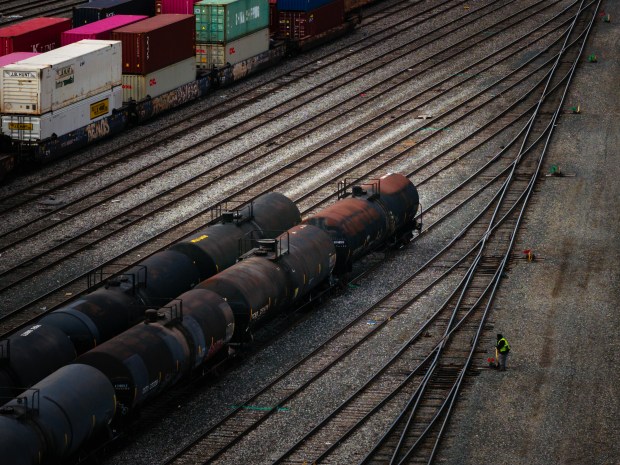 A switchman manually switches a track at the Norfolk Southern Ashland Yard in Chicago’s New City neighborhood on Nov. 27, 2025. (E. Jason Wambsgans/Chicago Tribune)
And when some of the trains running through Melrose Park turn south near Rockwell Avenue in Chicago, they’ll encounter the hand switches and century-old bridges that Union Pacific and other railroads and public agencies have been planning to replace since 2003.
The railroads and government officials will break ground on a $170 million project to refurbish some but not all of these West Side tracks next year, according to a spokesman for CREATE. This is an acronym for the Chicago Region Environmental and Transportation Efficiency Program, a public-private partnership.
Some of these CREATE improvements will occur in Chicago’s 25th Ward, which Ald. Byron Sigcho-Lopez represents. He said he agrees that Chicago needs to upgrade its rail infrastructure. But some of his constituents, he said, worry about safety hazards, including a 2023 Norfolk Southern derailment in Ohio that spilled 11 cars of hazardous chemicals, including a cancer-causing chemical called vinyl chloride.
Since 2003, CREATE has raised less than half of the $5.8 billion it needs from railroad and government sources to complete its original project list.
On Friday, Union Pacific announced $2.1 billion in additional infrastructure improvements to facilitate the merger nationwide. But the railroad’s application did not specify any new investment for Chicago.
Under STB rules, Union Pacific will need to show that the merger would not just preserve competition but also enhance it, and produce public benefits that can’t be achieved any other way.
The board adopted this higher standard after a chaotic set of mergers in the 1990s not only disrupted train service but also reduced the number of big railroads operating in the U.S to four, increasing the potential for monopoly pricing abuse.
In 1960, three dozen so-called Class One or major railroads operated in the U.S.
As part of its mandate, the STB will also have to consider whether, as many independent analysts expect, a Union Pacific tie-up with Norfolk Southern would force the country’s two remaining big railroads, BNSF and CSX, to merge with each other or one of the two big railroads remaining in Canada.
Friday’s Union Pacific application could trigger not only the STB evaluation but also negotiations between Union Pacific and affected communities and industries.
Based on the outcome of those negotiations, the STB could place limits on route changes or price increases at the combined railroad. The board could also limit how many trains the combined railroad could run and how long each train would be.
But on Friday, Union Pacific said the merger would yield substantial public benefits so concessions won’t be necessary.
The railroad withdrew its prior commitment to spend $750 million for concessions to soften the merger’s impact on shippers and others. Union Pacific also excluded intermodal freight, its fastest-growing business, from its pledge to keep prices flat for competitors who need to continue using its tracks after the merger.
These steps angered some customers. The American Chemistry Council, which includes some of the country’s largest rail shippers, warned Friday it will fight any merger “that fails to promote competition over monopolies and drives prices even higher.”
Like everybody else in the railroad industry, Rick Paterson, an independent railroad analyst in New York, is trying to predict how the STB will react to Union Pacific’s hard line on concessions to shippers and others to enhance competition.
“If you’re a board member, you might say to yourself, ‘They’re not even trying and it’s a middle finger,’” Paterson said. “Or you might say, ‘The enhanced competition test was always vague and unsatisfiable as written. So I don’t blame them for not trying to satisfy an unsatisfiable test, and we’ll just go forward and evaluate what they’ve proposed based on its own merits.’”
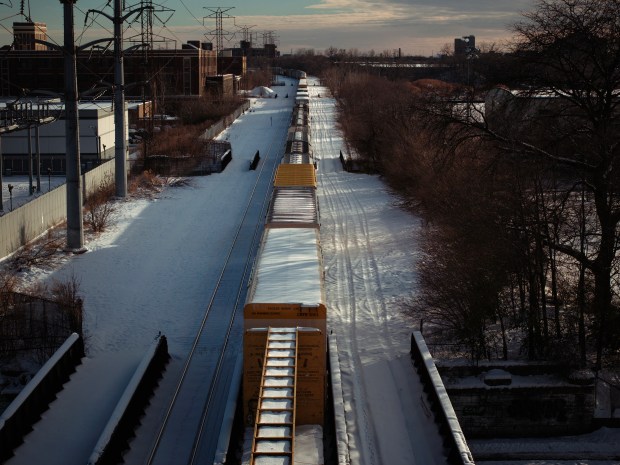 A Union Pacific train moves north through the Garfield Park neighborhood on Dec. 8, 2025. (E. Jason Wambsgans/Chicago Tribune)
Paterson and others will begin to find out by Dec. 18, 2026, when the STB is required by law to either accept the application as complete, ask for modifications or reject it entirely. If the STB decides to move forward, its review could last 18 months or more.
Even if the STB says yes in the end, the two railroads would likely act primarily as separate units at first, as they give Norfolk Southern workers time to adapt to Union Pacific’s operating methods, said Brian Watt, managing partner at 1634 Co., a freight forwarder based in Winter Haven, Florida.
“Chicago looms large in the merger discussion not because it’s uniquely dysfunctional, but because it reveals the system’s design limits. It’s where handoffs accumulate, delays compound, and labor, terminal, and dispatch complexities intersect,” he said in an email.
“Chicago is not the disease. It’s the diagnostic,” Watt said. “If the railroad rushes to demonstrate theoretical synergies rather than operational discipline, Chicago will expose the mistake quickly and publicly.”
John Lippert is a freelancer.