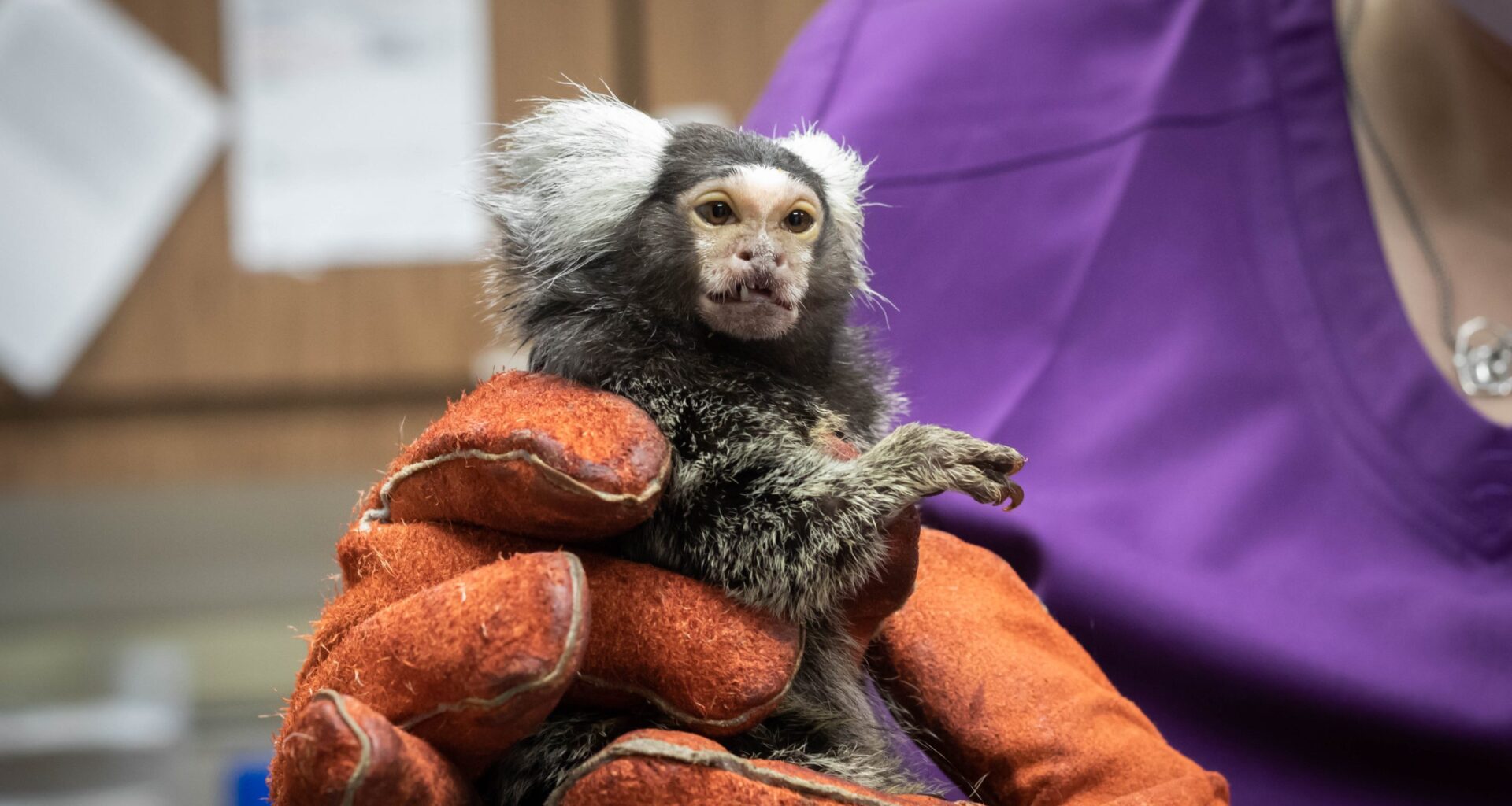
San Antonio is home to one of the nation’s largest colonies of marmosets, squirrel-sized monkeys native to Brazil that love mini marshmallows.
Roughly 450 of these miniature monkeys reside at Texas Biomedical Research Institute’s Southwest National Primate Research Center.
Scientists at Texas Biomed and from around the world utilize marmosets to gain insights around human aging, reproductive health, cognitive decline and Alzheimer’s plus chronic conditions like diabetes, as well as infectious diseases.
Since aspects of their biology, brains and aging processes are similar to humans’, marmosets are especially important for research on aging, longevity and extending health span.
Research into longevity and health span, or the number of years someone lives in relatively good health, has boomed in recent years.
Studying marmosets
Corinna Ross, the director of Texas Biomed’s primate center, isn’t shy about her love for monkeys.
Her office is adorned with mementos, knickknacks, artwork, stuffed animals and printed monkey memes above her desk. She prefaces her answers to questions with a warning: “Stop me, because I get kind of excited.”
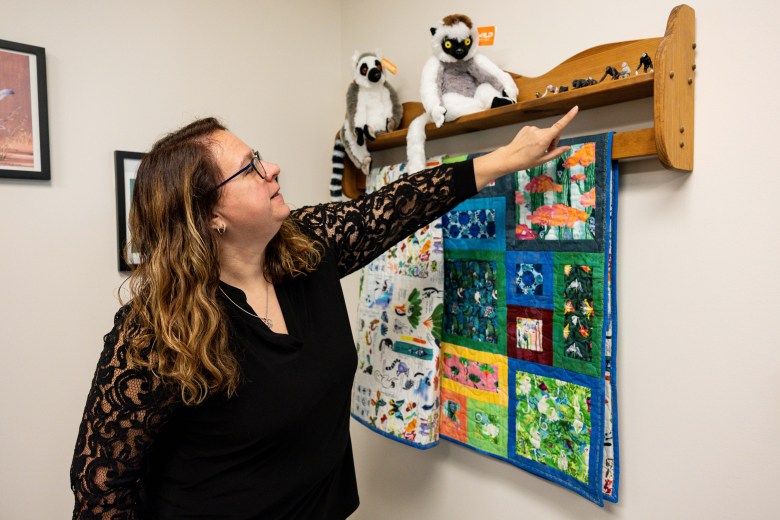 Director of the Southwest National Primate Research Center Dr. Corrina Ross points to a set of miniature primate figurines atop a shelf in her office at the Texas Biomedical Research Institute. Credit: Amber Esparza / San Antonio Report
The San Antonio Report wasn’t able to visit the marmosets in person, due to tight safety restrictions.
Visitors to the colony, where marmoset families live in wired enclosures, must be in full personal protective equipment and need to be tested for measles and tuberculosis, since one such infection can wipe out an entire colony.
Ross has been with the primate center since 2006 and was appointed its director in 2022. In addition to overseeing the daily operations of the primate center, which houses roughly 3,000 monkeys of a variety of species, she’s a researcher herself who studies animal health and function and its implications for human health and aging.
Currently, her research is focused on the microbiome, the community of tiny microbes and other microscopic creatures that live in human bodies. Researchers have in recent years uncovered a myriad of impacts these organisms have on health and disease, from type 2 diabetes to neurological disorders.
“Can we alter and enhance the health of the microbiome, and does that help our aging outcomes?” Ross said.
Marmosets are great candidates for research on aging for a few reasons.
They’re small, easy to handle and thus don’t need to be sedated for treatment, like larger primates. They’re afflicted by many of the same diseases that often come with human aging, like cognitive decline, cardiovascular disease and diabetes. And their family structure, social cognition, communication, hormones and brain architecture are remarkably similar to ours.
And “they get chunky like we do,” Ross says with a laugh, adding that they love sweets, especially mini marshmallows sometimes used in research.
Amid the ongoing debate over the ethics of animal testing, Ross said that Texas Biomed is using “new approach methodologies” that seek to minimize the harm to primates in research. That includes using non-animal methods whenever possible, reducing the number of animals used in testing, and enriching the living conditions, ensuring better handling and pain relief for the animals.
“We’ve done this for a long time,” Ross said. “It just has the new name.”
Alternative approaches to animal testing, like organs-on-chips, organoids and artificial intelligence, are advancing and could further reduce the need for live animal subjects.
When explaining the rationale for animal testing in a San Antonio Report panel in 2023, Texas Biomed President Dr. Larry Schlesinger said while the research nonprofit wants to be a leader on testing alternatives, “they’re not prime time.”
“… What’s key is that you spend every day on the health and wellbeing of those animals,” Schlesinger added. “We have 150 incredibly dedicated personnel who work every day to ensure those animals are safe, that they’re not in pain. We have the resources and infrastructure to do that well.”
Researchers have made a number of significant findings with the help of the marmosets since the species arrived at Texas Biomed in 2002. In 2013, researchers found that baby marmosets that started eating solid food earlier than other infants were more likely to be obese at age 1, equivalent in age to a human teenager.
That finding has influenced recommendations for parents to avoid early supplementation of solid foods for babies, like adding cereal to baby formula, a common practice that has been linked to childhood obesity and type 2 diabetes.
Research on the marmosets has been instrumental in moving forward the research into a vaccine against Zika virus, a mosquito-borne disease found mostly in subtropical parts of the world, including the Caribbean, Latin and South America, Africa and parts of Asia.
And because marmosets are reproductively similar to humans, they have been utilized for research on in vitro fertilization, contraceptives and pregnancy.
Longevity drugs and neuroscience
Marmosets aren’t the brightest monkeys, especially compared to other primates that can perform more complicated cognitive tests, like chimpanzees, orangutans and rhesus macaque monkeys, to name a few.
“We joke — we say [marmosets are] very smooth-brained,” Ross said.
Still, because they share so many of the same core features of human brain pathways and complex social and cognitive behaviors, researchers see them as critical test subjects for the field of neuroscience research.
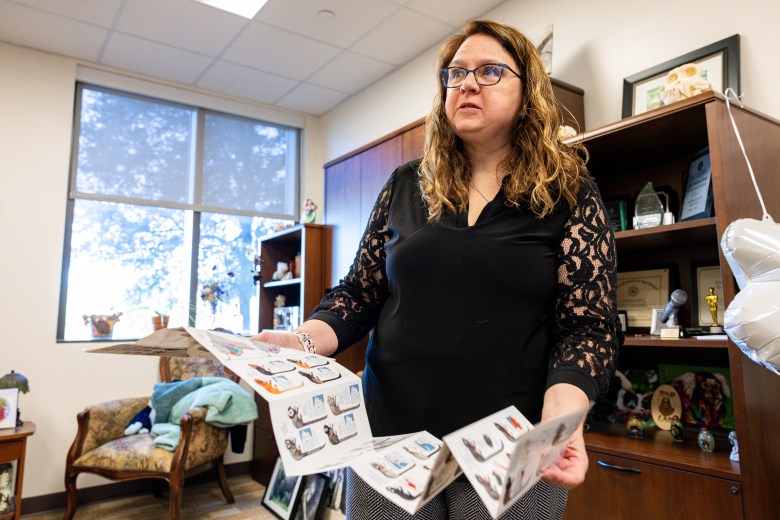 Dr. Corrina Ross talks about her admiration for primate artist Stephen Nash, illustrator of the marmosets and tamarins pocket guide she holds and keeps in her office at the Texas Biomedical Research Institute. Credit: Amber Esparza / San Antonio Report
One way researchers gauge cognitive decline in the marmosets involves a conveyor belt that sits just outside of their cage, where mini marshmallows cruise along at varying speeds for the monkeys to grab.
Every now and then an apple slice, which the monkeys aren’t huge fans of, will pass by.
“They don’t like apple, so if you put two treats in a row, they have to wait and let the apple go by to get the preferred treat,” Ross said. “Animals that have cognitive decline, aging or Alzheimer’s-like symptoms, they can’t impulse control, so they’ll get the apple, they’re not super happy about getting the apple, and they’ll miss the higher-end reward.”
Drugs researchers think could have anti-aging, lifespan-extending potential have been tested on the monkeys, like rapamycin, metformin and semaglutide (better known under the brand name Ozempic).
“Rapamycin is not the wonder drug we were hoping for,” Ross said. “It doesn’t just keep you young forever, but it does protect cognitive function, and we’re still working through the data on motor function and ambulatory function. But rapamycin looks like it didn’t cause harm, so that was the big thing.”
UT San Antonio’s Sam and Ann Barshop Institute for Longevity and Aging Studies works closely with Texas Biomed and the marmoset colony. The school also has its own small colony of about 40-50 marmosets.
Conservation plan
Texas Biomed is engaged in a national effort known as the Marmoset Coordinating Center, which seeks to connect small marmoset colonies into a larger networks to spur collaboration and information-sharing on best practices and exchanging monkeys to prevent inbreeding in smaller colonies.
Texas Biomed’s colony has grown from 60 in 2002 to between 450 and 500 monkeys today. The primate center is heavily funded by the National Institutes of Health.
Ross said San Antonio’s colony helps support conservation efforts in the wild in addition to the human research they contribute to.
Marmosets don’t tend to live very long, on average about six years in colonies, higher than the around four to five years they live in the wild: “Everything eats them,” Ross said.
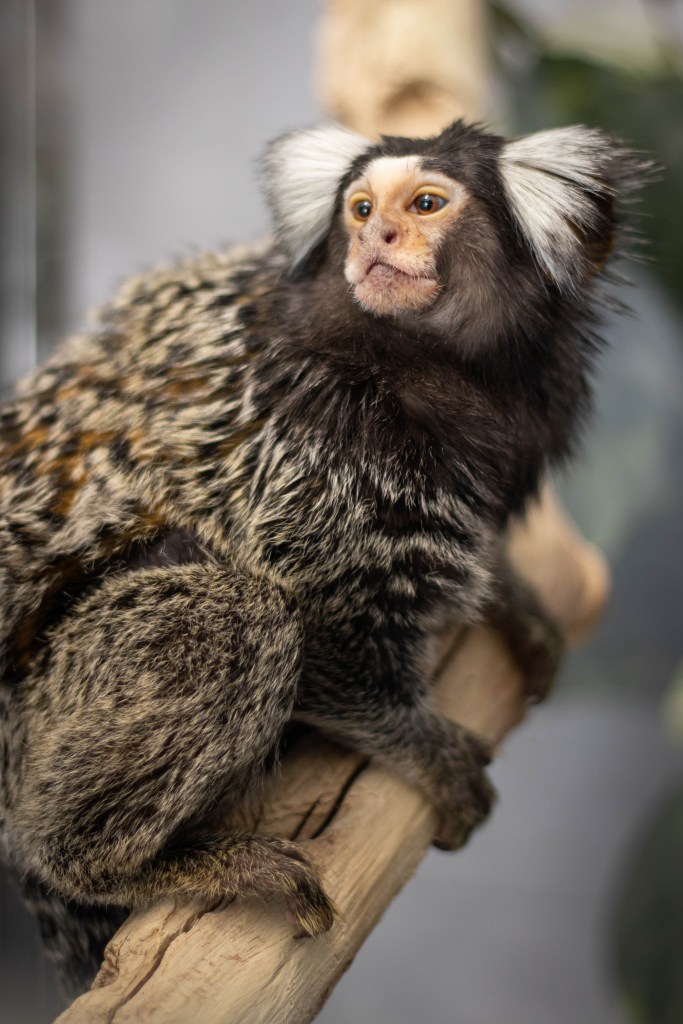 One of Texas Biomedical Research Institute’s adult marmosets. Credit: Courtesy / Texas Biomedical Research Institute
The marmosets at Texas Biomed are common marmosets, one of 22 species of the tiny monkeys. They’re highly adaptable and thus not endangered. But some of their cousins are not as lucky.
The golden lion tamarin, for example, is highly endangered. The species almost went extinct in the ‘70s and ‘80s, and then again in the mid-2010s when an outbreak of yellow fever wiped out a third of the population. Researchers in Brazil were able to vaccinate the monkeys, the first time a vaccine had been administered to save an animal species.
Ross said that the primate center collaborates with biologists and others working to preserve these populations.
“What we’d like to do is both link what we see about how the animals act and move in the wild to what we see with them here,” Ross said. “We think about them from our biomedical model, and then have it go back to the field. We provide tools and techniques for researchers working in conservation to be able to assess animal health if they’re aging and maybe need veterinary help and assistance. Those things can go back and forth. We’re not siloed.”