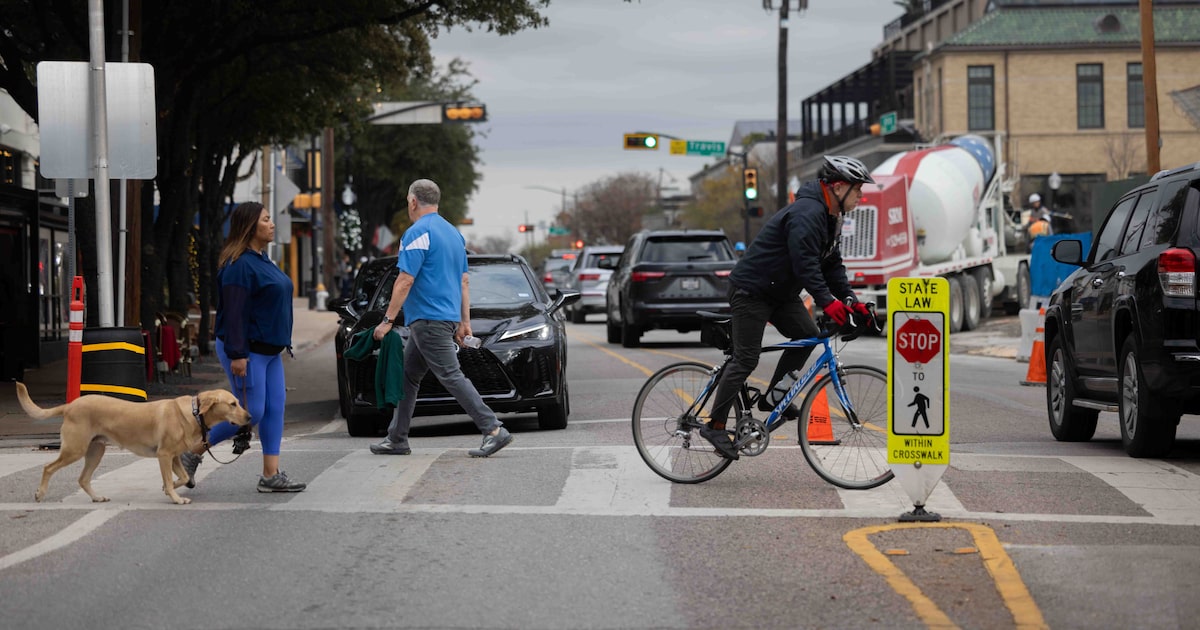
A Dallas City Council work group has rated the city as one of the “most dangerous” metropolitan areas in Texas for pedestrian fatalities and severe injuries, based on findings from prior years’ crash reports.
Despite the large rate of pedestrian-involved deaths in Dallas since 2023, the number has stayed the same and appears to be decreasing.
In February, the work group released a report describing Dallas as the “most dangerous large city in Texas for pedestrian fatalities and severe injuries,” based on numbers from 2023 and 2024.
Council members formed the Street Design Manual Work group in 2023 to evaluate city policies and suggest changes that promote safe transportation, align with the bike plan, and reduce traffic-related deaths using Vision Zero and its Comprehensive Environmental and Climate Action Plan.
Breaking News
In 2023, there were 71 fatal crashes involving pedestrians and 198 crashes resulting in severe pedestrian injuries in Dallas, according to the report and Vision Zero.
In 2024, there were also 71 fatal crashes involving pedestrians, but only 162 severe pedestrian injury crashes in Dallas, according to Vision Zero.
On a per capita basis, Dallas residents were killed or seriously injured at a 57% higher rate than in Austin, El Paso, Fort Worth, Houston and San Antonio residents in 2023, according to the report.
But, through November 2025, Vision Zero states Dallas has had only 38 fatal pedestrian crashes and 108 crashes resulting in severe pedestrian injuries.
When the group released the report this February, they found that speed limits, lane widths, the city not prioritizing safety above factors like cost and traffic flow, and hazardous sidewalk closures during construction were a few causes hurting street safety in Dallas.
Some of the recommendations made by the group to decrease traffic fatalities included:
- Foster a city culture that prioritizes safety and adherence to policies by developing accountability measures to incentivize a safety culture and employ disciplinary procedures for willful policy violations.
- Align design speeds with speed limits of 25 mph in congested areas and 30 to 35 mph elsewhere.
- Limit lane widths to 10 feet for most streets, with 11 feet for outer lanes of multi-lane roads with heavy bus or truck traffic. Consider 9-foot lane widths for most urban settings, with exceptions for heavy bus or truck traffic or as needed to accommodate mass transportation options.
- Improve signage and street markings in high pedestrian and multi-modal areas to emphasize safety.
- Avoid placing unnecessary obstacles on sidewalks by ensuring sidewalk impediments like poles, fire hydrants, benches or trash cans are thoughtfully placed to minimize obstructions.
- Maintaining safe pedestrian access through construction sites by requiring sites to provide protective scaffolding, canopies and debris chutes.
The City will continue these efforts and will continue to review the panel’s findings to incorporate additional strategies, as appropriate.
Since summer 2025, The News has reported on more than 10 pedestrian-involved fatal accidents.
Many of the victims happened to be walking at night, like 23-year-old Seth Rains, who was hit and killed on July 27.
Rains was leaving a concert in the Dallas Design District when he was hit around 2:40 a.m. at Turtle Creek Boulevard and Market Center Boulevard.
In September, 29-year-old Dallas Comedian Henry Cruz was fatally hit in downtown.
Only a few weeks later, another pedestrian was killed when they were hit by a truck a driver lost control of the in the 5200 block of Harry Hines Boulevard. And this November, 23-year-old Aya Knox died after she was hit and pinned under a car in downtown. Firefighters had used extrication tools and airbags to lift the car off the woman.
The Dallas Department of Transportation and Public Works said in a statement to The Dallas Morning News that the city is continuing to review the work group’s findings and exploring how to best incorporate additional pedestrian safety strategies in Dallas.
“Partnerships with other city departments have led to progressive improvements such as increased enforcement actions, more outreach, and more consistent compliance applicable with city manuals, which align well with the panel’s findings,” the city said in the statement.
The city has also prioritized traffic safety through the City’s Vision Zero initiative.
The city adopted the Vision Zero Action Plan in 2022 as a way to decrease traffic deaths and serious traffic crashes in Dallas by 2030. The plan included various methods to boost traffic safety, but concentrated on pedestrian deaths.
Since the plan’s creation, city staff previously told The Dallas Morning News the city has completed or nearly completed several transportation studies identifying the 7% of streets that account for 62% of the city’s severe traffic crashes.
The city also said it has worked with TxDOT to add new traffic signals along Loop 12 to provide safer opportunities for pedestrians to cross the roadway. This area has seen the largest number of serious and fatal pedestrian crashes in Dallas, according to TxDOT crash data.