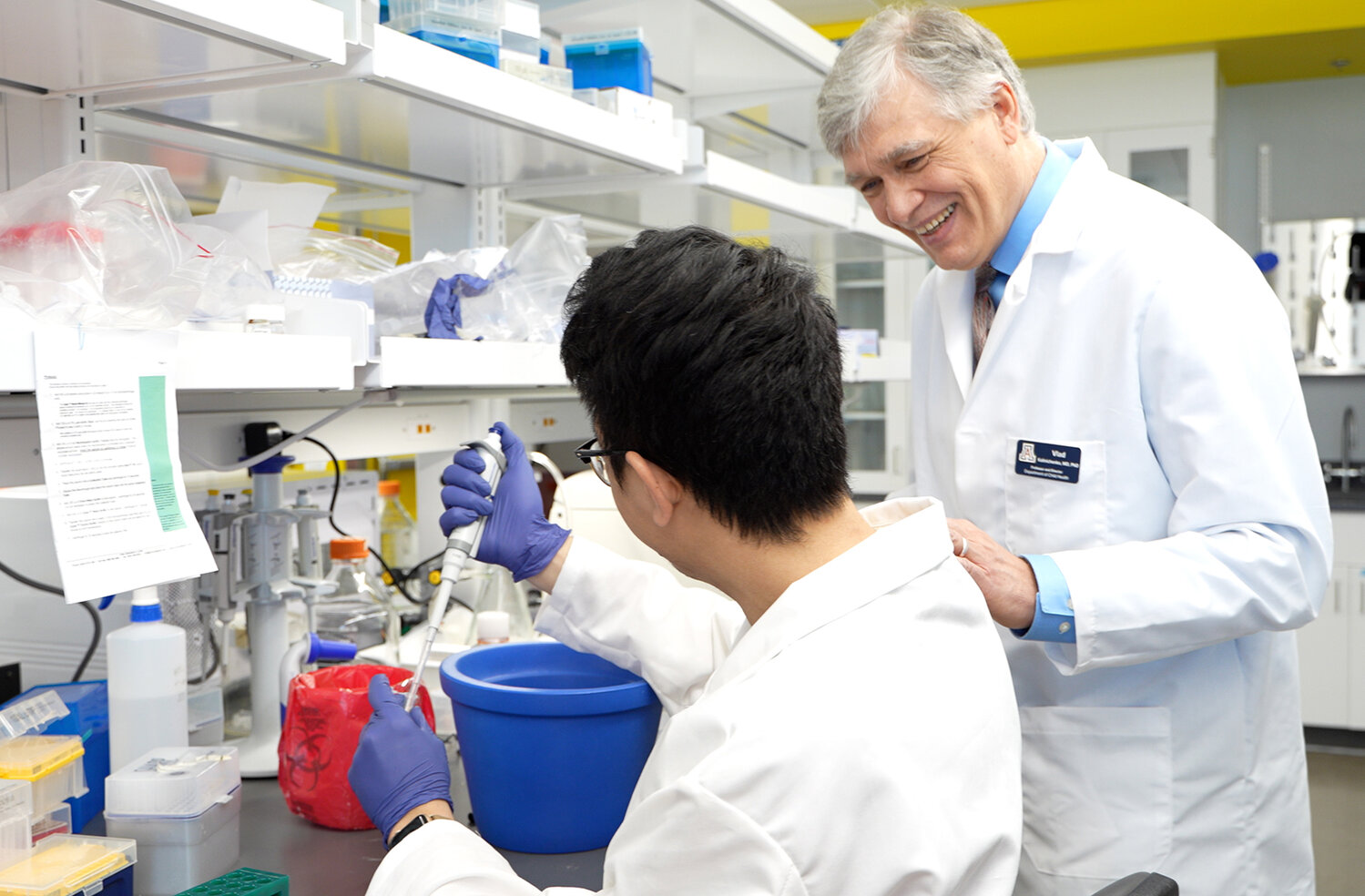
Phoenix Children’s Research Institute at the University of Arizona College of Medicine-Phoenix recently announced it has secured three grants from the National Institutes of Health that totaled nearly $9 million.
The grants, known as R01 grants and considered the most competitive federal research awards available, puts Phoenix Children’s on the same level as places such as Boston Children’s, Children’s Hospital of Philadelphia, and Cincinnati Children’s, local officials said in a release. About 20% of those who apply for these grants get funded.
“An R01 is an investigator-initiated research grant and one of the most prestigious and competitive grants offered by the National Institutes of Health,” said Dr. Vlad Kalinichenko, director of Phoenix Children’s Research Institute at the University of Arizona College of Medicine-Phoenix. “These are usually multi-year grants, funded in one-year installments.
“The grants are reviewed by panels of experts from medical centers and universities across the United States and are scored based on innovation, the significance of the research, the institution from which the grant is submitted and the expertise of the research team,” Kalinichenko added.
Kalinichenko received $6 million dollars for two projects focused on severe pediatric lung diseases. His team has developed nanoparticles that deliver medicine directly to lung cells, reducing damage to other organs.
Potential applications for this treatment extend to asthma, cystic fibrosis and lung cancer treatment.
“It usually takes many years to put together a competitive R01 proposal because extensive preliminary data are needed to demonstrate the promise, novelty and feasibility of the research,” Kalinichenko said. “In general, these are hard grants to obtain.”
In the release, another grant went to Dr. Matthew Halanski to advance research on spinal growth and refine a surgery technique called Vertebral Body Tethering. Unlike traditional spinal fusion, this less-invasive approach uses a flexible cord that allows children’s spines to continue growing and moving as they develop — offering faster recoveries and better quality of life.
Phoenix Children’s has invested heavily in the past decade in research infrastructure. The health care facility is now consistently landing major federal grants and recruiting nationally recognized researchers.
“Because this is a multiyear grant, it represents a significant commitment, not only to the research team but also the institution,” Kalinichenko said. “With this funding, we’re able to maintain stable research teams for the full duration of the projects. This long-term commitment from NIH allows the research to progress in meaningful ways over time, leading to significant advances and ultimately improvements in patient care.”
The impact to families is that they can now stay in the Valley for specialized care instead of traveling to out-of-state hospitals for treatment. It also means more medical talent can stay in Arizona instead of going to other hospitals, and Arizona children are more able to benefit through clinical trials and early adoption of new treatments.
“The key factor is the merit of the research proposal to significantly advance the research field and show a clear application for the future, particularly in terms of progress toward clinical use to improve patient care,” Kalinichenko said. “It usually takes many years to put together a competitive R01 proposal because extensive preliminary data are needed to demonstrate the promise, novelty and feasibility of the research. In general, these are hard grants to obtain.”
Phoenix Children’s Research Institute is affiliated with the UofA College of Medicine-Phoenix. Students and residents training at the site get exposure to cutting-edge research, making them more likely to practice in Arizona long-term. This addresses the ongoing physician shortage, especially in pediatric subspecialties.
“In many institutions, having one or more R01 grants is considered important recognition of Established Investigators, meaning the research labs are well known, well regarded nationally and internationally and capable of generating significant advances in research fields,” Kalinichenko said.

Jeff Wendt
Reporter | Phoenix/Cave Creek
Meet Jeff
Jeff Wendt started at Independent Newsmedia in January 2023, after 25 years working for Gannett and The Arizona Republic. Started as a high school sports scoretaker, worked up to reporting high school sports and then became an associate high school sports editor in 2002. Also worked in the Design Studio as a copy editor.
Community: Jeff serves on the Board of Elders at his local church.
Education: Arizona State University with a Bachelor’s Degree in Journalism and Mass Communication
Random fact: Attended Game 2 of the 2001 World Series.
Hobbies: Playing video games (yes still the kid in me), watching reality TV, playing poker.
Keywords
Phoenix Children’s Research Institute,
University of Arizona College of Medicine-Phoenix,
R01 Grants,
National Institutes of Health,
Dr. Vlad Kalinichenko,
Dr. Matthew Halanski,