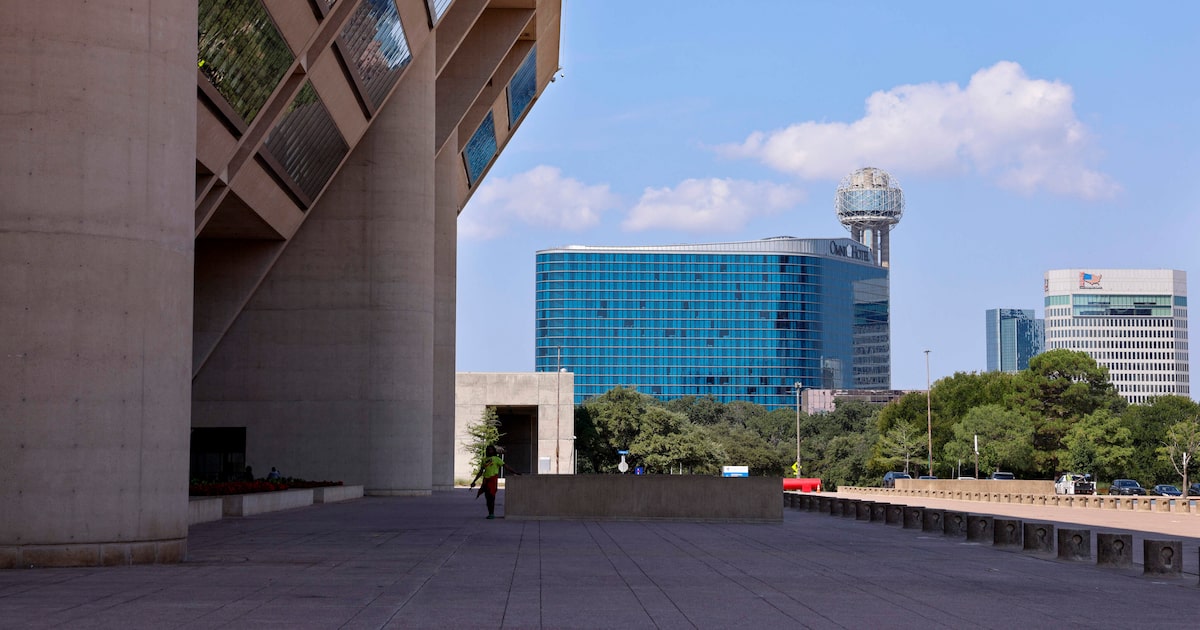
A group of prominent Dallas architects says downtown Dallas’ revitalization does not have to come at the expense of the iconic building at 1500 Marilla St.
Ten past presidents of The American Institute of Architects at various levels identified three empty or underutilized sites in the southern half of downtown Dallas that could prevent the I.M. Pei-designed City Hall building from being torn down for a new sports and entertainment district to cater to the NBA’s Dallas Mavericks.
The three locations include the Hunt Realty-owned former Reunion arena site and the vacant parking lots behind City Hall owned by developer Mike Hoque. The third, and the largest site among the three, included over 30 acres of land that will be available after the new Kay Bailey Hutchison Convention Center is demolished and reconstructed. The redevelopment is also expected to bolster major public transit connections by way of the Dallas Area Rapid Transit and what could be a new high-speed rail hub in the Cedars.
“There are other sites that merit consideration across Riverfront Boulevard and outside the downtown freeway loop,” the 10 presidents said in their study, but for now they have stuck to the central business district.
Political Points
Dallas officials are currently in the midst of assessing whether the aging City Hall needs renovation or replacement. Mavericks CEO Rick Welts told The News the basketball team is looking for a 30- to 50-acre site in Dallas’ urban core, and city officials have previously expressed an interest in keeping the team downtown to prevent the urban core from slipping into decay. Notable developers like Lucy Billingsley and Craig Hall have thrown their support behind moving City Hall as have former Mayors Tom Leppert and Ron Kirk.
However, architects and preservationists have pushed back, pointing at land that is waiting to be activated and could potentially house a massive mixed-use development. In their report, the experts compared the construction around Staples Arena in Los Angeles, the ball park village in St. Louis, Mo., as well as the Power and Light district in Kansas City, Mo. Each of these properties use between 20 acres to 22 acres, indicating the amount of land that’s been historically needed to build a stadium and surrounding entertainment district.
Hoque, one of the owners of the areas identified, is also steering a redevelopment of the Bank of America Plaza. He had plans to build apartments, a hotel tower and a business complex in the underutilized parking lots behind City Hall between Canton and Cadiz streets. He received a $96 million incentive package from the city and purchased a city-owned building last year, but construction has not begun.
Last year, Hoque also purchased the city-owned building at 711 S. St. Paul St., which once held a homelessness services provider and was demolished after being marred by neglect and vandalism.
Arthur Santa-Maria, vice president of Hoque Global, said the firm welcomed the possibility of using his property for the arena.
The development of an entertainment district complements the company’s own Newpark development, which was “always envisioned as a technology and education hub.”
“We think that there is great opportunity for the groups that are looking to make moves or invest in downtown,” he said, adding the company advocates for more resources in the southern half of the urban core.
These efforts also include other entities such as the Texas Department for Transportation, which is reshaping what the I-30 canyon would look like, as well as the city’s bid to spur revitalization through the convention center redevelopment.
“What other major cities across the U.S. do you have this much land/continuous land or a whole new revitalization?” Santa-Maria asked. “The opportunity is tremendous. We are champions of that.”
The Hunt-Realty owned Reunion Arena was part of a proposal reported by The Dallas Morning News in March, which sought to move the convention center development west onto a city-owned parking lot and part of Hunt’s planned $5 billion redevelopment project for the Reunion area.
Last month, city officials tapped the Economic Development Corporation to put together a team of engineers, architects, real estate brokers and other experts to evaluate the 47-year-old building’s structural condition, repair costs and potential relocation options. The group will present its findings to the city manager by Jan. 19 and to the City Council’s finance committee on Feb. 23.
A staff assessment prior to that showed keeping City Hall would cost the city between $343 million and $595 million over 10 years. These estimates included costs for security, operations, maintenance, repair costs and bond debt.
The structure at 1500 Marilla St. was part of Dallas’ rebranding and self-introspection, an ambitious attempt to move away from the moniker of “city of hate” that grew stronger after President John F. Kennedy’s assassination on Elm Street.
Earlier this year, The News reported discussions about the building’s future had picked up steam amid rising maintenance needs, and these talks coincide with efforts by city officials to retain the NBA’s Dallas Mavericks, which share a home with NHL’s Dallas Stars at the American Airlines Center.
City Hall debate
The stakes: Some Dallas officials and developers argue the Dallas City Hall building limits major redevelopment in southern downtown.
Architects’ response: A group of prominent Dallas architects says the building should remain, and that large, underused sites nearby can support major projects without moving the civic complex.
Where: The sites they point to:
- Former Reunion Arena area: About 23 acres.
- Near the Kay Bailey Hutchison Convention Center: Over 30 acres, expected to open during the center’s reconstruction.
- Parking lots behind City Hall owned by developer Mike Hoque: About 16 acres.
What’s next: The analysis sharpens a growing debate over whether the council should renovate or replace City Hall, or instead focus development on surrounding land.