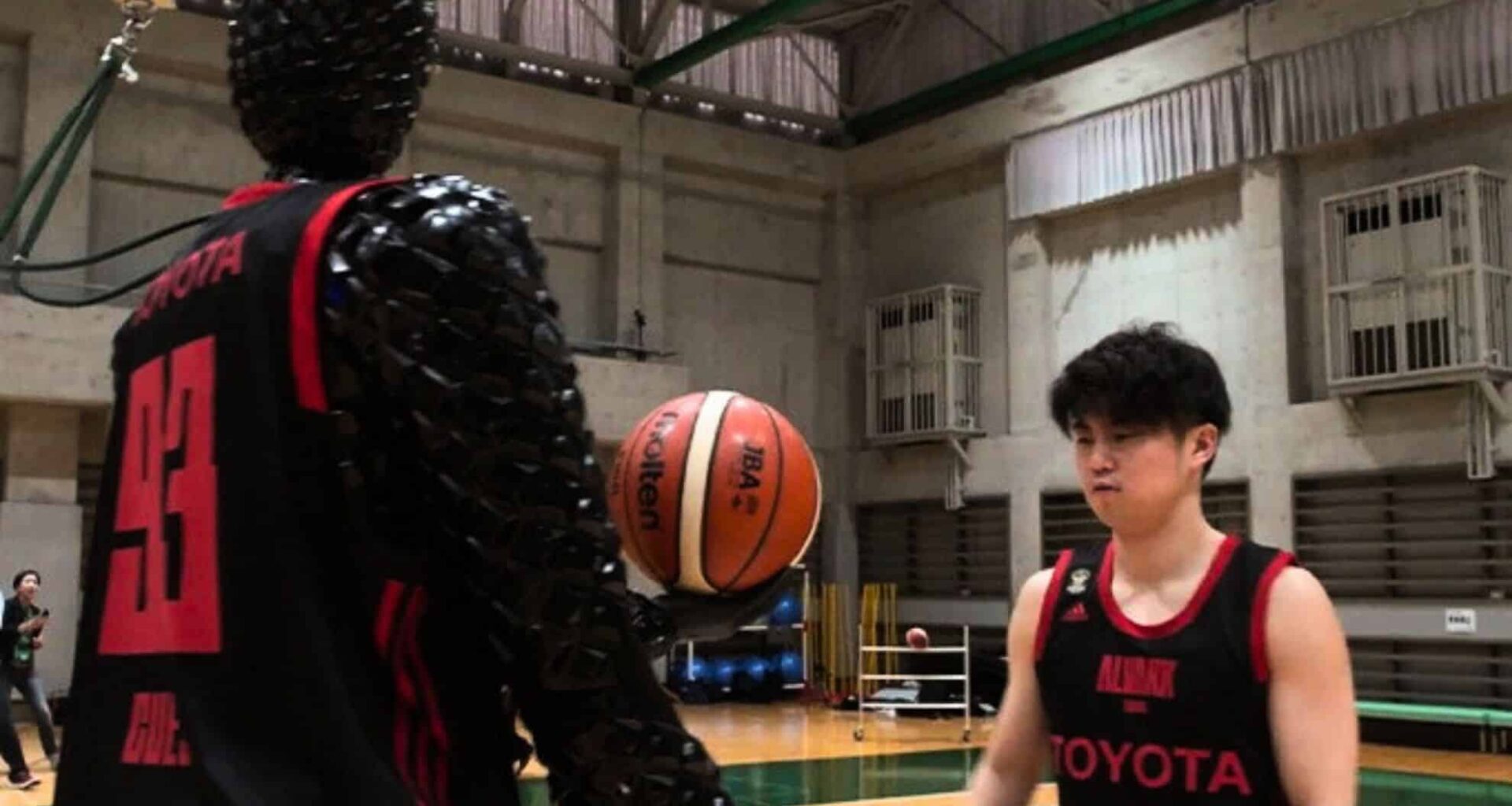
On a quiet indoor court in central Japan, a humanoid robot stood motionless at one end of the floor, facing a basketball hoop nearly 25 metres away. The distance alone would challenge elite professional players. When the ball left the robot’s hands and dropped cleanly through the rim, it marked not a novelty but a technical milestone in robotics.
The machine, known as CUE6, is the latest iteration of a long-running robotics project developed by Toyota Motor Corporation. In September 2024, the robot completed what Guinness World Records confirmed as the longest basketball shot ever made by a humanoid robot, measured at 24.55 metres, during a controlled demonstration in Aichi Prefecture, Japan. The attempt was independently verified under official record conditions, according to Guinness World Records.
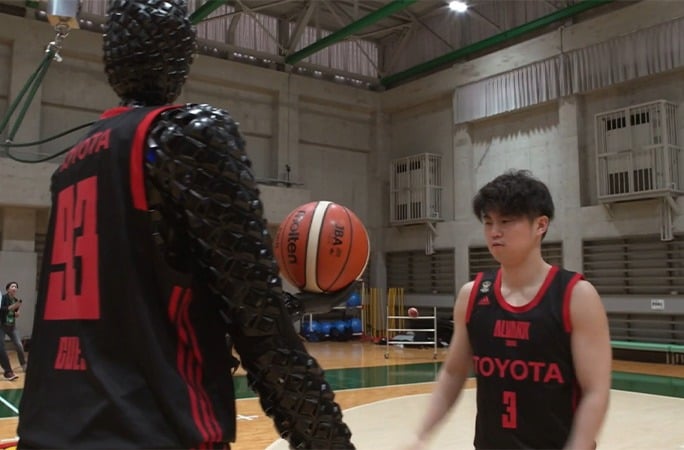 He’s trained to recognize patterns and even to correct his posture, arm position and shot strength for variables in real time, just like a human would. Credit: Guinness World Records
Unlike viral demonstrations designed primarily for entertainment, the CUE6 project was built as an engineering testbed. Toyota researchers have described it as an exploration of how machines can perceive, calculate, and execute complex physical actions in real-world environments. The shot itself, they say, was not the goal but the outcome of years of work on motion control, balance, and adaptive learning.
A Record Built on Measurement and Control
According to Guinness World Records, the CUE6 attempt surpassed all previous robotic basketball shots and represents the second world record set by the CUE project. An earlier version of the robot had already achieved a separate record in 2019 for making more than 2,000 consecutive free throws without a miss.
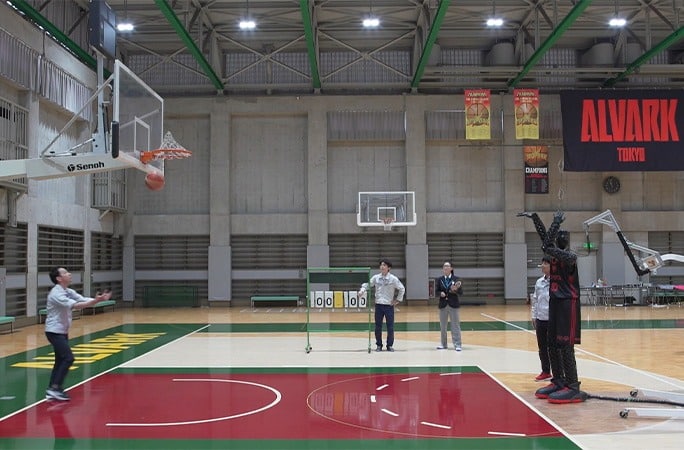 The longest basketball shot ever was made from 34.6 metres (113 ft 6 in) away by Joshua Walker (USA) in 2022. Credit: Guinness World Records
The sixth-generation robot reflects a significant redesign. Toyota engineers explain in official documentation that CUE6 incorporates reinforced joints, high-output motors, and elastic components that store and release energy during movement. These mechanical upgrades allow the robot to generate the force needed for long-distance shooting while maintaining balance and structural stability.
Toyota’s own reporting notes that the robot recalculates its posture before every attempt, using sensor feedback to adjust joint angles, centre of gravity, and release timing in real time. According to project lead Tomohiro Nomi, quoted in Toyota’s corporate newsroom, “CUE6 analyses its own motion and improves accuracy by refining how it uses its body.”
Precision Engineering, Not Performance Art
While the image of a robot making a long-range basket draws public attention, researchers involved in the project emphasise that the demonstration is fundamentally about precision engineering rather than spectacle.
Reporting by The Washington Post notes that earlier versions of the CUE robot already demonstrated shooting accuracy comparable to elite human players, particularly at shorter distances. The challenge for CUE6 was scaling that precision across nearly an entire basketball court, where small mechanical errors can dramatically alter outcomes.
To achieve this, engineers refined both hardware and software. The robot’s limbs are powered by motors capable of handling high torque, while control algorithms coordinate more than two dozen joints simultaneously. Each shot requires synchronised movement across the lower body, torso, and arms, with timing measured in milliseconds.
According to Toyota engineers, the system does not rely on pre-recorded motion paths. Instead, it continuously adjusts based on sensor feedback, allowing it to reproduce consistent results across repeated attempts. This capacity for fine-grained physical adaptation is central to broader advances in robotics, particularly in environments where conditions cannot be perfectly predicted.
Beyond the Court
Although CUE6’s achievement is visually striking, researchers say its real significance lies in what it demonstrates about the future of human–machine interaction. Robotics systems capable of precise, adaptive movement are increasingly relevant to fields such as manufacturing, mobility assistance, and healthcare technology.
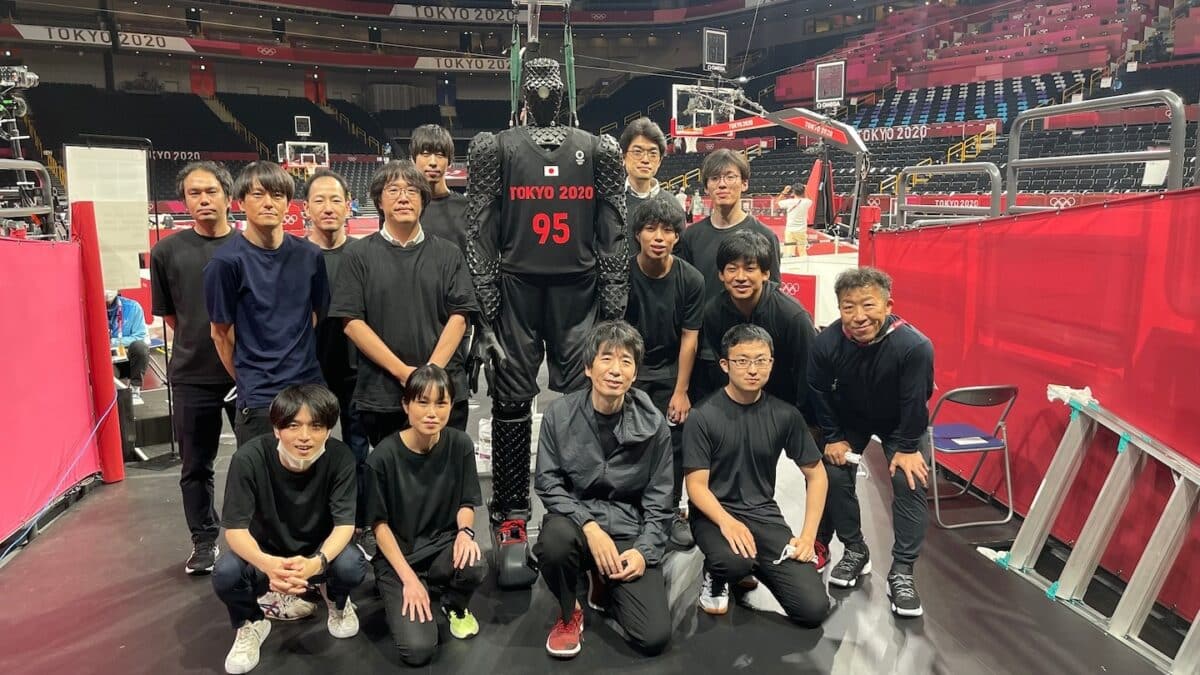 Toyota’s CUE team, led by Tomohiro Nomi (front, third from left), has designed a basketball robot that has delighted observers at the Tokyo Olympics by making free throws, three-pointers and even half-court shots. Credit: Ben Golliver/The Washington Post
Toyota has indicated that insights gained from the CUE project are being applied across its robotics research portfolio, including work on assistive devices and human-supportive machines. While no commercial applications have been announced, the company has framed the project as a long-term investment in understanding how machines can safely and effectively operate alongside people.
As Guinness World Records noted in its coverage of the achievement, the feat reflects “the growing capability of humanoid robots to perform complex physical tasks once thought to be uniquely human.”
What remains unresolved is how far such systems can scale beyond controlled environments. For now, the image of a robot calmly releasing a basketball from nearly 25 metres away stands as a precise measurement of progress—one grounded not in spectacle, but in engineering discipline and incremental advance.