
Editor’s note: During the holiday season, the Fort Worth Report is following up on the stories you told us you appreciated the most in 2025.
It’s been nearly two years since cattle began to die — and Johnson County residents noticed issues with their own health — after a fertilizer made from treated sewage sludge was applied to neighboring farmland.
Calls for help have “fallen on deaf ears,” Johnson County Commissioner Larry Woolley said.
Commissioners declared a state of disaster in February to make the 200,000-resident county eligible for relief funds and to request assistance from Gov. Greg Abbott.
The declaration was made after extensive testing on farmland in the area revealed dangerous levels of per- and polyfluoroalkyl, or PFAS. The substances often are referred to as “forever chemicals” because they accumulate in the environment and break down very slowly.
By April, state officials told the county it wasn’t eligible for funds as no state laws provided disaster relief for beef-producing cattle and farmers, Woolley said.
“It’s hard for me to wrap my head around,” the commissioner said.
The county’s residents and officials say the forever chemicals stem from the application of a biosolids fertilizer produced by Synagro, the company that formerly operated Fort Worth’s wastewater treatment plant.
 The back patio overlooks cattle on the Coleman’s vast property in Grandview, Texas on Aug. 5, 2024. (Azul Sordo for The Texas Tribune)
Synagro officials, who have previously denied wrongdoing, did not immediately respond to a request for comment.
The fertilizer continues to affect Johnson County resident Tony Coleman and his land. He and wife Karen Coleman refrain from selling their beef cattle for fear of spreading chemical contamination, he said.
“We were just starting to flourish,” Coleman said. “We have lost out on hundreds and thousands of dollars by not selling our beef because we don’t want to hurt anybody.”
‘Not an isolated incident’
For the first time, the Environmental Protection Agency acknowledged health risks posed by forever chemicals in biosolids, or treated sewage sludge, in a risk assessment issued just days before President Donald Trump took office for the second time.
Scientific research finds exposure to PFAS can lead to health effects such as:
- Decreased fertility or increased blood pressure in pregnant women.
- Development effects or delays in children.
- Increased risk of some cancers.
- Reduced ability of the body’s immune system.
Synagro’s fertilizer first prompted action by the county in 2024 when five farmers — including the Colemans — filed a civil lawsuit against the company, alleging their product led to the deaths of animals and health issues in humans.
The lawsuit cited findings from tests and samples taken by environmental crime investigator Dana Ames. Her investigation was conducted in late 2022 after receiving complaints from residents who noticed smoke, odors and animal deaths shortly after a neighbor applied the Synagro-produced fertilizer.
Samples of soil and water taken from the county contained levels of forever chemicals exceeding federal limits.
Researchers have found PFAS in treated wastewater and biosolids because treatment plants receive waste from industrial and commercial businesses that use the substances.
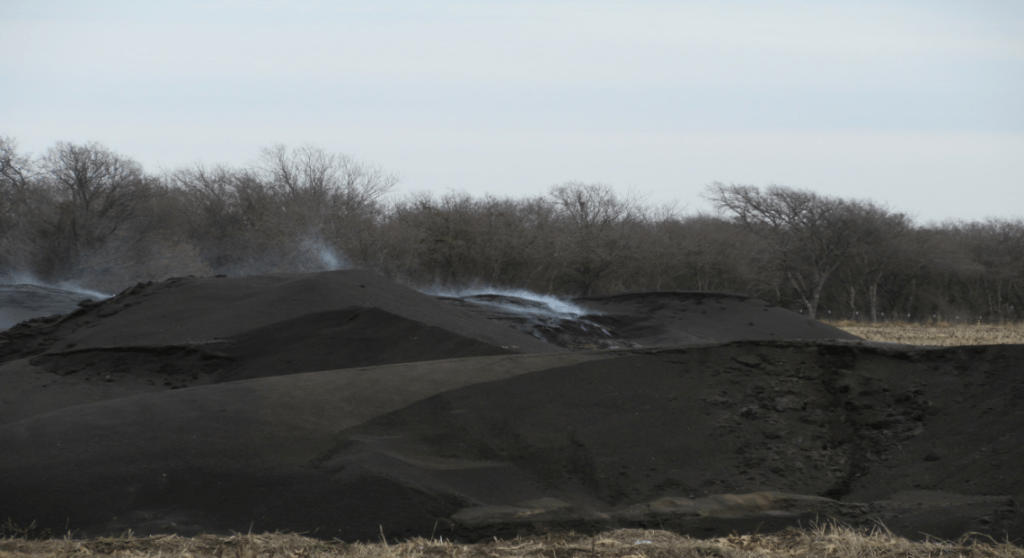 Piles of Synagro’s biosolids fertilizer in Johnson County release plumes of smoke in December 2022, near Tony Coleman’s farm. Coleman has since sued Synagro. (Courtesy photo | Dana Ames)
After Johnson County declared a disaster, more residents notified county officials of incidents they say were caused by chemical contamination, Wooley said, including cattle and fish kills.
There could be more incidents, he said.
“It’s definitely not an isolated incident,” he said. “I know there’s a lot of it that is being unreported.”
Synagro seeks to dismiss the lawsuit the five Johnson County farmers filed on the grounds that the company should be protected from legal action due to previously being contracted by Fort Worth to oversee the city’s biosolids processing operations. The farmers initially filed in Maryland but refiled as a class action lawsuit in Dallas County in April 2025 to include more affected plaintiffs.
The fertilizer company also argued that through the Texas Right to Farm Act, they are protected from the lawsuit because their product is an “agricultural activity” protected under that statute, Whittle said.
Synagro is not the only entity that faced legal action.
The nonprofit Public Employees for Environmental Responsibility filed a lawsuit on behalf of the farmers and ranchers in Johnson County in June 2024, arguing the EPA failed to identify and regulate toxic chemicals in sewage sludge.
The lawsuit points to harmful impacts on communities across the country, including Johnson County, due to a lack of regulating forever chemicals.
In September, a U.S. district court judge dismissed the case, citing a lack of “jurisdiction,” according to court documents.
Although the EPA is responsible for reviewing its regulations on forever chemicals in biosolids every two years, federal law does not require the agency to also identify and regulate pollutants in sewage sludge within that same time period, the court noted.
PEER attorney Laura Dumai said the EPA fails to comply with that review process as the agency is responsible for identifying risks from other kinds of PFAS.
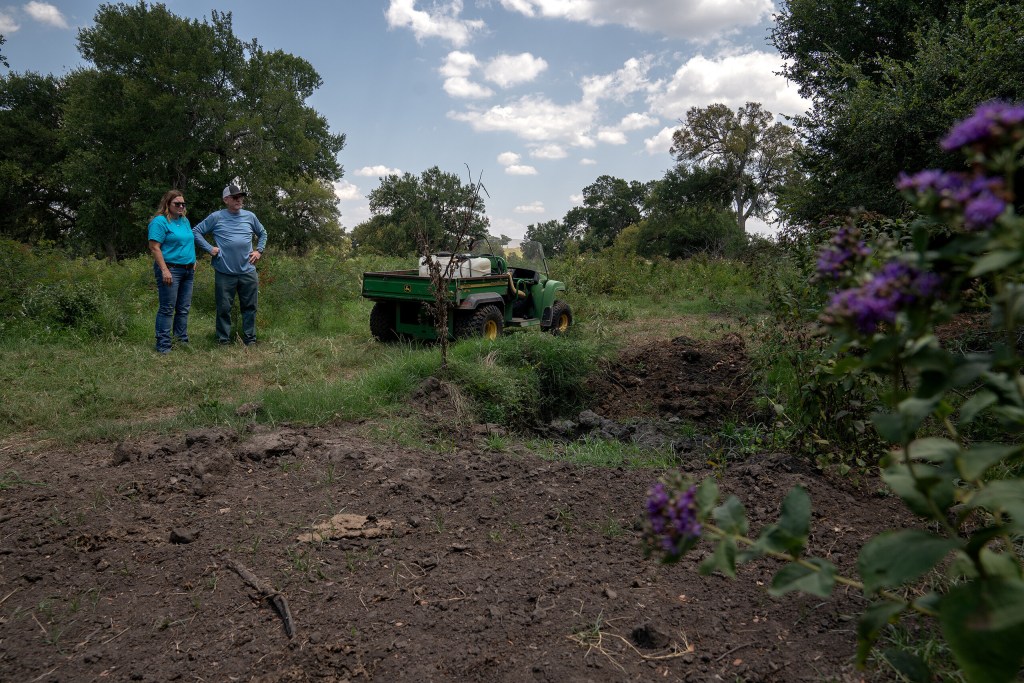 Tony and Karen Coleman stand over a plot of land where they buried a deceased calf and bull on their property in Grandview on Aug. 5, 2024. (Azul Sordo for The Texas Tribune)
“The EPA was supposed to review the regulations every two years for any new threats that might arise in whatever — pharmaceuticals, chemicals, even new scientific information about old chemicals that we thought were safe,” Dumais said.
EPA officials declined the Report’s request for comment on the lawsuit.
PEER is appealing the dismissal, which will have a federal circuit court review the decision before it can go back to the district level.
“The EPA should be protecting all of America from this harm,” Dumais said.
Looking to lawmakers
Meanwhile, local leaders want Texas to take action.
State Rep. Helen Kerwin, R-Cleburne, filed a bill this year that would have prohibited the manufacturing and distribution of certain levels of forever chemicals.
The bill, which would have supported Johnson County residents in their fight, failed to make it to the governor’s desk. But Wooley says the fight doesn’t end there.
North Texas officials are revisiting the failed legislation to see how they can successfully limit forever chemicals in the next legislative session in 2027.
With other parts of the country taking action as well, Woolley and others have hope.
For example, Oklahoma’s House Committee on Agriculture is studying PFAS to possibly introduce new bills in that state’s next legislative session, Woolley said.
Further north, the New York Farm Bureau urge state officials implement a ban on using biosolids fertilizer on farm land. The lobbyist group is also calling for required testing on sewage sludge, including on biosolids, to ensure they do not contain forever chemicals prior to land application.
“Three years ago, I’d never heard of (PFAS), and a lot of people hadn’t heard of it either,” Woolley said. “I choose to look at it as we’ve done a good job … it’s created quite an eye opening experience for a lot of people.”
Nicole Lopez is the environment reporter for the Fort Worth Report. Contact her at nicole.lopez@fortworthreport.org.
At the Fort Worth Report, news decisions are made independently of our board members and financial supporters. Read more about our editorial independence policy here.
This <a target=”_blank” href=”https://fortworthreport.org/2025/12/27/fallen-on-deaf-ears-sewage-sludge-continues-to-affect-johnson-county-farms-residents-say/”>article</a> first appeared on <a target=”_blank” href=”https://fortworthreport.org”>Fort Worth Report</a> and is republished here under a <a target=”_blank” href=”https://creativecommons.org/licenses/by-nd/4.0/”>Creative Commons Attribution-NoDerivatives 4.0 International License</a>.<img src=”https://i0.wp.com/fortworthreport.org/wp-content/uploads/2021/04/cropped-favicon.png?resize=150%2C150&quality=80&ssl=1″ style=”width:1em;height:1em;margin-left:10px;”>
<img id=”republication-tracker-tool-source” src=”https://fortworthreport.org/?republication-pixel=true&post=323211&ga4=2820184429″ style=”width:1px;height:1px;”><script> PARSELY = { autotrack: false, onload: function() { PARSELY.beacon.trackPageView({ url: “https://fortworthreport.org/2025/12/27/fallen-on-deaf-ears-sewage-sludge-continues-to-affect-johnson-county-farms-residents-say/”, urlref: window.location.href }); } } </script> <script id=”parsely-cfg” src=”//cdn.parsely.com/keys/fortworthreport.org/p.js”></script>