
Here at Top Comments we strive to nourish community by rounding up some of the site’s best, funniest, most mojo’d & most informative commentary, and we depend on your help!! If you see a comment by another Kossack that deserves wider recognition, please send it either to topcomments at gmail or to the Top Comments group mailbox by 9:30pm Eastern. Please please please include a few words about why you sent it in as well as your user name (even if you think we know it already :-)), so we can credit you with the find!
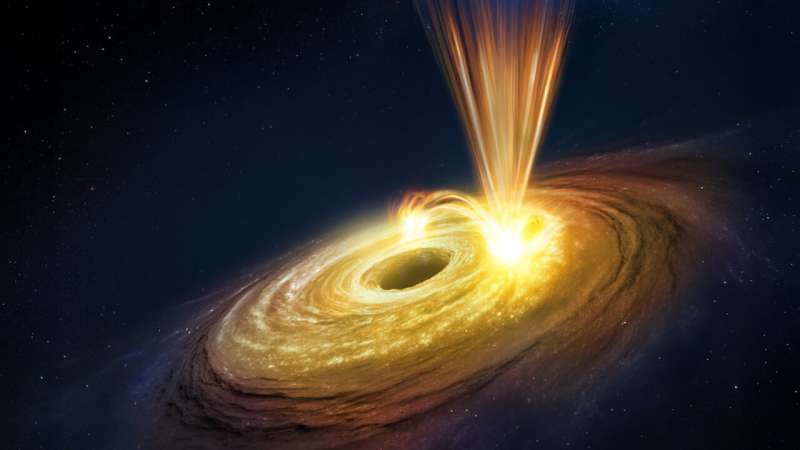
The supermassive black hole at the center of the galaxy NGC 3783, about 135 million
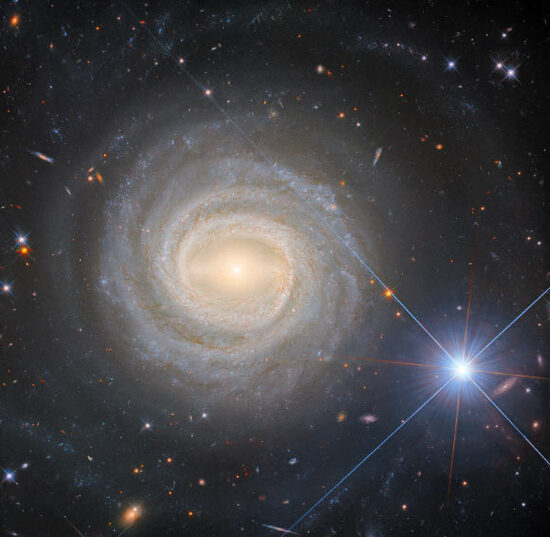
Image of NGC 3783 obtained by the Hubble Space Telescope. Image credit: NASA / ESA / Hubble / M.C. Bentz / D.J.V. Rosario.
lightyears from Earth, was observed spewing material at speeds never seen before, 60,000 km/sec. This occurrence was observed by an international collaboration using two x-ray imaging satellites.
To study NGC 3783 and its black hole, Gu and colleagues simultaneously used the European Space Agency’s XMM-Newton and the X-Ray Imaging and Spectroscopy Mission (XRISM), a JAXA-led mission with ESA and NASA participation.
—
“We’ve not watched a black hole create winds this speedily before,” says lead researcher Liyi Gu at Space Research Organization Netherlands (SRON). “For the first time, we’ve seen how a rapid burst of X-ray light from a black hole immediately triggers ultra-fast winds, with these winds forming in just a single day.”
The black hole in question has a mass equivalent to 30 million suns. Despite the extreme winds observed emanating from this black hole, the phenomenon appears to be similar to what what the Sun does on occasion, though on an enormously different scale.
The winds from the black hole resemble large solar eruptions of material known as coronal mass ejections, which form as the sun hurls streams of superheated material into space. In this way, the study shows that supermassive black holes sometimes act like our own star, making these mysterious objects seem a little less alien.
The last coronal mass ejection from the Sun was observed on November 11 of this year; the winds speeds associated with a solar ejection are around 1,500 km/sec, which is pretty impressive by itself, but pales in comparison to the black hole ejection speed.
Through x-ray astronomy and other techniques (such as gravitational wave detection), we continue to learn more about these exotic and energetic objects.
Comments are below the fold.
Top Comments (December 27-28, 2025):
Highlighted by DonaldWindrip:
This four-comment conversation between Paoli Cemetery and sidnora in annieli’s recommended post Here’s the seven most dangerous cities in the US because Stephen Miller wants you very afraid.
Top Mojo (December 26, 2025):
Top Mojo is courtesy of mik! Click here for more on how Top Mojo works.
Top Mojo (December 27, 2025):