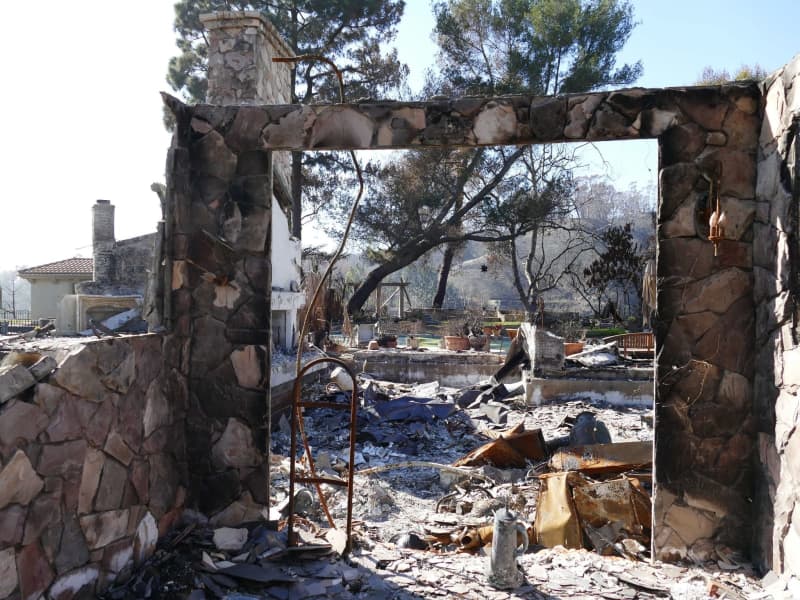
Dozens of Topanga residents gathered to hear Assistant Fire Chief Drew Smith discuss how the Los Angeles County Fire Department plans to keep Topangans alive in a fierce firestorm.
In the red-brick atrium of the community centre in the western Los Angeles County town near Malibu, Smith explained that if a fire explodes next to the town and flames will reach homes within minutes, orchestrating a multi-hour evacuation through winding mountain roads for Topanga’s more than 8,000 residents will just not be a viable option.
In such cases, Smith told attendees at the town preparedness event, the department now plans to order residents to shelter in their homes.
“Your structure may catch on fire,” Smith said. “You’re going to have religious moments, I guarantee it. But that’s your safest option.”
Dispute about the advice
But wildfire emergency response leaders and experts have described such an approach as concerning and point to Australia as an example.
After the nation adopted a similar policy, a series of brush fires in 2009 now known as Black Saturday killed 173 people, with many sheltering in their homes.
Some in the bohemian community of nature lovers, creatives and free spirits — who often pride themselves on their rugged, risky lifestyle navigating floods, mudslides, wildfires and the road closures and power outages they endure — are realizing that the wildfire risk in Topanga may be too big to bear.
They see the shelter-in-place plan as a perilous wager, with no comprehensive plan to help residents harden their homes against fire and no clear, fire-tested guidance on what residents should do if they’re stuck in a burning home.
“Do we need to have some way of communicating with first responders while we are sheltering in place? Would the fire front be approaching us and we’re just on our own?” asked Connie Najah, a Topanga resident who attended an emergency preparedness fair and was unsettled by the proposal.
“What are the plans for helping people through this season and the next season while we’re waiting to have widespread defensible space implementation?”
No fire chief wants to face the scenario of a vulnerable town with no time to evacuate. But it is a real possibility for Topanga.
Smith, speaking to The Times, stressed that the new guidelines only apply to situations where the fire department has deemed evacuations infeasible.
“If we have time to evacuate, we will evacuate you,” Smith said.
Emergency operations experts say not enough has been done in their field to address the very grim possibility that evacuating may not always be possible — in part because it’s a hard reality to confront.
It’s not a small problem, either: Cal Fire has identified more than 2,400 developments around the state with at least 30 residences that have significant fire risk and only a single evacuation route. Topanga is home to nine of them.
Recent fires, including the 2018 Camp fire in Paradise and Woolsey fire in Malibu, have made the issue too hard to ignore.
In Topanga, Najah has a ham radio license so she can stay informed when power and cell service inevitably go down. The Topanga Coalition for Emergency Preparedness (TCEP) publishes a disaster survival guide. Every houshold gets one.
The guide had instructed residents to flock to predetermined “public safe refuges” in town, such as the baseball field at the community house or the large parking lot at the state park, to wait out fires.
If residents couldn’t make it to these, there were predetermined “public temporary refuge areas” within each neighborhood, such as street intersections and homes with large cleared backyards, that provide some increased chance of survival.
But when the Fire Department determined the spaces were not capable of protecting the town’s entire population from the extreme radiant heat, it pivoted to sheltering in place — the last and most dangerous option listed in the old guide.
David Shew, a trained architect and firefighter who spent more than 30 years at Cal Fire, said that for a shelter-in-place policy to be viable, a community would need to undertake significant work to harden their homes and create defensible space — work that has not been done in most California communities.
It’s “not really safe for people to just think, ‘OK, I’ve done nothing but they told me to just jump in my house,’” he said.
And once a house ignites, suggestions like sheltering in a bathroom are of little use, said Mark Ghilarducci, a former director of the California Governor’s Office of Emergency Services.
“Under certain circumstances, your home could potentially provide a buffer,” he said. But if a house is burning and surrounded by fire in the wildlands, “you’re in a position where you are essentially trapped, and your bathroom’s not going to save you.”
Smith said, however, that the fire department had done its own analysis of the Topanga area and determined that the fire dynamics in the area are too extreme for Topanga’s proposed public shelter spaces to be effective.
The department argues sheltering in place, although far from guaranteeing survival, eliminates the risk of residents getting trapped on roadways, unable to see, with almost no protection.
“There is no way that we can 100% eliminate the fire risk and death potential if you live in a fire-prone area,” Smith said.
Still, the history of shelter-in-place policies — and their more aggressive companion, “stay and defend,” which involves attempting to actively combat the blaze at home — looms heavy.
Australia as an example?
After more than 100 bush fires swept through south-east Australia in 1983, killing 75 people in what became known as Ash Wednesday, Australian fire officials adopted a “stay or go” policy: Either leave well before a fire reaches you, or prepare to stay and fend for yourself.
If you’re living in a high fire hazard area, the philosophy goes, it is your responsibility to defend your property and keep yourself alive amid strained fire resources.
Around the same time, California considered the policy for itself after dangerous fires ripped through the Santa Monica Mountains, Ghilarducci said.
State officials ultimately decided against it, choosing instead to prioritize early evacuations. Cal Fire’s “Ready, Set, Go!” public awareness campaign became the face of those efforts.
In 2009, an explosive suite of brush fires broke out, yet again, in south-east Australia and seemed to confirm California’s worst nightmare: 173 people lost their lives in the Black Saturday tragedy.
Of those, 40% died during or after an attempt to defend their property, and nearly 30% died sheltering in their homes without attempting to defend them. About 20% died while attempting to evacuate.
Afterward, Australia significantly overhauled the policy, placing a much greater emphasis on evacuating early and developing fire shelter building standards.
Nearly a decade later, California confronted its own stress test. The Camp fire ripped through Paradise in the early morning on November 8, 2018. The time between the first sighting of the fire and it reaching the edge of town: one hour and 39 minutes. The time it took to evacuate: seven hours.
Among the miraculous stories of survival in Paradise were the many individuals who found refuge areas in town: a predetermined safety zone in a large, open meadow; the parking lots of stores, churches and schools; a local fire station; roadways and intersections with a little buffer from the burning trees.
But the same day, the intensity of the Woolsey fire in the Santa Monica Mountains — similarly plagued with evacuation challenges — unsettled fire officials. It’s in these conditions that Smith doubted Topanga’s refuge sites could protect residents.
Stuck without many options, the Fire Department began slowly thinking about refining the policies that proved disastrous for Australia. The Palisades fire brought a renewed urgency.
Just a month before ReadyFest, LA County Fire Chief Anthony Marrone stirred anxiety among emergency response officials when he appeared to endorse a stay-and-defend policy, telling KCAL-TV “We’ve always told people that when the evacuation order comes, you must leave. We’ve departed from that narrative. With the proper training, with the proper equipment and with the proper home hardening and defensible space, you can stay behind and prevent your house from burning down.”
The department later clarified the statement saying the change only applies to individuals in the Santa Monica Mountains’ community brigade, which serves the community at large, who have received significant training from the department and operate under the department’s command.
Now, residents worry the policy to shelter in place is coming without enough preparation.
Fireproofing your home
There are some relatively simple steps homeowners can take, such as covering vents with mesh, that can slightly reduce the chance of a home burning.
But undertaking a comprehensive renovation — to remove wood decks, install noncombustible siding and roofing, replace windows with multipaned tempered glass, hardscape the land near the house and trim down trees — is expensive.
A report from the community development research nonprofit Headwaters Economics found a complete home retrofit using affordable materials costs between $23,000 and $40,000. With high-end materials that provide the best protection, it can cost upward of $100,000.
Many Topangans have taken up the challenge, anyway. James Grasso, president of the Topanga Coalition for Emergency Preparedness (TCEP) lost his home in the 1993 Old Topanga fire. He has slowly been hardening his property since the rebuild and has even built a concrete fire shelter against a hillside with two steel escape doors and porthole windows.
Researchers have found comprehensive home hardening and defensible space can reduce the risk of a home burning by about a third, but not bring it down to zero. (Albeit, none have tested Grasso’s elaborate setup.)
Wildfire safety experts hope the state someday adopts building standards for truly fire-proof structures that could withstand even the most extreme conditions and come equipped with life-support systems.
But any such standards are years away, and the LA County Fire Department has to have a plan if a fire breaks out tomorrow.
For Grasso, fire risk is a risk like any other, like the choice to drive a car every day.
In exchange for the beauty of living life in Topanga, some folks will learn to accept the risk and do what they can to mitigate it: Harden a home, fasten a seat belt.
Others – especially those unable to take the drastic steps Grasso has been able to – will deem the beauty of life in Topanga not worth the risk of getting trapped by flames.
“The amount of money it takes to get to this point is too cost-prohibitive for us at this moment,” Najah said. “It’s really a tough place to be in. … It’s not going to be easy, and we’re not the only rural community. All over the state, people are having to deal with this.”
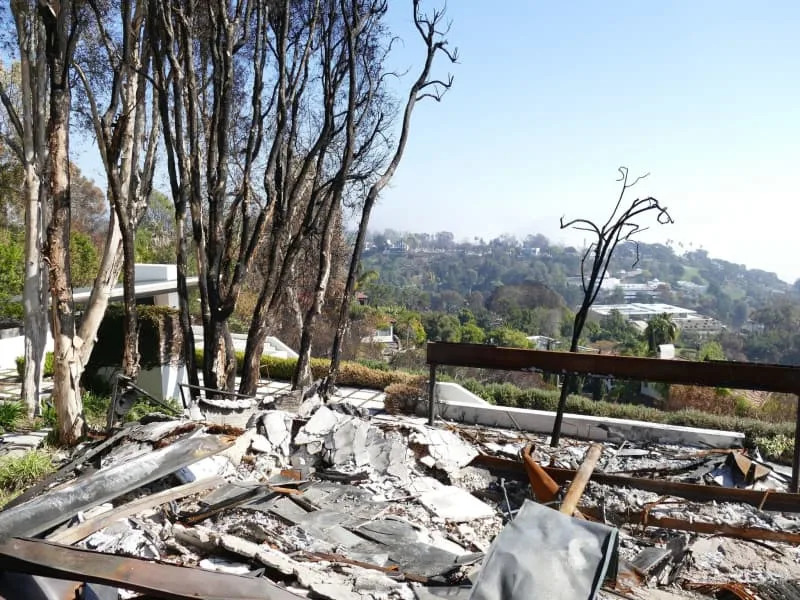
Homes burned to the ground following the Pacific Palisades fires that began burning in the Santa Monica Mountains in Los Angeles County on January 7, 2025. They destroyed large areas of Pacific Palisades, Topanga and Malibu before being contained after 24 days on January 31. Barbara Munker/dpa
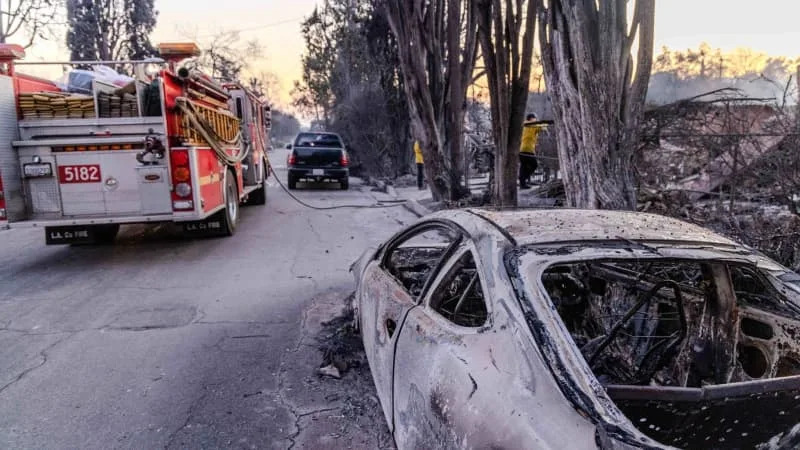
LA Fire fighters put out hot spots on a property already destroyed in the Eaton Fire. The state – the most populous in the United States – is plagued by wildfires. Amy Katz/ZUMA Press Wire/dpa