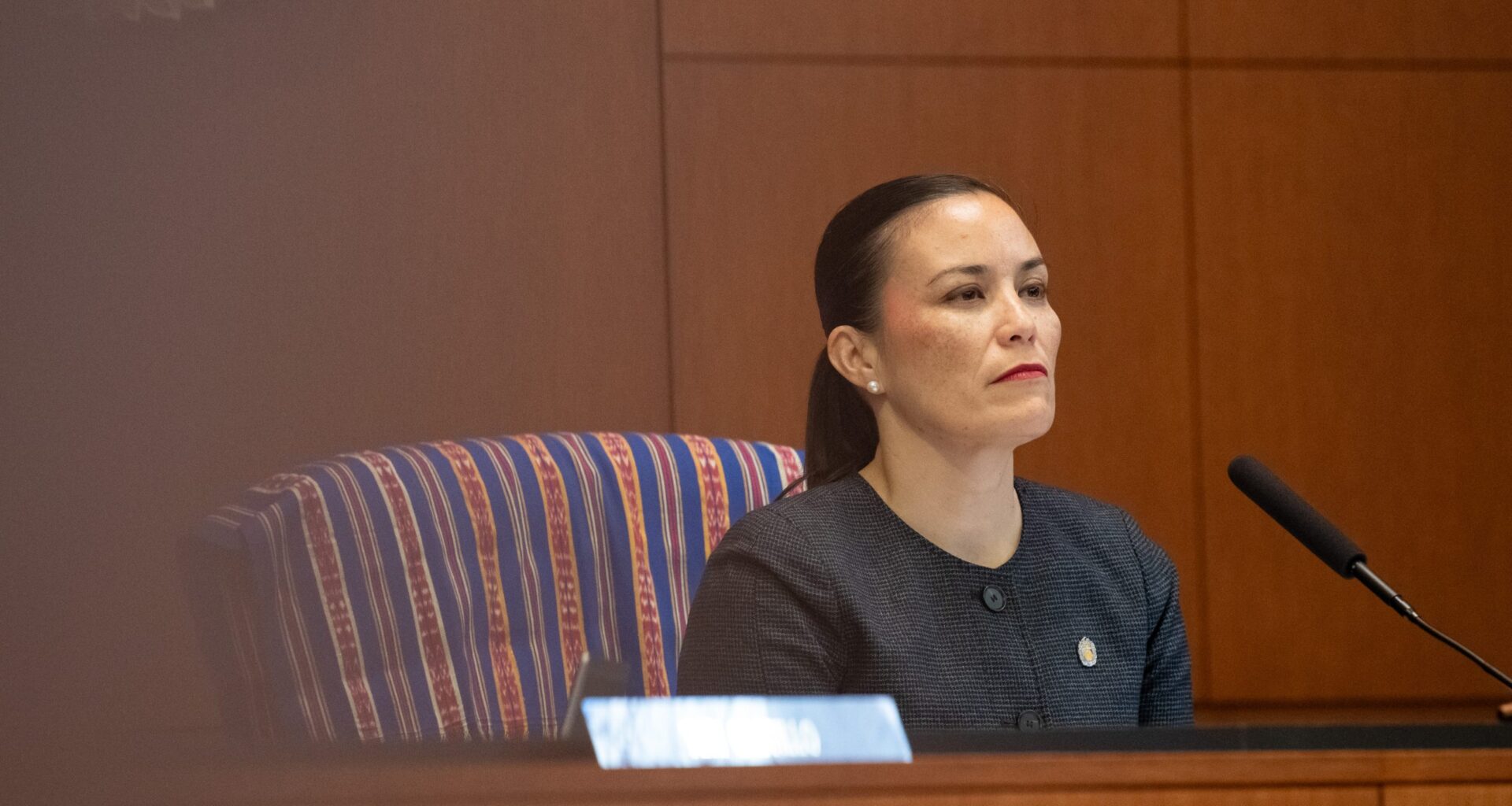
Mayor Gina Ortiz Jones campaigned as one biggest skeptics of Project Marvel, but efforts to slow it down just after taking office ended in a high-profile defeat, with the city manager and a majority of the council going around her to keep it moving.
Now with more experience under her belt, Jones is preparing to take another swing at the issue when negotiations return to City Hall.
“We have this generational opportunity before us in terms of how we think about a revitalized downtown,” she said in a Dec. 19 interview at her office. “So we’re not just looking and judging what based on what people offer us.”
That approach is giving some supporters of the project heartburn, after plans for the roughly $1.3 billion downtown Spurs arena and surrounding development looked locked up just weeks ago.
The council voted 7-4 to approve the framework for a $489 million city contribution to the arena in August, and Bexar County voters followed it up by approving another $311 million on the Nov. 4 ballot.
But details of the city’s non-binding agreement must still come back before the council in the new year, meanwhile, Jones says she’s actively working to buy time for the city to see what other financial hurdles come its way before finalizing a deal with the Spurs.
Across an array of issues at City Hall, disagreements with the council continue to dog Jones’ agenda, particularly when it comes to the progressives she should theoretically have on her side.
But she ends the year with a first big win under her belt on moving the city’s elections — and a new approach to some of her old ideas.
The San Antonio Report sat down with Jones to talk about what’s next on Project Marvel, her efforts to prepare the city for federal cuts, and a victory on her plan to move city elections to November that seemed ripped from the jaws of defeat.
The conversation has been lightly edited for clarity and length.
City Manager Erik Walsh said at our CityFest event in October that the council will need still need to finalize its deal with the Spurs in January, and we saw recently saw that the city is now seeking a consultant to study the Spurs’ downtown sports and entertainment district, looking at its potential burden on city services, like fire and emergency medical services, as well as what the project is expected to generate in sales tax, and other potential revenue sources.
Does this latest study make good on the independent economic analysis you’ve been asking for? And what do you see coming down the pipeline next for Project Marvel?
There’s a couple things. One, it’s a major project. We certainly are going to need somebody to manage the day-to-day. You’re not going to have somebody here with the capacity to do all of that, so you need some kind of “project honcho.”
Separately, there is the cost of service analysis. How much does it add to the general fund? How much does it cost to do X, Y and Z in there? Which is a little bit different [from an independent economic analysis].
When we do a cost of service analysis, you have to know what service you’re looking to provide, right? That’s why I think it’s really important that we have a broader conversation about what we want downtown … not unlike what we did a couple months ago with the put out an RFP for the strategic plan for the River Walk, where we say we want these kinds of elements in there, now what do bidders think that could look like?
I think [city staff] wanted to have some numbers, that small piece of it [from the cost of services analysis], but I think for me, there’s a broader conversation we have the opportunity to have, and, frankly, responsibility to have.
We’re going to see a city the size of Austin join us [in terms of population growth] by 2050, so now is the time to be thoughtful about planning for not 1,200 affordable housing units, but what does 40,000 units of housing look like downtown? What does public transit look like to support basic services downtown, et cetera.
Then once we have a better idea of what we want/need, I think that’s a better way to judge what we’re being offered, either by the [Missions Minor League Baseball team] or by the basketball folks.
Does that mean you’re still pushing for a separate financial study?
I think you still need numbers. I think you still seem to need some analysis. The [Project Finance Zone] money, for example, is [expected to provide] $2.5 billion over 30 years. I think you need some analysis that helps you understand what the accurate, best allocation is of that money. What goes toward the arena? What goes toward the convention center? What goes toward the Alamodome?
There are options about how we spend that money. [Statute says] you can do the thing itself, as well as the connected infrastructure, so we should have a conversation about, do we really need to have a [city] bond that pays for [arena district infrastructure], when we can use some of the PFZ money instead?
We need some analysis that helps us do that. I think we also need some analysis about what overall bill for the infrastructure for all of these things. So I think it would still be very helpful for us to get an independent look at the numbers that were provided by the Spurs.
The city and the Spurs agreed to a non-binding term sheet in August that outlines their respective commitments to this project. Just after voters approved the county’s portion of the funding on the Nov. 4 ballot, you said at the Texas Tribune Festival that you will continue to push for a revenue sharing agreement with the Spurs, and that the $75 million community benefits agreement the team agreed to is “better than what we had,” but that the city will “continue to negotiate for more.”
Some council members believe the window for such negotiations have closed. What are you asking for and when are the next opportunities to get it?
To me, non-binding means non-binding, and that means you’ve got room to negotiate. And many of them actually, that was the exact reason they voted for it, because they said, ‘Well, it’s non-binding.’”
In the term sheet, if you look at the list of project agreements, there’s seven of them. Once those are finalized, then we will vote on all of those together, and so that is when the [deal with the Spurs] would be final … [likely sometime in] 2026.
It’s clear we need a much more defined timeline [of next steps]. I imagine we’ll get that [from city staff] in the new year. Part of that is helping us understand, when do certain decisions need to be made? How much time do we have to do that, so that we can appropriately include public input and public engagement on these things?
You’ve talked about wanting to hold off on final agreements for Project Marvel until San Antonio has a better sense of its financial situation, both in terms of the fiscal year 2027 budget deficit, but also federal cuts, with a particular emphasis on health care.
There are the tax credits for Obamacare plans that expire at the end of the year, a continuing resolution funding the federal government through March 14, and the One, Big, Beautiful Bill’s SNAP and Medicaid eligibility restrictions and work requirements, which take effect incrementally over the coming years.
What do you think is a reasonable timeframe to say, OK, the dust has settled enough for us to know what kind of financial situation we’re in?
I don’t know if there’s going to be a time when the dust settles. Everything’s kind of in flux with the federal government. I’m most concerned about the implementation of the cuts to Social Security and Medicare.
States have some leeway in terms of when they implement [aspects of the One, Big, Beautiful Bill], so could we see some of those sooner than anticipated, maybe not the end of 2026, but maybe closer to like, the spring. It’s really tough to say.
Even if we don’t know what’s coming, I think taking steps to help reduce uncertainty is important. That’s why we had a tabletop [exercise] last Friday.
It was really about helping us think through, okay, if we lost 50% of our housing funding, if we lost 50% of our testing funding or public health funding, what would that look like? So 40 community partners came together, mental health, [school districts], utilities, and, provided input on what that would mean for them.
[Staff is] going to provide a readout around the end of January … Then we can have a discussion as a council on, if we were to see that cut come down, would we be comfortable with that level of risk? And if not, what would it take to fill that gap? Then we can have a more fulsome conversation as we’re looking at some really tough choices in the budget.
For all of us trying to read the tea leaves on the dynamics of this new council and your leadership, what should we take away from the 6-5 vote to move San Antonio’s municipal election to November of odd-numbered years?
Some progressives who one might have expected to support it were critical, like Councilwoman Teri Castillo (D5), who voted no. Then one of the council’s more conservative members, Councilwoman Misty Spears (D9), ended up helping carry it over the line.
The community got a win.
I think for a lot of folks, it’s about the issue, and for others, maybe it’s about something else. You’ll have to go ask them. But I was very thankful that there were six votes on the dais that saw the clear benefit to the community, that were willing to listen to the feedback that was there in the room from leaders that work on this voting rights issue, and have done so for decades.
I’m thankful that there were six that weighed all of that, and then took the time, as Misty Spears did, to go survey their immediate district about what they wanted and how they felt about this issue, and then acted accordingly.
Did you have any idea Councilwoman Spears might vote that way going into that meeting?
We had had a conversation, but it was private, so I’m not going to share it.
Many council members in that meeting expressed a desire to keep working toward moving San Antonio’s city elections to November of even-numbered years, when turnout is much higher, and they would be on the ballot with state legislative and congressional races, as well as perhaps Texas’ statewide positions or the presidential race, depending on how it’s timed. Is that something you also plan to keep pushing for?
I think we want to take every step to make sure we’re always hearing from as many voters as possible. As we know, though, [our ability to do that] is really determined by the state and what they’ll allow. We’ll see if that’s something that they end up allowing. I’m not super optimistic about that, to be honest, though.
What do you make of the threats against Councilwoman Spears’ office, made by a City Hall staffer, which seem to be somewhat partisan in nature?
It’s really unfortunate. Months ago, [when threats had been made] against me, I had [City Manager Erik Walsh] bring in staff … just help people understand, what are steps you can take in-person and online to protect yourself and your family. … Not only what to [watch for], but also how to report it.
In this day and age, we cannot discount any of those things. Everything’s got to be reported. Everything’s going to be taken seriously. We’re just living in a different time.
It was unfortunate that [Spears’] staff didn’t feel safe, and that it sounds like there were some issues there, even prior to that [incident], that were shaping those engagements. Everybody deserves to work and live in a place where they feel safe.
This last city election ushered in a much larger bloc of progressive-minded members who could really flex their muscle if they stuck together, yet we haven’t really seen it happen so far. Do you foresee that group working more closely in the coming year, and if so, where?
Frankly, I thought we would have had more votes on this one [the ordinance to move city elections from May to November], right? Voting shouldn’t have been that hard.
But I think — I do hope — that there are other areas in which we can continue to work together. Certainly affordable housing, certainly how we navigate priorities in the budget to shore up communities that are going to be impacted by some of these federal cuts, as well as even how we think about what goes in the [city’s next bond program], balancing that between downtown revitalization, but also flood infrastructure, for example.
So I think we go case-by-case. And I think in each of these, you build trust, you demonstrate how you can work together.