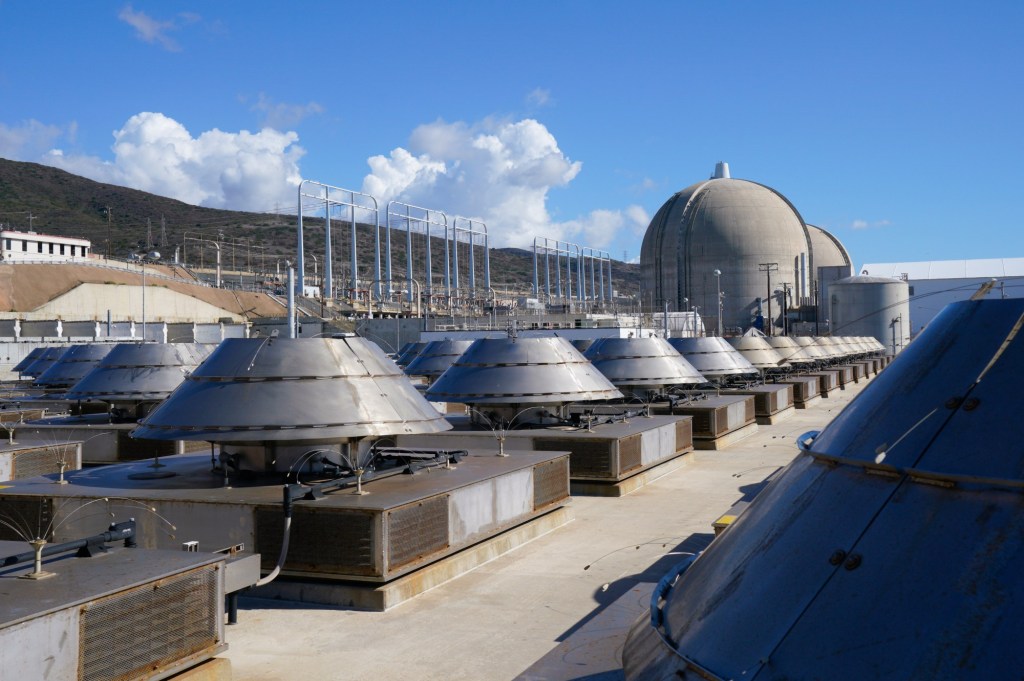
Some 3.55 million pounds of nuclear waste is beached at San Onofre.
The spent fuel held in more than 120 stainless steel canisters at the now-shuttered San Onofre Nuclear Generating Station, lodged between the Pacific Ocean to the west and Interstate 5 on the east, has nowhere to go because the federal government has yet to find a permanent repository to send it.
It’s not just an issue for the facility at San Onofre, known as SONGS, but for all the spent fuel that has stacked up over the years at commercial nuclear power plants across the country.
But are there other avenues where the waste can go?
Recent progress and research in both the public and private sectors aimed at reprocessing spent fuel and using it to power advanced reactors or other emerging technologies may offer at least some glimmer of hope.
With those possibilities in mind, Jim Desmond of the San Diego County Board of Supervisors recently introduced a resolution to explore potential pathways at SONGS for nascent initiatives on the nuclear energy horizon.
“We’ve talked about this problem for more than a decade,” Desmond said after the board unanimously approved the measure on Dec. 9. “We can’t keep waiting. It’s time to turn this challenge into an opportunity.”
What does reprocessing mean?
The power generated by a commercial nuclear facility comes via the process of fission that splits uranium atoms within the core of a nuclear reactor. What’s left in the fuel assemblies is called “spent” nuclear fuel, or waste, that is highly radioactive.
Nearly 95% of spent fuel consists of uranium and 1% is made up of plutonium.
Broadly speaking, reprocessing refers to separating the unburned uranium and plutonium from the spent materials produced during fission reactions, enabling the reprocessed spent fuel to be used again. This results in a significant reduction in the amount of radioactive material that ends up going to a repository.
Though the leftover uranium and plutonium can be reused, the U.S. does not reprocess its spent fuel. That’s because commonly used reprocessing methods produce a stream of separated plutonium that could make nuclear weapons.
Such fears of proliferation prompted President Jimmy Carter to issue what amounted to a national ban on reprocessing in 1977. On the other hand, some other countries — most notably, France — have reprocessed and recycled used fuel at its nuclear facilities for decades.
A new day for nuclear?
With data centers increasingly hungry for electricity to power artificial intelligence applications, nuclear power is getting another look as a means to meet a predicted surge in power demand on the grid.
Nuclear supplies baseload power — and lots of it — without emitting any greenhouse gases into the atmosphere.
A growing number of startups have jumped headlong into cutting-edge nuclear technology.
For example, one Silicon Valley-based company named Oklo focuses on designing and deploying advanced fission power plants.
Among its projects, Oklo is working with the U.S. Department of Energy and the Argonne National Laboratory to build the first privately funded reprocessing facility in Oak Ridge, Tenn.
Oklo is pursuing methods that would not create pure streams of plutonium and has plans to produce new fuel, using spent fuel, at commercial scale in the late 2020s or early 2030s.
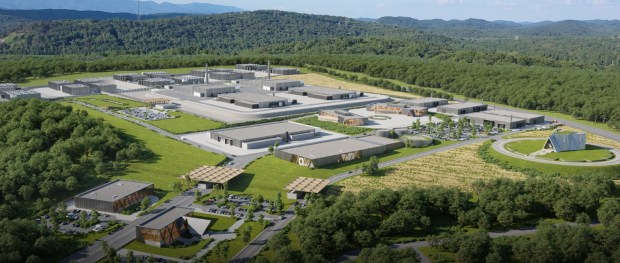 A rendering from advanced nuclear technology company Oklo for a fuel recycling facility in Tennessee. (Oklo)
Meanwhile, the Idaho National Laboratory is conducting research on advanced fuels, reactors, microreactors and molten salt reactors.
If these projects already plan to use spent nuclear fuel, Desmond’s resolution calls on San Diego County to be on the lookout for opportunities for them to access at least some of the waste sitting around San Onofre. The measure specifically mentions seeking partnerships with one or more national labs.
“As a county, we should position ourselves to participate in this ‘nuclear renaissance’ and join in the growing demand to finally do something with the (spent fuel) sitting in perpetual limbo at sites throughout the country,” Desmond said in a six-page report submitted to the Board of Supervisors before the Dec. 9 vote.
For now, the resolution has no specific dollar figure attached to it.
It directs the county’s chief administrative officer “to explore opportunities” and report back to the board in 90 days with results — including any costs or potential funding sources.
“The objective would be to move the (waste) to an off-site facility for research on advanced reprocessing techniques and its use in powering next generation/advanced reactors,” the report said.
The Union-Tribune asked the Idaho National Laboratory about Desmond’s proposal. A spokesperson for the lab said the Department of Energy would be better suited to answer questions, but DOE did not respond to emails.
However, Oklo’s head of communications said, “We think the county’s initiative is an important step toward moving beyond indefinite on-site storage and should be part of the broader national conversation about used fuel management.”
Bonita Chester of Oklo went on to say in an email, “That said, we do not have any agreements in place related to recycling fuel from San Onofre today, and any such decision would need to be in collaboration with the federal government, the fuel owners and local communities.”
The Union-Tribune also reached out to Southern California Edison, the utility that operates SONGS, about the county’s resolution.
“We appreciate the focus on the important issue of spent nuclear fuel, and we welcome thoughtful consideration of all reasonable, secure options for clearing San Onofre of spent fuel,” SCE spokesperson Jeff Monford said. “Reprocessing certainly can be part of an effective solution, but in SCE’s view all solutions should hold the federal government accountable to its obligations related to spent fuel storage and disposal.”
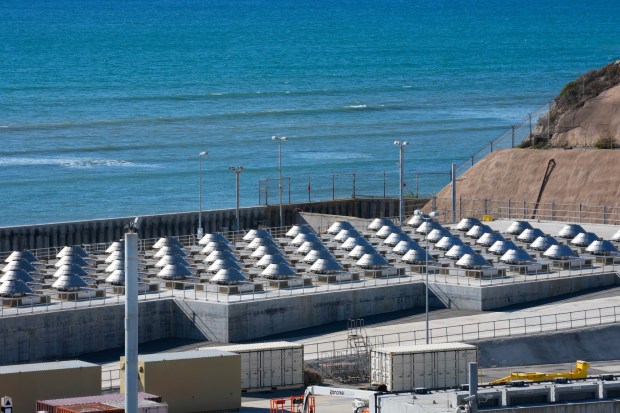 The storage facilities holding canisters of nuclear waste at the north end of the San Onofre Nuclear Generating Station overlook the ocean. (Nelvin C. Cepeda / The San Diego Union-Tribune)
Desmond is one of the members of the San Onofre Community Engagement Panel, a group formed by SCE that acts as a liaison between the plant’s co-owners and the public. The panel holds meetings on topics that include the disposition of the nuclear waste at SONGS.
Across the country, roughly 91,000 metric tons of spent fuel have stacked up at facilities in 35 states.
For decades, Yucca Mountain in Nevada had been slated as a permanent site to hold the spent fuel.
But the Obama administration cut off funding for Yucca in 2010, following years of protests from lawmakers in the Silver State who had long opposed it. The project’s costs came to at least $15 billion before getting shelved.
With Yucca off the table, federal officials have gone back to the drawing board, looking at potential sites to accept some or all of the country’s commercial spent fuel, on an interim (still-to-be-determined number of years) or permanent basis.
Some in the nuclear business say the U.S. should establish an interim and final facility before tackling recycling.
Lots of questions and some skepticism
There’s certainly no guarantee the San Diego County resolution would result in any proposed projects actually using spent fuel from SONGS — and even if some of the waste were to be tapped, it’s not clear how much of a dent it would make in the 3.55 million pounds currently stored at San Onofre.
In addition, a host of questions would be raised about how the waste would be shipped and all the necessary permits, licensing and approvals that would need to be cleared.
On a broader level, some question whether reprocessing spent fuel is worth the effort and doubt whether advanced nuclear technologies will pan out.
The Washington Post reported that test reactors in the U.S. and Great Britain have experienced cost overruns and engineering setbacks that have forced developers to push back target dates for their projects.
Notwithstanding the success in France, reprocessing facilities in Japan and the U.K. have gone way over budget. And while recycling reduces the amount of waste that’s left over, it still leaves highly radioactive and long-lived material that must be safely handled and stored.
Others still worry about the specter of nuclear weapons.
Ross Matzkin-Bridger, senior director of the Nuclear Materials Security Program at the nonprofit Nuclear Threat Initiative, called the momentum toward reprocessing “a siren song” in an article posted earlier this year by the Bulletin of the Atomic Scientists.
“The dream of turning waste into a valuable commodity has ignited the human imagination for centuries,” wrote Matzkin-Bridger, who worked at the Department of Energy during the Biden administration. “But just as the alchemists of generations past were never able to turn their toils into a solution for changing lead into gold, real-world experience and science show that reprocessing doesn’t live up to the hype.”
Other details
At the request of Supervisor Paloma Aguirre, the county’s resolution included an amendment to formally support the Nuclear Waste Administration Act, proposed by Rep. Mike Levin, D-Calif.
The legislation proposes creating a new, independent federal agency solely focused on managing nuclear waste. It’s co-sponsored by Rep. August Pfluger, R-Texas.
The bill also prioritizes spent nuclear fuel from sites that no longer generate electricity and whose locations pose “a high risk to national security or public safety.” Given that San Onofre is in the process of dismantlement and is located in an area with earthquake risk and next to one of the busiest freeways in the U.S., the waste at SONGS would meet those requirements.
The waste at SONGS is housed in a pair of storage facilities at the north end of the plant.
One storage site contains 73 stainless steel canisters containing spent fuel that have been lowered into vertical cavities. The other holds 50 canisters that are stacked horizontally.
Another 13 canisters are filled with material classified as greater than Class C waste, collected during the dismantlement efforts at SONGS. They sit in the horizontal storage facility.