For nearly three decades, the scientific world has operated under an assumption: the universe is flying apart faster and faster, doomed to a lonely, cold end.
But a new study suggests we might have misread the cosmic speedometer entirely.
In a challenge to the theory of eternal expansion, South Korean astronomers propose that the Universe may be fated for a gravitational collapse known as the ‘Big Crunch.’”
The research, conducted by Yonsei University, Seoul, argues that the universe is no longer accelerating. In fact, it may already be slowing down.
“Our study shows that the universe has already entered a phase of decelerated expansion at the present epoch and that dark energy evolves with time much more rapidly than previously thought,” said Professor Young-Wook Lee, the lead researcher.
“If these results are confirmed, it would mark a major paradigm shift in cosmology since the discovery of dark energy 27 years ago,” Lee noted.
Standard candle flickers
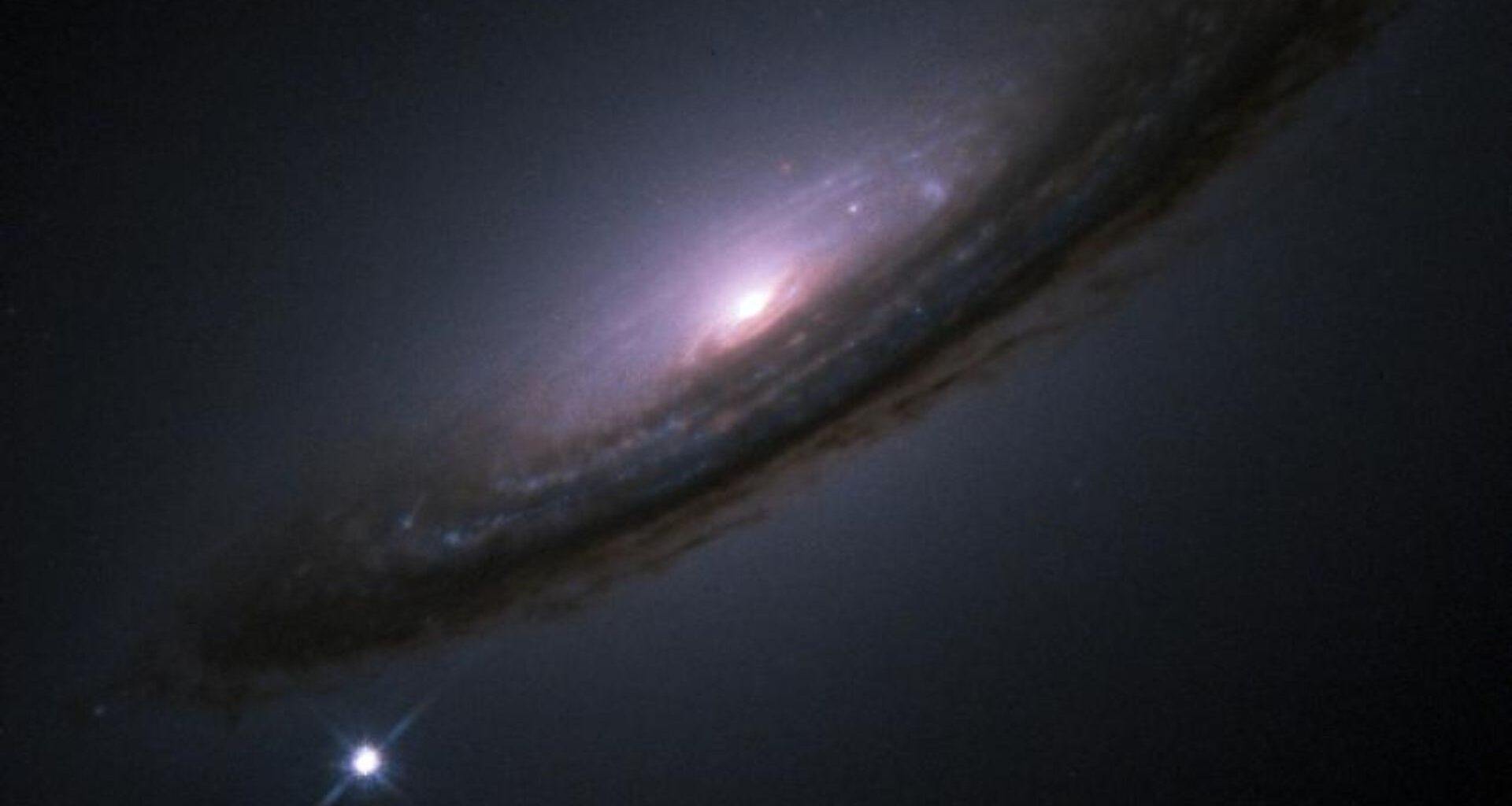
Since 1998, astronomers have relied on Type Ia supernovae to measure cosmic distances. Because these exploding stars were thought to always shine with the same intrinsic brightness, they were dubbed “standard candles.”
If a candle looked dim, it was far away. If it looked too dim, it meant the universe was expanding faster than expected, pushed by a ghostly force called dark energy.
However, Professor Lee and his team found a “glitch” in the candle.
After examining 300 host galaxies, the researchers found that a supernova‘s luminosity is actually linked to the age of its “progenitor stars.”
Specifically, they discovered that older stellar populations produce brighter explosions, while younger ones appear systematically fainter.
This means the dimness astronomers previously attributed to the universe’s rapid expansion may actually be due to the stars’ age — proving that the “standard candles” for measuring the cosmos change over time.
“Based on a much larger host-galaxy sample of 300 galaxies, the new study confirmed this effect at extremely high significance (99.999 percent confidence), suggesting that the dimming of distant supernovae arises not only from cosmological effects but also from stellar astrophysics effects,” the researchers stated.
Decelerating phase
The “Standard Model” of cosmology suggested that dark energy is a constant, unchanging force. This new data suggests otherwise.
Once the researchers accounted for this “age bias,” the traditional model of a constant dark energy force fell apart. The corrected data instead points toward a universe where dark energy is not a steady pressure but a fading one that weakens over time.
This new perspective aligns perfectly with measurements of the Cosmic Microwave Background (the afterglow of the Big Bang) and Baryonic Acoustic Oscillations (ancient sound waves frozen in space).
By combining these different cosmic maps, the study effectively rules out the long-standing theory of a “cosmological constant,” suggesting instead that the universe’s engine is running out of steam.
“Our analysis — which applies the age-bias correction — shows that the universe has already entered a decelerating phase today. Remarkably, this agrees with what is independently predicted from BAO-only or BAO+CMB analyses, though this fact has received little attention so far,” noted Lee.
To prove their case, the Yonsei team is performing an “evolution-free test,” focusing only on supernovae from galaxies of the same age.
The final verdict is likely to rest with the Vera C. Rubin Observatory in Chile. Armed with the world’s most powerful digital camera, it is expected to discover 20,000 new supernova hosts over the next five years.
The study was published in the Monthly Notices of the Royal Astronomical Society.