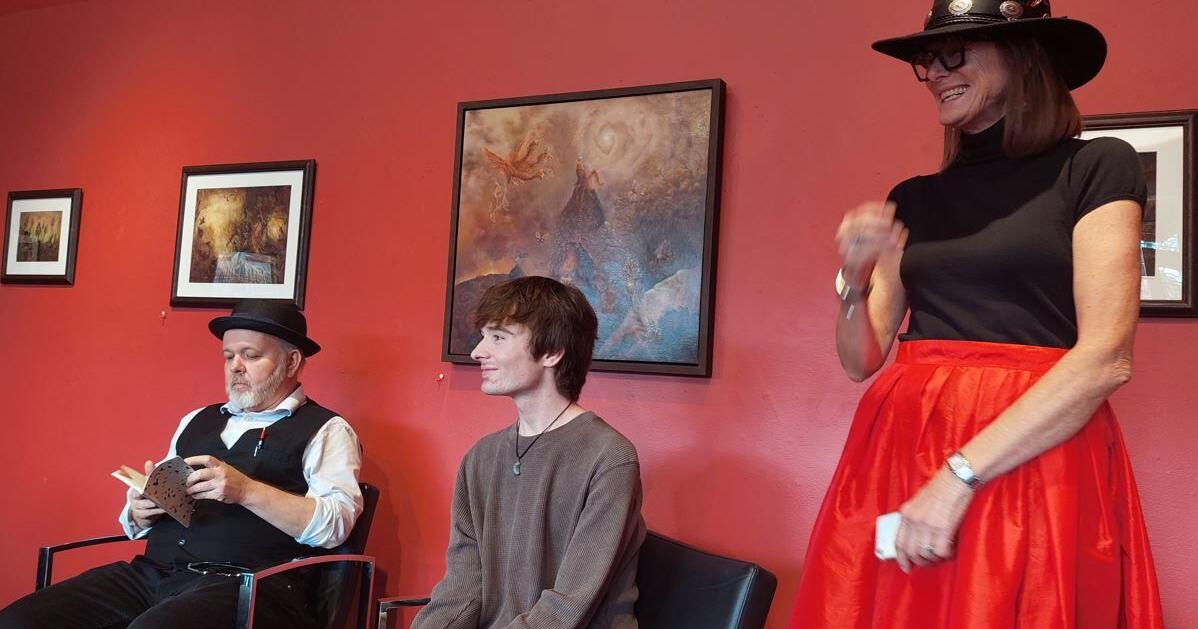
On Dec. 6, Redbud Arts Center in the Heights hosted an exhibit for artist Michael Morris. Last summer, he was awarded first place at their Emerging Visions Exhibition by curator Bradley Sumrall of the Ogden Museum. It was so successful, that Redbud planned a follow-up event recently for a hungry art world to learn more about Morris.
Executive Director and Curator of Redbud, Tanja Peterson describes Morris’ work this way:
“His watercolor paintings unfold as quiet, surreal worlds; psychological landscapes shaped by memory, mythology, and intuition,” she said. “The exhibition is appropriately named Hiraeth, after a Welsh word describing a deep longing for home, a place or time that may no longer exist, or perhaps never did.”

Every last piece at the Dec. 6 exhibition sold, as indicated by the traditional red markings. (Photo by Stephanie Shirley)
Stephanie Shirley
There was something else extremely unique about December’s exhibition; Morris sold every one of his works at the exhibition, something that rarely happens, according to Peterson.
Morris modestly refers to himself as a painter and printmaker. But, his body of work suggests so much more.
“Growing up, I developed a fondness for stories and myths, and how they mattered to the people of their day,” Morris said. “I became interested in mysteries, which evolved into an exploration in historical esoteric and occult practices. All these things make their way into my work and I apply the learnings into my art and myself.”
At only 23, Morris is a promising young talent with a very old soul.
“I was originally born in Beaumont. At four, we moved just south of Houston, between Clear Lake and Pasadena, so I have so I’ve spent the majority of my life in this area,” Morris said. “My dad has always been an artist. I vividly remember drawing with him at our coffee table. We’d draw pictures together and from then on, I’d do them on my own. I just loved expression and was always drawing.”
Adam and Eve, by Michael Morris, is a silverpoint drawing eliciting a conversation about gender. (Photo by Stephanie Shirley)
Stephanie Shirley
Morris said he first became interested in the concept of magic around age 12, influenced by the video games he grew up playing in the 2010s and his early fascination with Greek myths and fables. He works in many mediums, but credits his middle school art teacher with sparking his love for watercolor. He explained that elements like alchemy and hermeticism have always felt present in his life, shaping both his interests and the ideas he gravitates toward.
Taming the Light, by Michael Morris, is an oil representation of the struggle to find one’s way. (Photo by Stephanie Shirley)
Stephanie Shirley
“One of the things I first noticed was this beautiful palette that you have; it’s uniform throughout the watercolors and the oils,” said Sumrall. “I was thinking about these concepts of the black, the red, and the white. With black being putrefaction, death and dissolution and the white being purification and red being unification towards perfection in Alchemy. Were those colors and those concepts also a part of this?” In art, alchemy is defined as the practice of ‘transforming ordinary materials or experiences into something extraordinary, often with spiritual or psychological depth’.
Morris said many of the scenes in his work exist in a state of transition, a concept rooted in an early Celtic belief in the “in-between”—the periods between winter and spring, or dawn and dusk, when the world is thought to sit closer to the spiritual realm. During these liminal moments, he explained, gods, ancestors, fairies, demons, and ghosts are believed to move more freely, an idea that has deeply influenced his work.
Sumrall chose a work at random, Cosmic Guides, and asked Morris to address the inspiration, imagery, narrative behind the process. Morris shared that he’d been through a particularly challenging time of life between college and graduate school.
“I’ve always felt guided. My mom, in particular, encouraged me as a child and instilled a belief in guardian angels,” Morris said. “That was always really comforting as a kid. The flying figures were inspired by one of my favorite alchemists, a greater influence than any other artist, Paracelsus. He believed in these kinds of spirits that relate to the natural world; sylphs (the elements of air).”
They were one of the elementals, along with earth, fire and water.
“Some hold chamomile flowers representing resilience and endurance. I’ve always felt deeply connected to the natural world, believing these spirits are guiding me,” Morris continued. “I suspect they represent parts of myself. People have even commented that they look like me. That wasn’t the intention, but it’s probably fitting.”
Hillaree Hamblin, HCU’s Director of the Masters of Fine Arts Program, was moved by Morris’s expression:
“He has an understanding of love, life, and death well beyond his years.”
Cosmic Guides, by Michael Morris, is a watercolor imagery depicting the search for guidance. (Photo by Stephanie Shirley)
Stephanie Shirley
Sumrall also asked Morris about the intentionality of the androgynous characters in his works. Morris feels like imposing things like gender, race and age takes the conversation to an unintended place outside of what he is trying to communicate.
“I just wanted these humanoid figures to be stripped of everything,” Morris said. “I didn’t realize the alchemical significance of intersex figures as being the unification in opposites until recently. Many alchemists believed that Jesus was intersex. I think all us have an understanding of what it means to be male or female. We all have masculine and feminine traits. I feel like denying those parts of ourselves, as in men being taught not to be emotional, is such a disservice. Perhaps, that’s why men tend to die sooner than women, but that’s just my personal perspective!”
For further information on the artist, exhibit or gallery, please visit: redbudartscenter.com