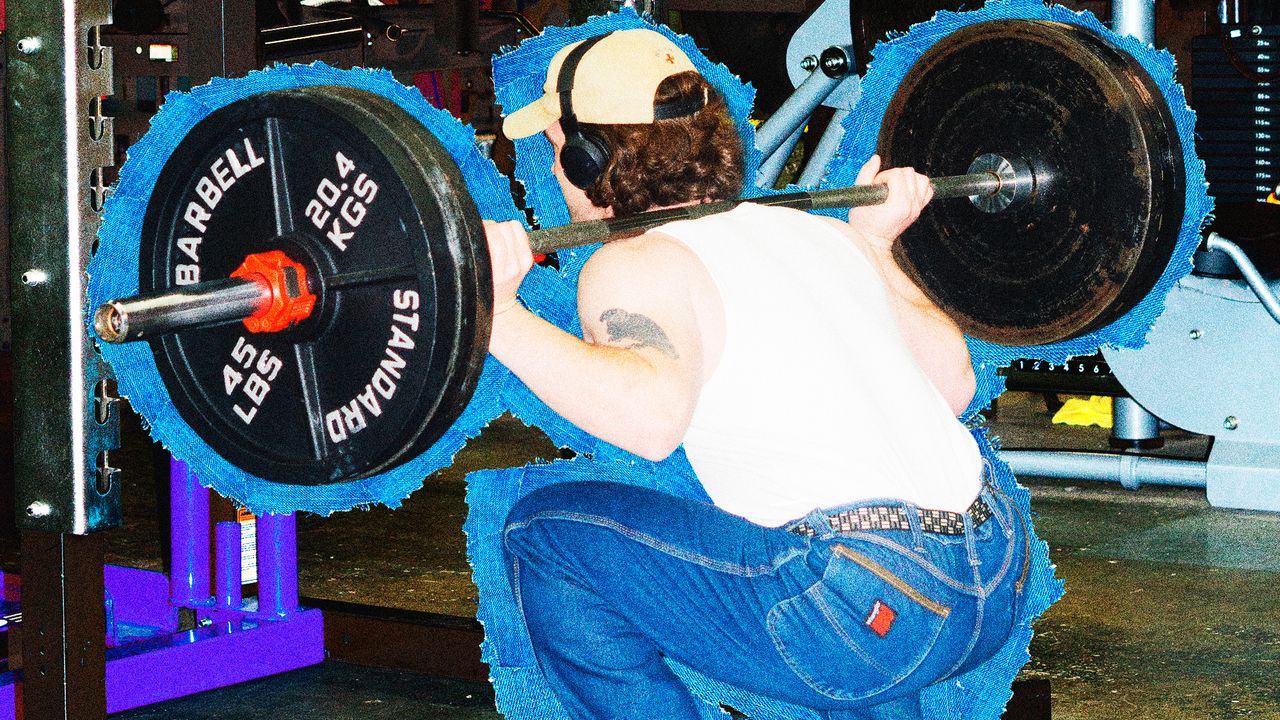
For Atlas, the decision is half convenient, half idiosyncratic. After years of regular workouts at gyms, in standard gym clothes, the pandemic forced him to set up a home gym—and his young children forced him to get in quick workouts whenever he could. “During my kids’ nap, I’d run out and do a workout,” Atlas says, “and I happened to be wearing jeans during the nap.”
As Atlas increased the weight and taped more workout videos, he kept the jeans both on and offscreen, switching over to a pair specially designed for lifters by Barbell Apparel with a gusseted inseam and extra roomy thighs after the brand sponsored him. And there turned out to be an additional benefit to the jeans, especially for someone trying to grow their online audience. “If I post a cool lift in jeans, there’ll be five people asking why I did it in jeans,” Atlas says, “which is engagement.”
Then there are the ordinary offline lifters among us who choose this denim-clad path. Jeremy Anderegg, a South Carolina archivist, has been exercising in jeans for years, often at home and occasionally in a gym. “I’ll rip off 100 kettlebell swings every day and do complexes,” he says, preferring to do so in Carhartt B11 single-knee jeans because “the double knees are too restrictive.”
Anderegg settled on the Carhartts when he was living in Brooklyn, partly out of an adherence to minimalism. “I’m not an equipment guy,” he explains, and at the time he bought his B11s, they were only his fourth pair of pants, period. “I’d bartend in them and then clear brush, and then would go out to dinner, changing my shirt as a low-key way to get the workouts in throughout the day.”
Which fits in with an accurate, if antiquated, conception of gym clothes—very simply, whatever clothes people owned and which they also wore to the gym. A century ago, in the Zercher era, lifters sweated in what they could find. Those traditional outfits, while more formal and rarely designed for maximal movement, were produced from natural fabrics like cotton or merino wool. (Polyester did not come into use until, by some estimates, the 1950s.) While it’s counterintuitive now to think that baseball players wore wool cardigans to the ballpark, or that strongmen donned merino pants to lift weights, there’s something to be said about the exercise coming first.