TOI-561 b, a rocky exoplanet roughly twice the mass of Earth, orbits its host star at a blistering pace, about forty times closer than Mercury is to the Sun. Scientists long assumed that a world under such extreme conditions would be unable to retain an atmosphere.
But as reported by the Carnegie Institution for Science, new observations suggest this super-Earth is not a bare rock after all. The data was gathered using the JWST’s powerful Near-Infrared Spectrograph (NIRSpec), allowing researchers to analyze the planet’s dayside emissions.
Emission Data Reveals Unexpected Atmospheric Signature
The research team used JWST’s NIRSpec instrument to measure light in the 3- to 5-micron range coming from TOI-561 b’s dayside. The method involved observing the system before, during, and after the secondary eclipse, when the planet passes behind its star. This allowed scientists to isolate and analyze the thermal signature from the planet itself.
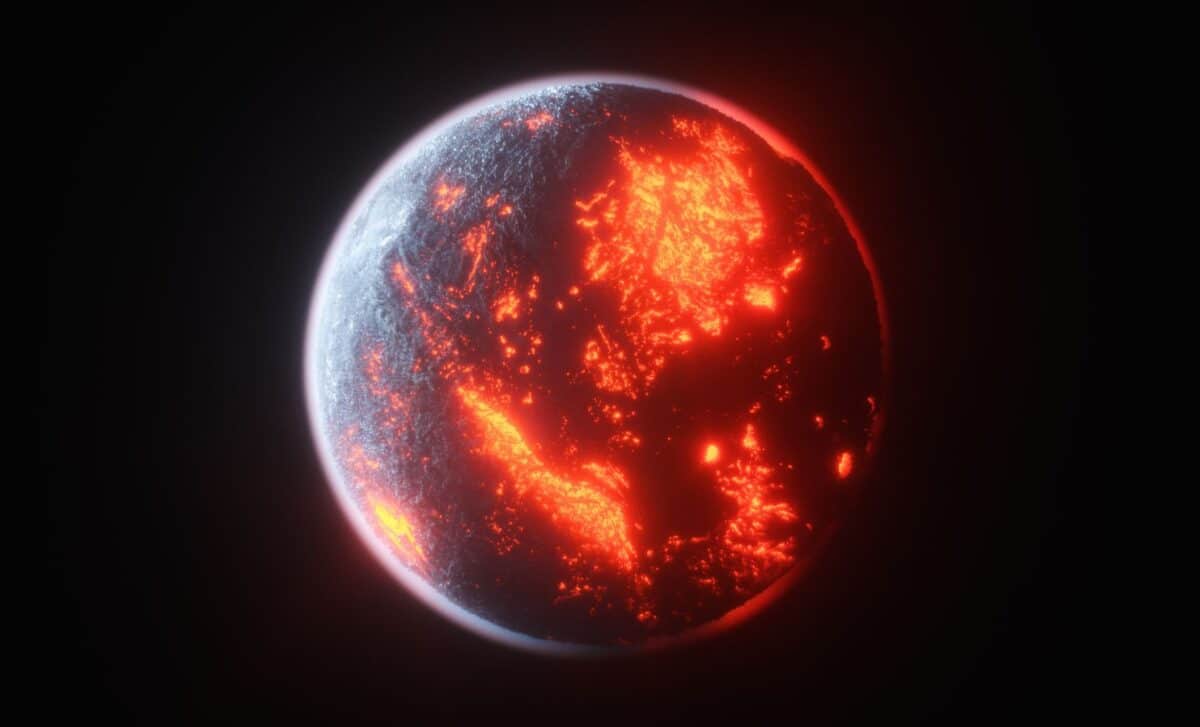
 An impression of TOI-561 b’s possible appearance. Credit: W. M. Keck Observatory/Adam Makarenko
The key finding was a dayside temperature of about 1,800 degrees Celsius (3,200 °F). This is significantly cooler than what would be expected if the planet lacked an atmosphere, which should have caused temperatures near 2,700 degrees Celsius (4,900 °F).
According to The Astrophysical Journal Letters, models that assume a bare-rock surface or a thin rock-vapor atmosphere predicted a much brighter dayside. Instead, the data closely matched models with a volatile-rich atmosphere, possibly made up of water vapor, oxygen, and carbon dioxide. Anjali Piette, co-author and researcher at the University of Birmingham, explained that:
“Strong winds would cool the dayside by transporting heat over to the nightside. Gases like water vapor would absorb some wavelengths of near-infrared light emitted by the surface before they make it all the way up through the atmosphere. It’s also possible that there are bright silicate clouds that cool the atmosphere by reflecting starlight.”
A Magma Ocean In Equilibrium With The Atmosphere
TOI-561 b is likely covered by a global magma ocean, contributing to a unique interaction between its surface and atmosphere. The co-author Tim Lichtenberg, from the University of Groningen, stated that there may be an “equilibrium between the magma ocean and the atmosphere” where gases escape into space but are also absorbed back into the planet’s molten surface.
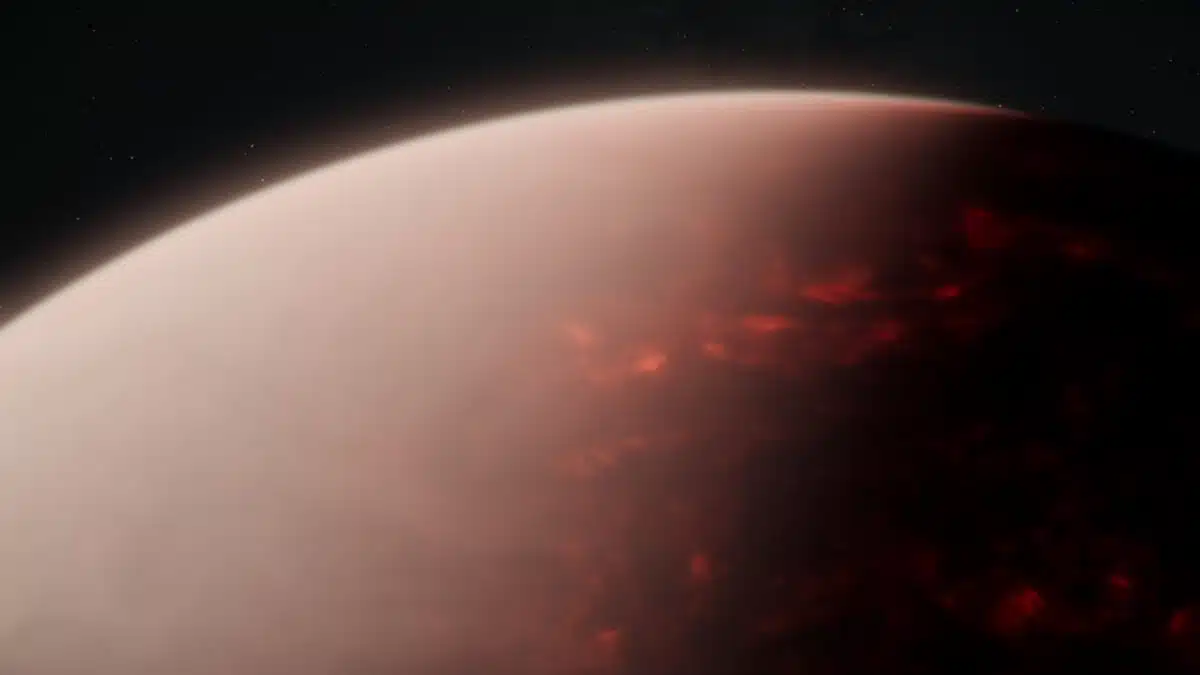 This conceptual image depicts a possible view of TOI-561 b, featuring a dense atmosphere hovering above a global magma ocean. Credit: NASA, ESA, CSA, Ralf Crawford (STScI)
This complex exchange could help explain how the planet has managed to retain an atmosphere despite the intense radiation from its host star.
“This planet must be much, much more volatile-rich than Earth to explain the observations,” Lichtenberg noted, calling it “really like a wet lava ball.”
The planet’s density also played a role in attracting interest. As noted by the lead author Johanna Teske, the team initially targeted TOI-561 b because of its unusually low density, which could have been caused by a smaller iron core or less dense rocky material in the mantle. But neither scenario alone accounted for the data, the atmosphere proved to be the missing piece.
A Relic From A Different Galactic Era
TOI-561 b’s star is twice as old as our Sun and resides in the thick disk of the Milky Way, an ancient galactic region populated by chemically distinct stars. As mentioned in the research, this means the planet likely formed in a very different chemical environment than Earth and other planets in the solar system.
NEWS 🚨: JWST found the strongest evidence yet of a rocky planet with an atmosphere outside our solar system
The exoplanet, TOI-561 b, defies prior beliefs that its insane 3,100°F dayside temp would prevent it from having a stable atmosphere
"…Gases are coming out of the… pic.twitter.com/zFJXt46GCc
— Latest in space (@latestinspace) December 11, 2025
Its host star is also iron-poor, which adds another layer of complexity to the planet’s composition and evolution. The combination of an old star, iron deficiency, and retained atmosphere makes TOI-561 b a particularly valuable object of study for scientists exploring the history of planetary formation in the early universe.
These findings come from JWST’s General Observers Program 3860, which continuously observed the system for over 37 hours. During that time, TOI-561 b completed nearly four full orbits, offering researchers a rare and detailed look at a planet that, until now, defied the odds. As Teske concluded, “this new data set is opening up even more questions than it’s answering.”