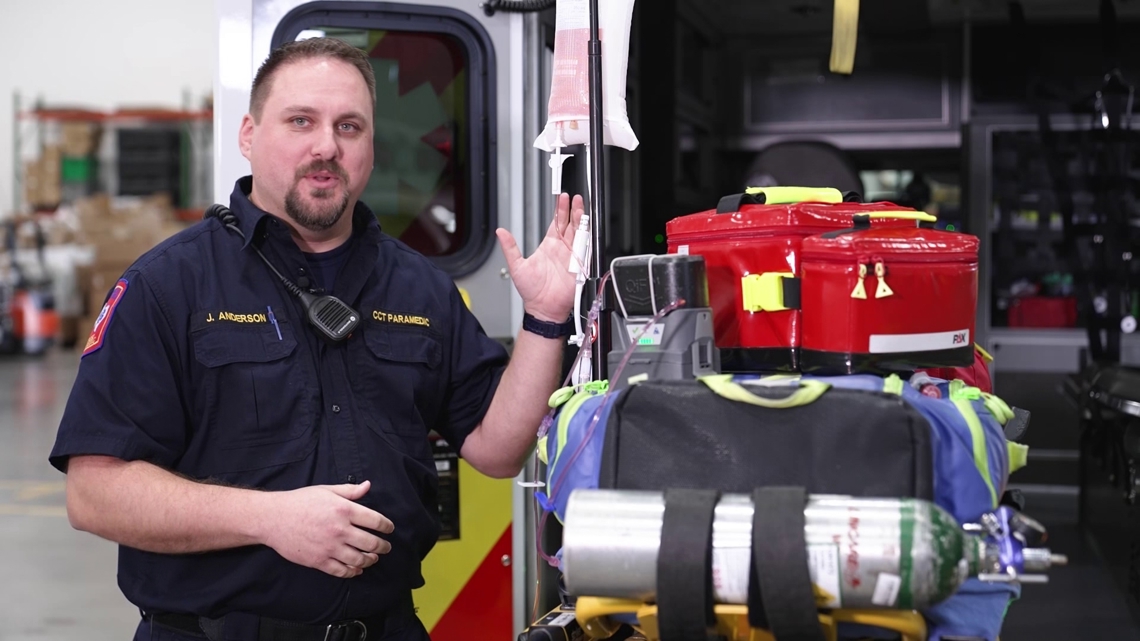
Dallas, Fort Worth and Arlington have all launched programs enabling first responders to transfuse blood to patients in the field
ARLINGTON, Texas — When Arlington EMS paramedic Dale Van Leeuwen arrived at the 911 call on Oct. 15, the trail of blood showed him something was terribly wrong.
It also gave him a chance to use a new program less than 48 hours old to help save a life.
The new mother inside the home was hemorrhaging blood days after giving birth — and she had lost a lot of it.
“She looked like a ghost,” he said. “We eventually found her in the bathtub and the entire bathtub was completely full with blood.”
Here’s where the Arlington’s new mobile blood transfusion program came in.
The partnership between AMR, Medical City Arlington and the Arlington Fire Department meant that three emergency units stationed throughout the city had been outfitted with special coolers carrying pints of O-positive blood for medical and trauma calls just like the one Van Leeuwen faced.
It meant that paramedics could replenish the young mother’s lost blood with fresh blood — rather than dilute what little she had left with the typical saline mix.
“This is actually putting what you’re losing out right back into you,” explained Arlington Fire EMS Lt. Jason Adams. “It’s red, but it’s liquid gold.”
And it allows medics to give blood to patients who need it on the way to the hospital, long before they might otherwise get it in the emergency department. In some cases, Adams said, paramedics can even administer blood to a patient trapped in a car while firefighters use Jaws of Life to extricate them.
“Both patients that I gave it to was almost an immediate turnaround. They almost immediately looked better, did better,” Adams said.
Deploying the program — which has already been used more than a dozen times in Arlington — was no easy feat. It involves a complicated dance of specialized equipment, training, contracts and trust — between the first responders and the hospital whose blood banks they rely upon for a fresh supply.
“The last thing I want to have happen is a unit of blood to go bad,” Adams said. “Someone gave that unit of blood out of their body and the worst thing we could do is waste it.”
In Arlington, that means any unused blood gets cycled back to the hospital with time to spare before it expires — and multiple alarms on the back-of-vehicle coolers designed to keep the blood at the near-freezing standard, even in hot Texas summers.
The program in Arlington is innovative, but it’s not novel in North Texas; Fort Worth and Dallas Fire Departments rolled out similar pilots in 2025. Texas lawmakers allocated $10 million in the last regular legislative session to help expand similar whole blood programs to other departments across the state as well.
“We’re proving how much of a difference it actually does make,” said Van Leeuwen, the paramedic.
He said the new mother who first benefited from the mobile blood transfusion in October was discharged days later — not a certain outcome given the gravity of her condition when paramedics arrived.
“Full recovery,” Van Leeuwen said. “She was able to go home to her newborn child.”