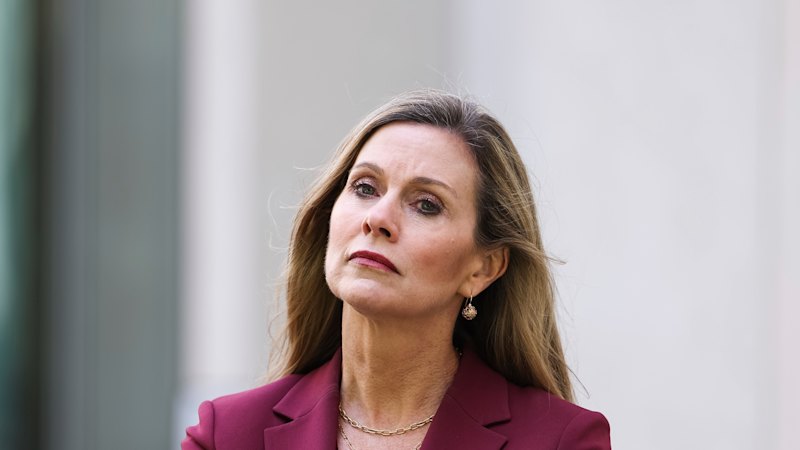
Jordan gave Inman Grant two weeks to reply to his request and accused eSafety of “attempts to mandate global content takedowns, and … to design and implement a global censorship regime.”
He said Inman Grant’s written response to the previous request for testimony, made on November 18, was insufficient.
Jordan has accused the eSafety commissioner of attempting worldwide online censorship and cited her office’s demand that Elon Musk’s social media platform X remove graphic footage of a church stabbing in Sydney, arguing global removal was necessary because Australians could use VPNs to access the content. The case was abandoned.
VPNs, or virtual private networks, may be used to conceal a user’s country of origin and circumvent geo-blocking of content.
Jordan also referred for the first time to Australia social media age bans and said he suspected Inman Grant may be using it as another way to impose global bans that would restrict free speech in the US.
Loading
“In 2024, you used concerns about VPNs as a pretext to demand global takedowns of social media content,” Jordan wrote. “The documents obtained by the Committee suggest that you may be using this playbook again. Testimony about each of these initiatives will inform the Committee’s legislative reforms aimed at ensuring that foreign censors cannot silence protected American speech.”
Jordan said the committee had obtained correspondence between eSafety and social media companies, where the Australian agency requested they demonstrate how they will enforce the social media age bans and prevent use of VPNs to dodge restrictions.
“New documents indicate that eSafety harassed American companies ahead of the implementation of the Social Media Minimum Age law.”
Asked how they would respond to this attack on an Australian government official by the US, the offices of Prime Minister Anthony Albanese and Communications Minister Anika Wells declined to comment.
Albanese and Wells flew to New York in September to showcase Australia’s world-leading social media ban for teens at the United Nations, but it was not part of the prime minister’s public discussions with US President Donald Trump in October.
Social media giants are complying with the ban introduced on December 10, although Reddit is challenging it in the High Court.
US Secretary of State Marco Rubio in December called the five people barred from the states “leading figures of the global censorship-industrial complex”.
Those barred from the US are Thierry Breton, a former European Commissioner for Internal Markets and Digital Services; Imran Ahmed, a British Labour strategist who is chief executive of the Centre for Countering Digital Hate; Clare Melford, a Briton who runs the Global Disinformation Index; and two leaders of German organisation HateAid.
“For far too long, ideologues in Europe have led organised efforts to coerce American platforms to punish American viewpoints they oppose,” Rubio said.
The eSafety Commission declined to comment.
Cut through the noise of federal politics with news, views and expert analysis. Subscribers can sign up to our weekly Inside Politics newsletter.