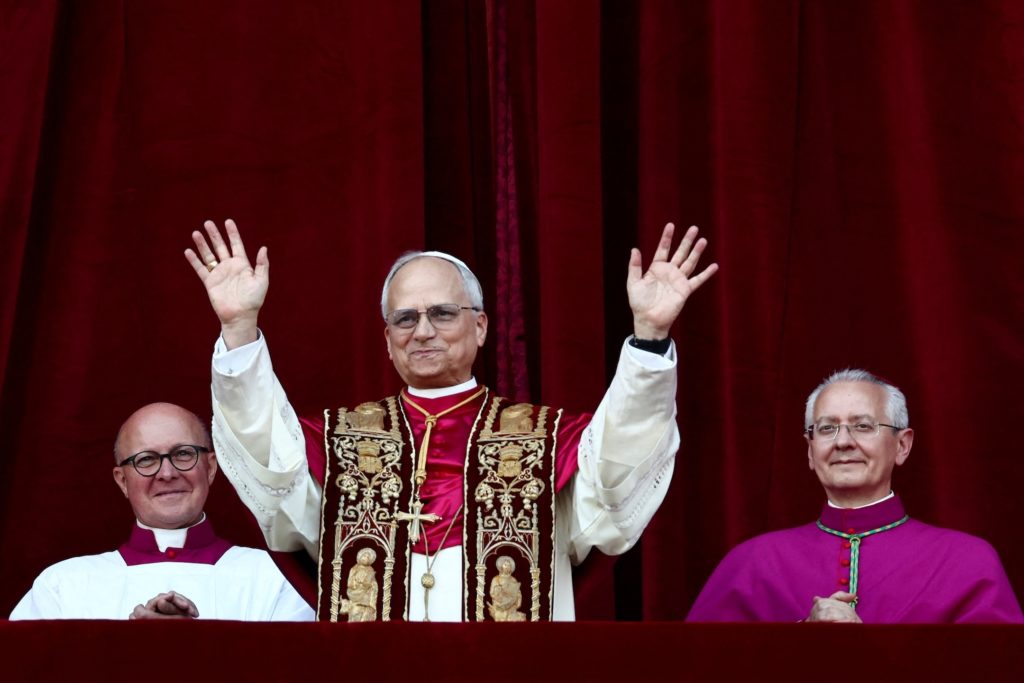
We are taking our annual look back at some of the year’s biggest images. We hear from four photojournalists who documented life on the frontlines in Ukraine, major changes in immigration enforcement in the U.S., the historic election of a new pope and more. It’s part of our arts and culture series, CANVAS.
Lisa Desjardins:
Tonight, we’re also highlighting our annual review of some of the year’s biggest images, stories through photography.
We hear from four photojournalists. Among them, they documented life on the front lines in Ukraine, major changes in immigration enforcement in the U.S., the historic election of a new pope, and more.
It’s part of our ongoing series on arts and culture, Canvas.
Mario Tama, Getty Images:
My name is Mario Tama. And I’m a staff photographer with Getty Images.
Evgeniy Maloletka, Associated Press:
My name is Evgeniy Maloletka. I’m a Ukrainian photojournalist. I’m working currently for the Associated Press as a chief photographer here in Kyiv.
Yara Nardi, Reuters:
I’m Yara Nardi. I’m a staff photographer for Reuters, and I’m based in Rome.
Victor Blue, Freelance Photojournalist:
My name is Victor Blue. I’m a freelance photojournalist and I’m based in New York City.
Mario Tama:
The morning of January 7 started out ominously. I was awoken at 3:00 a.m. by the sound of the Santa Ana winds, and the Pacific Palisades Fire broke out later that morning.
By that evening I was covering the Eaton Fire in Pasadena and Altadena. I never imagined that I’d be covering two major fires simultaneously on the same day burning through communities here in Los Angeles.
As photojournalists, our role is to act as the eyes of the public. I think of my job as to be there on the ground documenting what I find, what I see, but not just the flames, not just the destruction. I believe it’s our duty to try to capture the human toll, the human element.
Victor Blue:
It’s been an intense and historic year for our country’s relationship to its immigration and to immigrants and the immigrants that make up our country.
And it’s been gratifying to have been able to spend a lot of time covering that. And the big change is the hyperaggressive focus on capturing and removing folks with various levels of status. And there was like a flattening of folks, and either you lived here or you didn’t, you belong or you don’t.
And the aggressive enforcement of that perspective I think surprised a lot of the country and I think definitely is a historic shift for our society.
Evgeniy Maloletka:
2024 was the beginning of the war of the drones, of massive, massive use. But this year, it’s increased and three or four times higher the using of drones. Both sides, Ukrainians, the Russians, use different type of these drones to target each other.
It’s really hard nowadays to photograph what’s going on at the battlefield and to show because of the dangerous and the security situation because of the drones. I’m constantly coming back and forth for the rehabilitation stories, because I know that so many of our soldiers who return from the battlefield with wounds, and they are trying to live a normal life.
This is so important for me, as a Ukrainian, to tell as much stories as possible about all the Ukrainians, about — and what is happening with Ukraine nowadays in all of it, and how we live under the rockets, under these drones, trying to live a normal life. And this is our reality.
Yara Nardi:
Covering the pope’s death and the conclave and then the election of the new pope is one of the most important stories that I ever covered.
Even if you are secular, it’s really — it’s something big. It’s something that touch all over the world. There’s one shot that I really, really love that I took from the top of Saint Peter’s Basilica. You can see millions of people in a totally silence. And this was one of the deepest moments that I ever live in my life, just the silence.
I remember the silence.
(Crosstalk)
Yara Nardi:
When Pope Leo was elected and he came out from the balcony, I was really surprised, because I spent the last months thinking about who would be the next pope, and I never thought about him, to be honest.
I can see people really welcoming to him. They really want to know him, touch him, especially touch him. Most of the time, my picture are about hands, hands touching other hands, pope hands.
(Laughter)
Yara Nardi:
I love this side of the story.
Mario Tama:
I remember the morning that the National Guard troops arrived in L.A.
And although that day started peacefully, it eventually turned into chaos. And you’re trying to just maintain constant situational awareness. It’s a little bit hard to describe, but you’re kind of running on instinct and on feel. I’d heard of a major federal immigration raid happening at a cannabis farm out in rural Ventura County.
This was like a large-scale, almost like military-style raid. And so members of the community showed up and were protesting out in this rural farmland. It was a striking contrast between federal agents in gas masks and helmets with less lethal munitions standing in this pastoral farmland with protesters on the other side. And it was just something I never imagined that I would witness.
Victor Blue:
The agents and the migrants are the two great protagonists in this trauma. As photojournalists, we’re standing back kind of trying to understand both of those kind of categories of people, trying to communicate faithfully and accurately the experience they’re having as they interact in this way.
I’m not there to celebrate one side of this debate and I’m not there to demonize the other side of the debate. I’m there to help readers understand how complex and how three-dimensional and how nuanced everybody involved is. I’m not trying to make the decision for anybody what they think or feel about any of these issues.