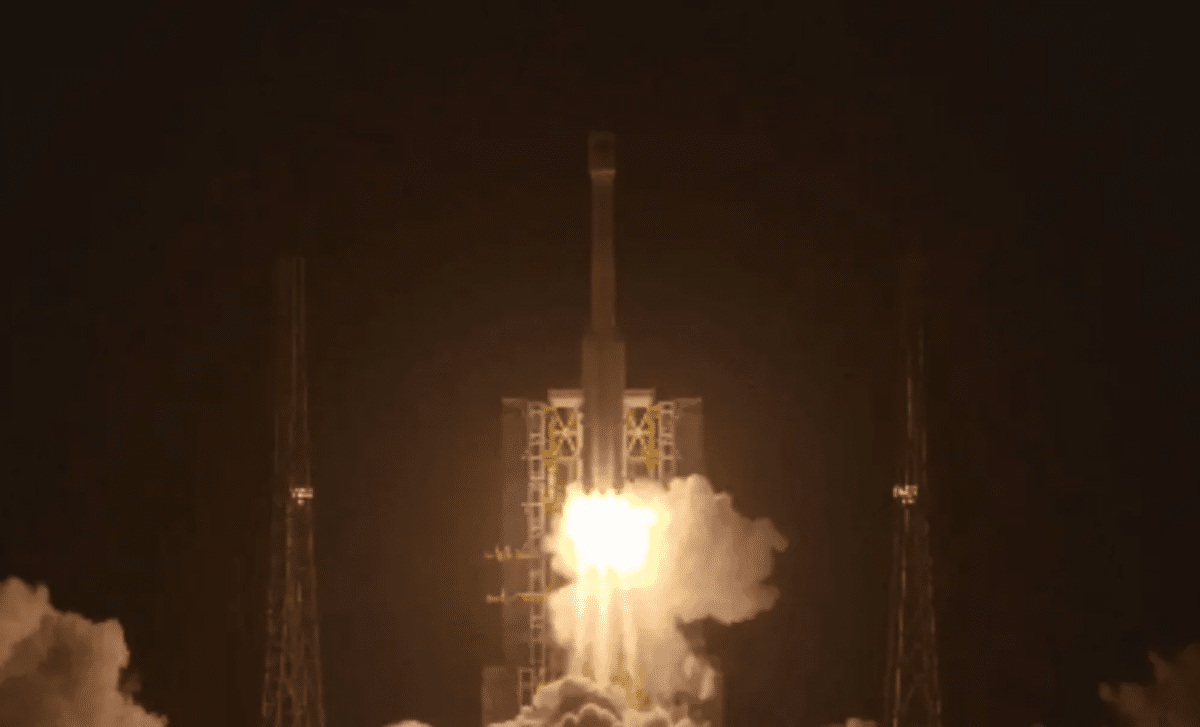
China launched two new-generation satellites, Shijian-29A and Shijian-29B, on December 31, 2025, using a modified Long March-7 rocket from the Wenchang Space Launch Site, as reported by CGTN. This mission continues China’s rapid expansion in orbital capability and technological experimentation, especially in the realm of space target detection.
A Strategic Launch To Close 2025
The final days of 2025 saw China’s space program adding another milestone to its growing legacy. At exactly 6:40 a.m. local time, a modified Long March-7 lifted off from the southern island province of Hainan, carrying a dual payload: the Shijian-29A and Shijian-29B satellites. These satellites have been inserted successfully into their preset orbits, and according to official sources, they are primarily designated for space technology verification tasks.
This launch adds to an increasingly sophisticated series of missions targeting orbital innovation and sensor performance trials. Designed for high-altitude deployment, the Long March-7 variant used in this launch has proven itself as a versatile medium-class launch vehicle, capable of delivering both single and dual payloads depending on mission requirements. The final launch of the year reflects how China’s spaceflight cadence has accelerated, completing 73 missions in 2025, compared to 51 in 2024.
Shijian-29: A Platform For Orbital Experimentation
The Shijian satellite series is often used by China Aerospace Science and Technology Corporation (CASC) to test new materials, subsystems, and orbital maneuvers. With the addition of Shijian-29A and 29B, the latest mission contributes to a broader program focused on advanced surveillance, detection systems, and responsive space operations. According to CGTN, these satellites are explicitly intended for technology verification related to space target detection, a domain critical for both civil and strategic applications.
While details about the onboard payloads remain limited, consistent with the traditionally discreet nature of Shijian missions, analysts suggest that they may include new sensors, radar prototypes, or AI-driven tracking systems capable of monitoring fast-moving objects or satellite constellations in orbit. This could be part of a longer-term effort to establish autonomous orbital situational awareness, a vital capability in an increasingly crowded and competitive low Earth orbit (LEO) environment.
Long March-7: Evolving China’s Orbital Logistics
The Long March-7 rocket has emerged as a backbone of China’s medium-lift capabilities, particularly suited for high-inclination or geosynchronous transfer orbits. Developed by the China Academy of Launch Vehicle Technology (CALT) under CASC, this platform is also a testbed for next-generation propulsion systems and modular launch infrastructure.
The rocket used in this mission was a modified version, signaling that continuous improvements are being made to address a variety of orbital mission profiles. This flexibility reflects China’s broader goal of streamlining launch operations while adapting quickly to diverse payload requirements. The success of the 623rd flight of the Long March rocket series confirms both the reliability and evolution of China’s space launch architecture.