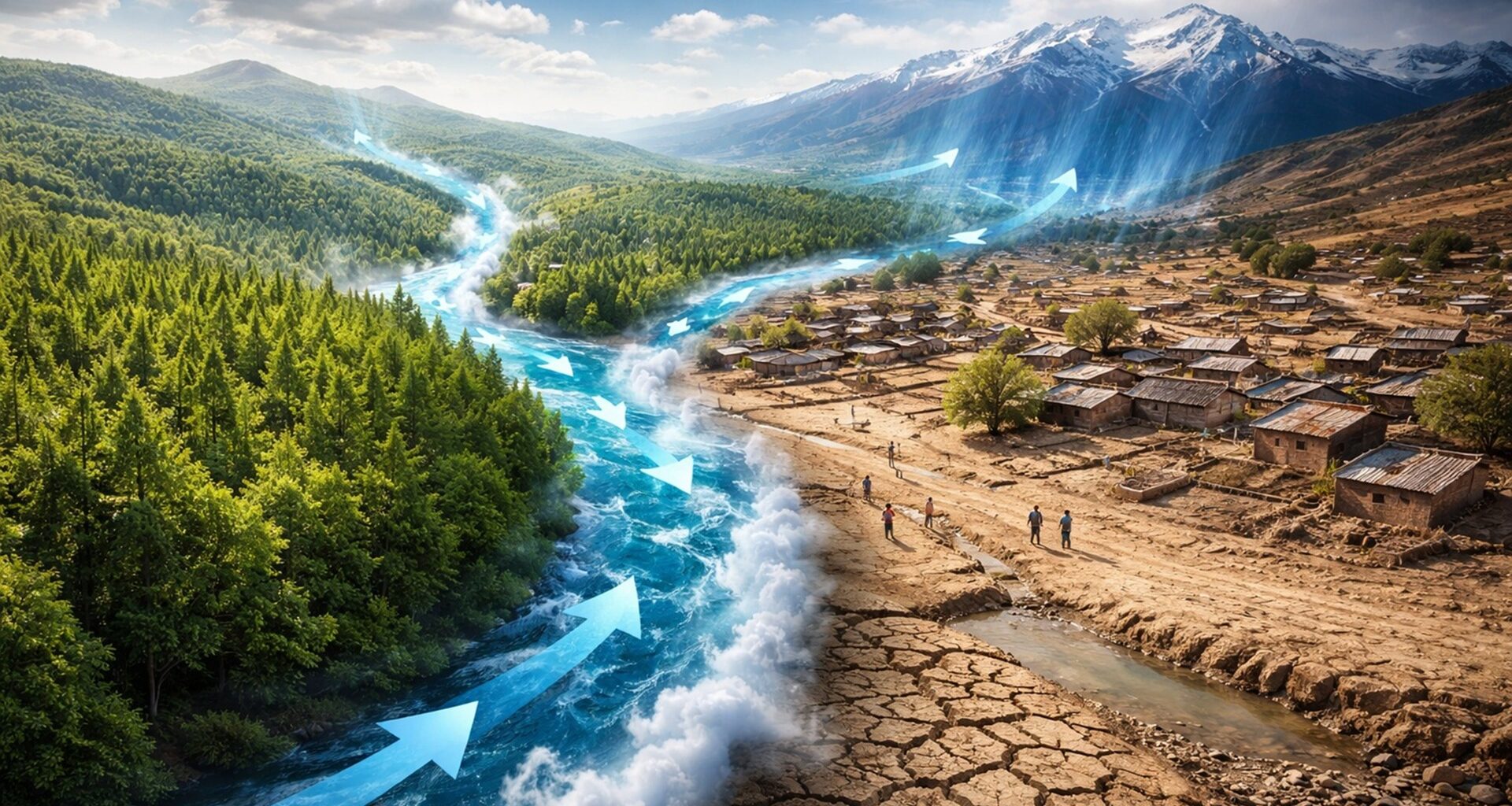
Between 2001 and 2020, reforestation and pasture restoration programs altered Chinese vegetation cover, intensified evapotranspiration, redistributed rainfall over up to 7.000 kilometers, and reduced the availability of freshwater in regions with high population density, agriculture, and economic activity, according to a recent scientific study.
Between 2001 and 2020, reforestation and tree restoration in China altered the water cycle, reduced water availability in 74% of the territory, and increased supply in the Tibetan Plateau, according to a study published on October 4 in the journal Earth’s Future.
Changes in vegetation cover and national effects
China’s efforts to slow soil degradation and address climate change through tree planting and grassland restoration have led to widespread and unexpected changes in water distribution across the country, according to new scientific research.
The study analyzed the period between 2001 and 2020 and identified that changes in vegetation cover reduced the amount of freshwater available to humans and ecosystems in the monsoon-influenced eastern region and the arid northwestern region.
— ARTICLE CONTINUES BELOW —
Are you in favor of US military intervention in Venezuela and the arrest of Nicolas Maduro?
— Click Oil and Gas (@clickpetroleoeg) January 3, 2026
These two areas together represent 74% of China’s land area. During the same period, water availability increased in the Tibetan Plateau, a region that corresponds to the remainder of the national territory.
Researchers point out that the redistribution of water did not occur homogeneously, even with the general intensification of the hydrological cycle associated with changes in land use on a national scale.
Evapotranspiration and the functioning of the water cycle
According to scientists, three main processes move water between continents and the atmosphere: evaporation, transpiration, and precipitation. Evaporation removes water from surfaces and soil, while transpiration releases water absorbed by plants back into the atmosphere.
The combination of these two processes is called evapotranspiration. This indicator varies according to vegetation cover, water availability, and the amount of solar energy reaching the Earth’s surface, explained study co-author Arie Staal.
Pastures and forests tend to increase evapotranspiration. The effect is especially intense in forested areas because trees have deep roots capable of accessing water even during prolonged droughts.
In the Chinese case, the expansion of this vegetation cover accelerated the transfer of water to the atmosphere, altering the balance between local loss and return through precipitation.
The Great Green Wall and forest expansion
China’s largest reforestation project is the Great Green Wall, located in the arid and semi-arid north of the country. Started in 1978, the initiative was created to contain the expansion of deserts.
Over five decades, the project has contributed to a significant increase in national forest cover, which has grown from about 10% of the territory in 1949 to more than 25% today, an area equivalent to the size of Algeria.
Last year, government representatives announced that the country had completed the encirclement of its largest vegetated desert, although tree planting continues as a strategy to combat desertification.
In addition to the Great Green Wall, other large-scale programs have reinforced forest expansion in different regions of the country in recent decades.
National programs and global impact
Among the main projects are the Grains for Green Program and the Natural Forest Protection Program, both initiated in 1999. The first encourages farmers to convert agricultural land into forests and pastures.
The second program prohibits logging in primary forests and promotes the reforestation of degraded areas. Together, these initiatives have transformed vast rural and forest landscapes across China.
Taken together, China’s ecosystem restoration efforts account for 25% of the global net increase in leaf area observed between 2000 and 2017, according to data cited in the study.
This accelerated vegetation growth, while relevant from an environmental standpoint, has had direct consequences for the water cycle, with effects that extend beyond the reforested areas.
Water redistribution and atmospheric transport
To investigate the hydrological impacts, the researchers used high-resolution data on evapotranspiration, precipitation, and land-use change, as well as an atmospheric moisture tracking model.
The results showed that evapotranspiration increased more than precipitation. This means that some of the water was transferred to the atmosphere without returning locally as rain.
This effect was not uniform because winds can transport water vapor over distances of up to 7.000 kilometers, causing evapotranspiration in one region to influence precipitation in another.
In China, forest expansion in the east under the influence of monsoons and the restoration of pastures in other areas increased evapotranspiration, but the increase in precipitation was concentrated on the Tibetan Plateau.
Water inequality and management challenges
As a result, regions outside the Tibetan Plateau experienced a reduction in the availability of fresh water, despite a more active hydrological cycle on a national scale, according to the study’s authors.
This scenario has direct implications for water resource management, since water distribution in China has historically been unequal. The north concentrates about 20% of the country’s available water.
At the same time, this region is home to 46% of the Chinese population and 60% of the arable land, increasing the pressure on resources. hydrological in areas that are already facing relative scarcity.
The Chinese government is seeking solutions to this imbalance, but researchers warn that measures may fail if they do not consider the effects of reforestation on water redistribution.
Lessons for other countries
The authors point out that ecosystem restoration and reforestation in other countries may also be affecting water cycles in similar ways, although the effects vary according to the local context.
From a water resources perspective, research suggests that each case should be analyzed individually to assess whether certain changes in land cover are beneficial or not.
This depends, among other factors, on how much water transferred to the atmosphere returns as precipitation and where it is deposited, Staal emphasized in an email communication.
The study concludes that large-scale environmental policies, while effective in restoring ecosystems, need to carefully consider their hydrological impacts to avoid unintended side effects on water availability.