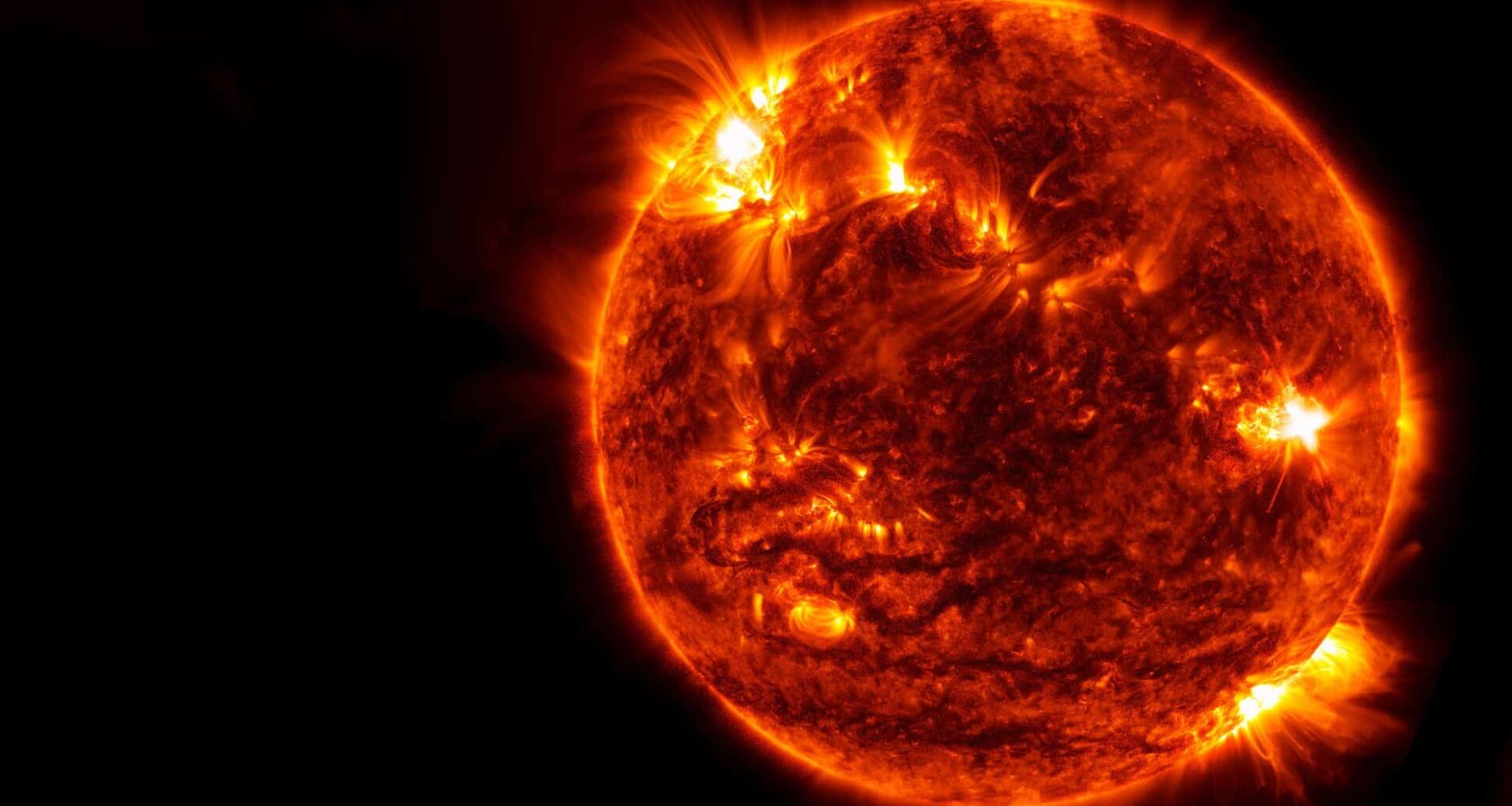
For years, solar scientists have been studying the Sun’s complex atmosphere, trying to decode the forces that shape its activity. From massive magnetic loops to tiny flickers of light, the Sun remains a vast, dynamic frontier in science. While individual instruments have provided critical insights, the collaboration between DKIST and Solar Orbiter marks a new chapter.
The two telescopes—one based on Earth and the other orbiting the Sun—work together to capture the Sun’s activity from complementary perspectives. The results have the potential to redefine our understanding of solar phenomena that influence everything from space weather to our planet’s climate.
A Unique Collaboration
The coordinated observations between DKIST and Solar Orbiter were a landmark achievement in solar science. As noted in a recent report published in Astronomy & Astrophysics, the two instruments worked in concert for the first time in October 2022 to observe a decaying solar active region. Solar Orbiter, positioned just one-third of the way closer to the Sun than Earth, provided a space-based perspective, while DKIST, the world’s largest solar telescope, offered a ground-based viewpoint from the summit of Maui’s Haleakalā. This unique setup allowed for a stereoscopic view of solar structures, providing details that would have been impossible with just one instrument.
While both observatories are equipped with advanced instruments, they complement each other in ways that enhance their individual capabilities. DKIST specializes in observing the middle layers of the Sun’s atmosphere, particularly the photosphere and chromosphere, while Solar Orbiter can capture the hotter, more dynamic outer layers, including the transition region and corona. By combining these perspectives, scientists can study solar phenomena from their origins deep within the Sun’s atmosphere to their outermost layers, creating a much more complete picture of solar activity.
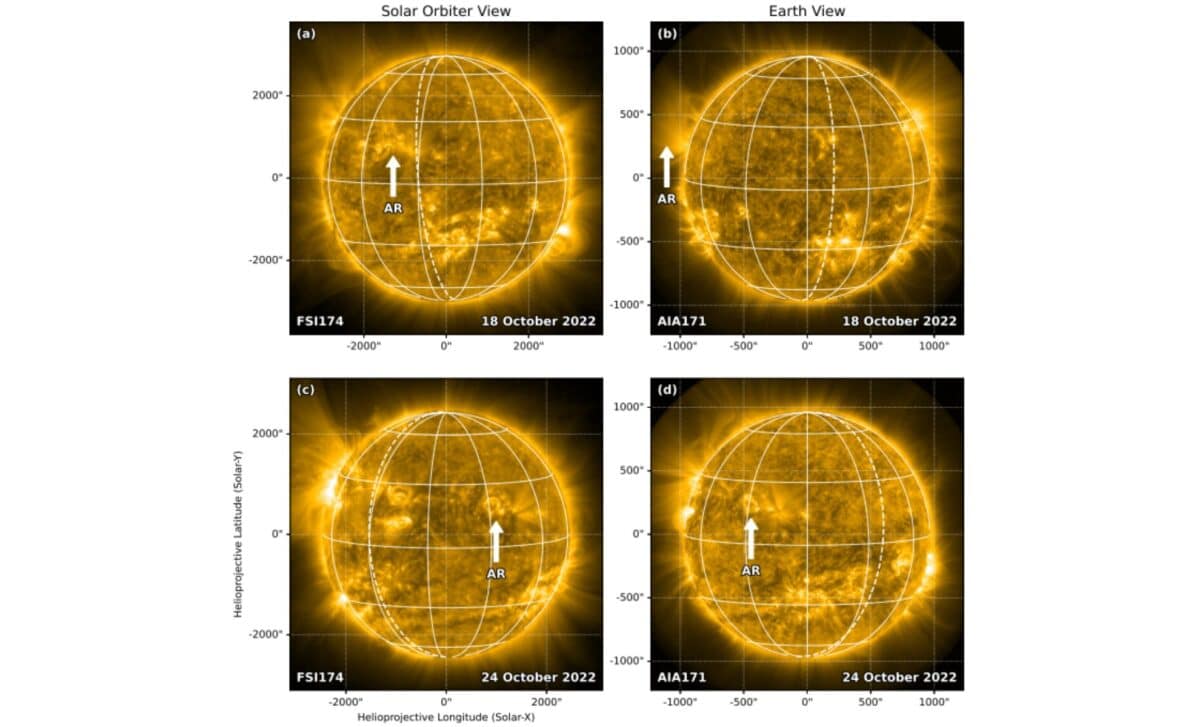 Active region selected by the coordinated observations as visible from the Solar Orbiter perspective and the Earth perspective ©Astronomy & Astrophysics
New Discoveries: The Case of “Campfires”
One of the most striking results from this collaboration is the discovery of tiny solar structures known as “campfires.” These small-scale, extreme ultraviolet brightenings were mostly overlooked by previous solar studies. However, the advanced instrumentation of Solar Orbiter and DKIST enabled their detection in unprecedented detail. According to Krzysztof Barczynski, a solar physicist involved in the research, although each individual campfire might seem insignificant, their sheer number suggests that they could have a profound collective impact on the Sun’s outer atmosphere, potentially contributing to solar phenomena such as solar flares.
The importance of these campfires lies in their potential role in explaining the Sun’s mysterious corona heating problem. While the Sun’s outer atmosphere reaches temperatures exceeding one million degrees Celsius, its visible surface remains relatively cooler, around 5,500 degrees. Understanding how these small features contribute to the Sun’s heating could offer crucial insights into the behavior of solar winds and the impact of solar activity on Earth.
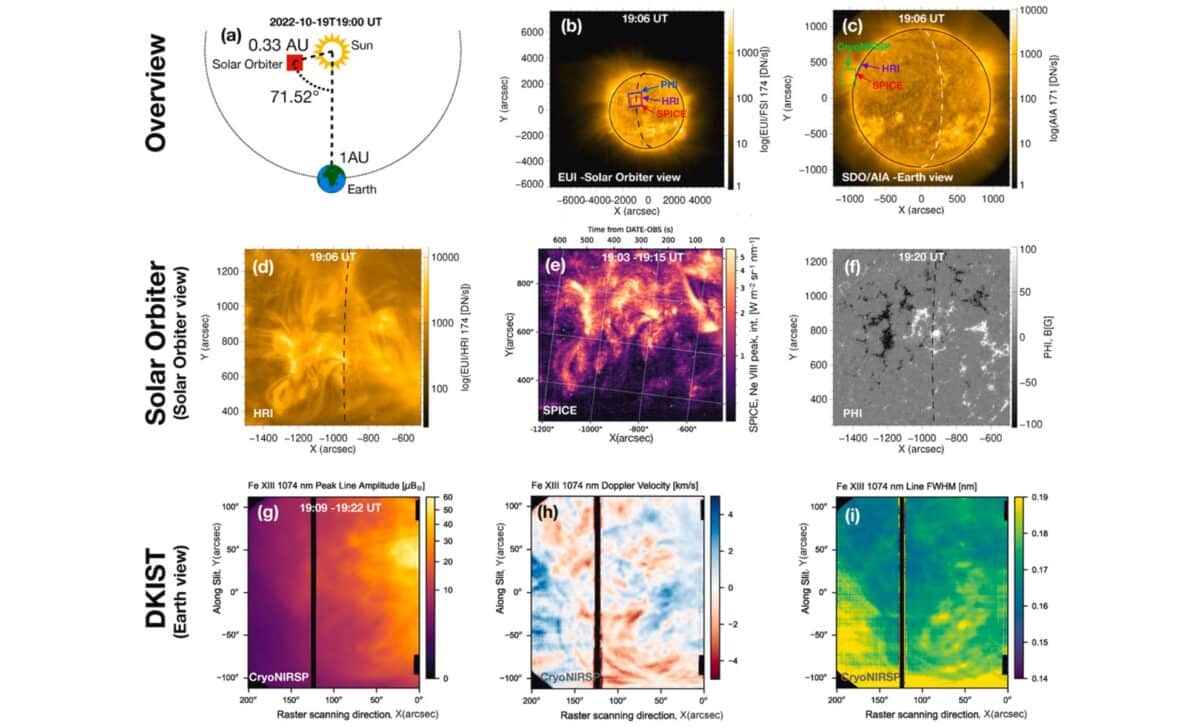 Overview of coordinated observations provided by Solar Orbiter and DKIST on 19 October 2022. © Astronomy & Astrophysics
Revealing the Sun’s Magnetic Secrets
The coordinated observations have also provided new insights into the Sun’s magnetic structures. Through a combination of high-resolution imaging and spectropolarimetry, scientists were able to examine the magnetic fields of a solar active region in more detail than ever before. The Solar Orbiter’s PHI instrument, which measures the Sun’s magnetic field, and DKIST’s ViSP instrument, which captures spectral data on the photosphere, allowed researchers to observe the Sun’s magnetic forces at different layers.
These observations are crucial for understanding solar activity, particularly how the Sun’s magnetic field influences solar eruptions like flares and coronal mass ejections. By studying how these magnetic fields evolve, scientists can gain a better understanding of the processes that drive solar weather, which in turn affects satellite communications, space missions, and even power grids on Earth. With this new stereoscopic view, solar physicists are closer to untangling the complex magnetic dynamics of our star.
The Road Ahead
As the datasets from this groundbreaking collaboration continue to be analyzed, solar scientists are poised to make even more discoveries. The initial findings from the coordinated observations are already reshaping how we view the Sun and its behavior, offering a more detailed and dynamic picture of our home star than ever before. According to the researchers, these observations have opened new avenues for tackling long-standing questions in solar physics, including the mystery of solar corona heating and the intricacies of solar wind formation.
The success of the October 2022 observations marks the beginning of a new era in solar research, one where space-based and ground-based observations complement each other to reveal the Sun’s hidden mysteries. As future campaigns, including one planned for 2025, continue to build on this success, the collaboration between DKIST and Solar Orbiter is sure to advance our understanding of the Sun, with far-reaching implications for space science and technology.