Mayor Mamdani took his oath of office in the abandoned City Hall subway station. With its brass chandeliers and vaulted Guastavino tiles — named after a Spanish immigrant — the station is a monument to a city that once built great things for working people. It was decommissioned 80 years ago because of safety concerns; its elegant curves were incompatible with newer, faster trains. Back then, the city reconciled its architecture with modern technology for the safety of its citizens. Today New York is less clear-eyed.
In March, Luis Cruz crossed a Brooklyn street but never made it home. He was struck and killed by a delivery worker on an e-bike. The operator faced no consequences; Cruz became another casualty in an unregulated epidemic because no laws hold these individuals accountable.
Cyclist deaths recently reached a quarter-century high, with e-bikes responsible for the majority. These machines have fundamentally altered our streets. They routinely fly down sidewalks, blow red lights, and ride the wrong way. When crashes happen, perpetrators vanish. There are no plates to record, no registration to trace, and no insurance to compensate the grieving.
The Dutch — forebears of our city and exemplars of cycling culture — require fast e-bikes to be licensed and insured as mopeds. Amsterdam’s cycling union, the Fietsersbond, successfully pushed for these regulations while expanding infrastructure, proving safety and bike-friendliness are not a zero-sum game. But in New York, we allow high-speed vehicles to operate with the oversight of a child’s tricycle.
We are stuck in a rhetorical stalemate threatening the “15-minute city” concept, a fragile ecosystem where residents access essentials within a short walk. It relies on “walk appeal” — the safety that encourages children and the elderly to step onto the pavement. When motorized vehicles dominate walkways without accountability, we are creating “Squid Game” on the sidewalk.
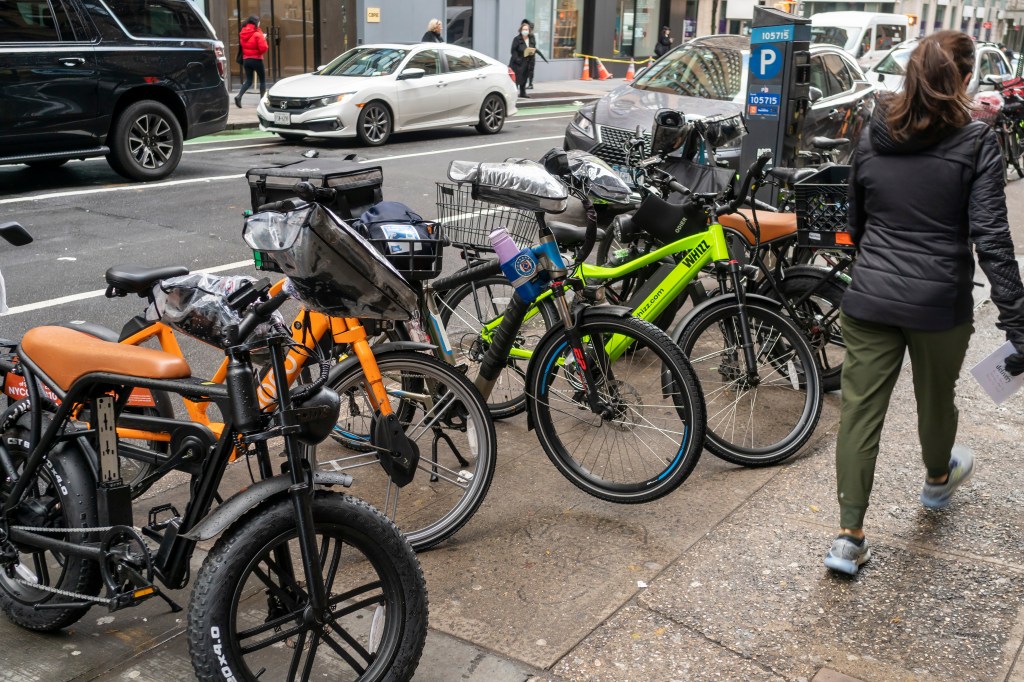
We need clarity about what is driving this crisis: the “throttle” e-bike. There is a difference between a pedal-assist bike — where a motor merely augments effort — and the 70-pound, throttle-powered machines used for delivery. We see them accelerating improbably on sidewalks while the rider, legs dangling, checks his phone. They have vestigial pedals but function like motorcycles: twist the grip and the bike hits 25 mph without a single rotation of the pedals. By calling them bicycles, manufacturers avoid safety standards that apply to every other motorized vehicle.
Yet, advocacy group Transportation Alternatives opposes Priscilla’s Law — named after Priscilla Loke, a teacher killed by an e-bike — which would require them to be registered with license plates. They dismiss the bill as a pretext for discriminatory policing, arguing that registration is merely a tool for the NYPD to target the working-class immigrants who power the delivery economy. In their effort to protect riders from the police, however, they have reached a fundamentally insulting conclusion.
As a progressive immigrant and cyclist, I find this argument patronizing. It assumes newcomers are uniquely incapable of meeting the same safety standards that NYC’s immigrant taxi and Uber drivers have navigated for decades. Using immigrants as a shield against public safety is a classic example of the soft bigotry of low expectations. It suggests we cannot be expected to respect the social contract because of where we were born.
Mamdani argues we should instead regulate delivery apps. He is only half right. Cars deliver food using the same apps, but because they are registered and insured — with explicit laws providing recourse for victims — they cannot drive on sidewalks or down one-way streets with total impunity. Because e-bikes lack these mandates, they do.
There is a strange irony here: progressives rightly demand registration for guns to ensure accountability, yet for e-bikes, the logic flips. By shielding the vehicle from oversight, advocates are taking a page out of the NRA playbook — blaming the “system” while shielding the hardware.
The fear of biased policing is real, but it is no excuse for lawlessness. There is a modern fix: automated enforcement using camera technology. No police stops, no face-to-face interaction — just consequences in the owner’s mailbox.
Mamdani, an immigrant himself, now wields the power of the highest office in the world’s greatest city as the leader of the many New Yorkers who voted for him because they desperately want the beautiful things he promised. Let’s start by making our sidewalks safe.
If it speeds like a moped, weighs as much as a moped, and can run you over like a moped, it is time we licensed it like one.
Butt is an award-winning filmmaker and screenwriter.