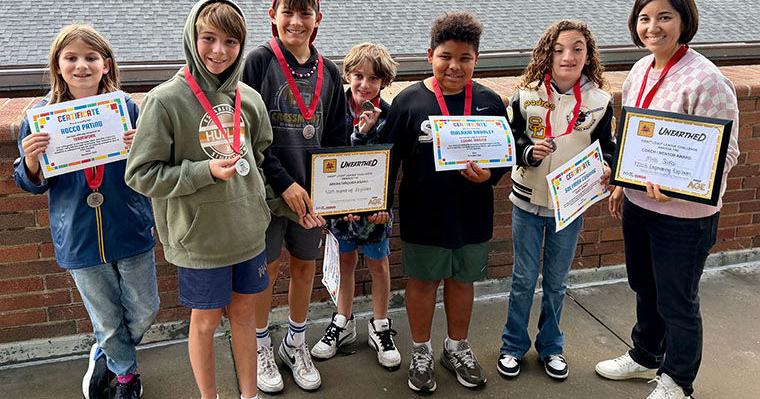
At the recent San Diego FIRST LEGO League Robotics competition, the Village Elementary Robotics team took home two awards in their first-ever competition. The team was awarded the Breakthrough Award for new teams, while coach Courtney Sakai was recognized with this year’s Coach’s Award.
This is Sakai’s second year as an educator at Village Elementary School and first year coaching a competition team alongside the robotics club program there. She comes from a background in teaching special education at the elementary school level and had previously been engaged with a robotics program before coming to Coronado.
“I’ve been teaching for a long time, about 15 years. I’ve found that when you present Legos together with coding, and all of this technology, to kids who maybe struggle in other areas, this really comes naturally to them,” Sakai said.
“I knew that there was robotics at the middle school and high school, and wondered why it was missing at the elementary school, so I asked the District if we could bring robotics to the elementary school. They were amazing. They went out and presented it to a bunch of people and donated us a grant that got us equipment.”
Last year and this year, Sakai has led the introduction of the program at Village, where she’s focused on teaching students the basic concepts involved with robotics. “We do five-week sessions of just club where kids come and learn from the very beginning,” she explained. “Each session is about ten kids, and they rotate. They have five weeks to explore and learn how to build and how to code, and I go through the [FIRST LEGO League] Core Values with them, and then the next group comes in.
“I let them experiment and be creative with how they use everything on a robot,” she added. “What’s nice is that, because they’ve never built a robot before or used all of those different parts, they’re really eager to use everything. And it’s cool to watch them play around with the coding and build whatever robots they think up, and just have a really fun time letting it spin around the room. So we have those groups cycling throughout the entire year.”
With the program’s success last year and excitement surrounding it from the students, Sakai was confident they could start a competition team this year in addition to the larger club program. As a coach, she brings her skills and past experience with teaching to lead the students and help them develop as individuals and as a team.
“My team this year was fully inclusive – with eight students from all backgrounds, students with disabilities, students without disabilities – of fourth and fifth graders. It really allowed me to give kids an outlet to explore other skillsets that they wouldn’t necessarily have an opportunity to do so otherwise,” Sakai noted. “They were great and worked together so well.
“They kind of partnered up within the team to take on different aspects [of the competition]. Two or three kids would work on one thing together, and another two kids would work on something else together, so they were able to really find little pockets within what they were doing and come together as a unified team.”
FIRST Lego League (FLL) is open for fourth through eighth graders to compete in, and Sakai mentioned that the team was a little intimidated at first at the prospect of competing with middle schoolers. “There’s the height difference, and just by looking, they seem so much older, but it’s really cool to watch how age does not matter,” she told me. “I had one of my students actually say, ‘They might be older, but younger kids have an advantage because they have bigger imaginations.’ There’s no limitation in your imagination when it comes to things like the project, or getting really creative on how to go about the [game] board because they just think so broadly and that really is to their benefit.”
As part of the larger Coronado Robotics program for the Coronado Unified School District, the Coronado Middle School Robotics teams have stepped in to mentor the elementary school students and show them the ropes. “Watching the inclusion of all of the Robotics teams with these middle schoolers wanting to help this team grow has been really cool,” Sakai said of the collaboration and inclusivity amongst all of the teams.
“We got to go to the competition with the other middle school teams and see what they did and learn from them. The kids on my team just naturally gravitated towards those older [Coronado Robotics] kids – even the high school teams. The high schoolers were great at prepping the kids for their presentations,” she mentioned. “Just exposing them to the next level of competition where the robots are very different and seeing these kids get so excited about what they could be doing four years from now, and watching that drive happen, where they’re saying, ‘I want to do that. I want to build the big ones and be 3-D printing things.’”
As a first-year competition team, Sakai said her main expectation for the team was mostly to go and gain that experience. “It’s the first time our kids have ever seen this, and I just wanted them to go in and have a good time – no stress, no tears, no panic, just enjoy it,” she commented. “I didn’t expect any sort of awards…and they came out with the Breakthrough Award, which is amazing.”
FLL competitions include two main elements. The first is the presentation of their project – a robotics solution they design to address a problem that goes with the FLL theme that year – and the game board in which the Lego robotics they create and code can score points.
“It was fun to watch them present,” Sakai said. “They’ve never experienced that, and they didn’t know what to expect. I can’t help them once they’re in the judging room. It was great to just see them use skills that we worked on with public speaking and how to have a conversation with those judges. I watched them pull out all of the information they knew and be professional. They don’t get to practice that every day.”
While coaches can’t help their teams during competitions, with their project presentations or their runs on the board, Sakai said the team was excited and animated while presenting, and eager to share their knowledge and answer the judges’ questions. “The Breakthrough Award was all about the most progress. The team out of the new teams that showed the most potential,” she continued. “To know that the judges saw what I see in them was great.”
The teams also get a chance to talk with the judges about their coaches at the end of their presentations. Sakai left the room for that portion and doesn’t know what they said, and was blown away when she found out she had won the Coach’s Award. “To get to share that award with [the team], getting the Breakthrough Award, we were so excited. We got to celebrate together, and for the parents to watch the hard work that these kids put in, they were so proud of their kids.
As Sakai sees it, robotics and the sort of recognition her team earned at the competition can be incredibly impactful for the students. “Being a full inclusion team with kids with disabilities, things can be harder for them; it’s a struggle, and this award really helped them recognize, ‘Wow. I did something I can be proud of, and I was successful. Maybe I’m not the best reader or speller, or I’m not great at math in class.’ But being able to walk away and say, ‘I am good at this, and I can do this,’ really boosted their confidence. That was something I was so excited to share with them.
“Being able to provide robotics to these kids and give them an opportunity, I don’t need an award, necessarily, to know that this is what they needed,” Sakai added. “The fact that I could bring that joy, my joy and my passion, to them and they could convey that joy and that passion? I think this is one of those core memories these kids are going to walk away with and have with them forever.
“It is a huge honor for me to have been recognized in that way. I know the time, and the effort, and the dedication it takes to be a coach. So for those judges to recognize that with our team, and with how new our team is, it was a huge honor to be able to have that.”
Sakai said it’s the everyday celebrations that are her favorite part about coaching robotics for the club and the team. “Those little celebrations when they’re working really hard on trying to accomplish a mission, and it’s not working, it’s not working, until suddenly something clicks. They change the code, they figure it out, and they make it work, and just watching them light up in that moment because they’re so proud of themselves,” she described. “It’s a big deal. They get so excited and are high-fiving each other and are so proud of accomplishing something they’ve worked really hard on together.”
Teaching and coaching at the elementary school level, Sakai also focuses on the importance of teaching them how to be independent and self-aware. “It’s about gauging where they’re at. It’s about teaching them that failure is okay and helping them understand when they need to take a break,” she explained. “It’s building their independence, especially within a team. So when we’re working together, and someone needs to take a break, how does somebody else jump in, and how do we approach that and problem solve?”
Sakai helps the students talk through those challenges with group meetings at the start of every session. “We fill out a sheet where we say, ‘Who’s here today? What’s our goal for the day? What’s everybody’s team responsibilities?’ We come up with an overarching goal, and whatever it is, everybody writes down on their own what they are personally going to be responsible for.
“At the end of the meeting, we sit down and talk about it. Did you meet your goal? Did you encounter problems? How did you solve them? Or did things come up that you felt you really struggled with, that you need help with? Then I let the team answer each other. One student might say, ‘I really had a hard time finishing this mission, and I got frustrated.’ And then I let the other kids say how they could maybe help them, or how they would solve that problem, rather than me telling them what to do. This is all about them as a team.”
With the program Sakai has seen how learning these and the skills it takes to build, code, research, and present has helped students build their self-confidence. That confidence follows them outside of the Robotics classroom to their other classes and areas of their lives, as well. “Watching these kids find an outlet to express themselves is amazing,” Sakai told me. “They’re finding something that, maybe, this is going to be their path as adults. Maybe they’re going to go into STEM (science, technology, engineering, math), and getting exposed to that very, very early on is a great opportunity for them.
“Next year I’m hoping to expand to be able to bring in more kids who are excited, form more teams, and make it even more public for the school,” she added. “I think everyone is excited about it.”
To learn more about Coronado Robotics and the awards the teams have earned, please visit https://www.coronadorobotics.com/.
VOL. 115, NO. 53 – Dec. 31, 2025