Chicago’s Department of Cultural Affairs and Special Events (DCASE) is under new leadership after a city investigation substantiated multiple harassment allegations against its former commissioner.
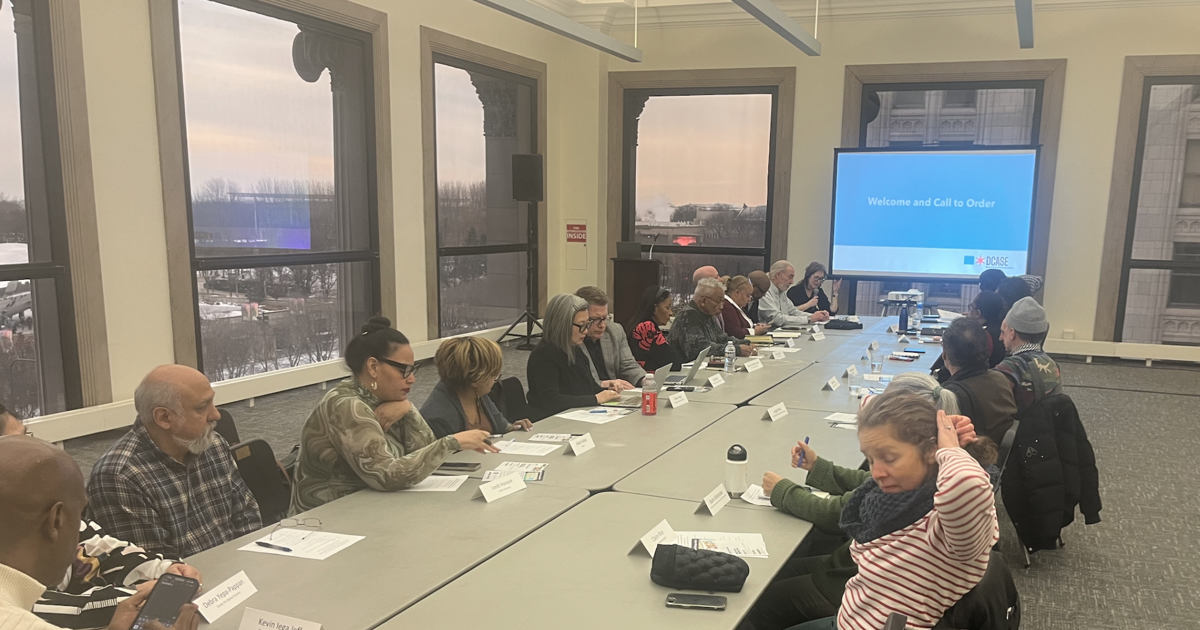
At a mid-December advisory council meeting at the Chicago Cultural Center, interim Commissioner Kenya Merritt focused on attendance figures and grant funding from 2025, describing a strong year for city-supported cultural programming. Neither Merritt nor other department officials referenced the investigation that led to the October resignation of former Commissioner Clinée Hedspeth or outlined any policy changes stemming from its findings.
“2025 was a strong year for cultural activations across Chicago,” Merritt told the council, citing 1.9 million in total attendance and $9.5 million in grant funding awarded to artists and organizations. “These numbers matter, but what matters even more is what they represent: shared experiences, neighborhood vibrancy and economic activity.”
Much of that activity occurred under Hedspeth’s leadership, including during the department’s busy summer festival season, before a city investigation substantiated allegations that she violated the city’s Equal Employment Opportunity Policy through repeated inappropriate conduct toward employees.
Hedspeth resigned in early October, days after Mayor Brandon Johnson’s office received the investigation’s findings. A spokesperson for the mayor said at the time that Johnson had planned to fire her if she had not stepped down and that she was placed on the city’s ineligible-for-rehire list.
The investigation, completed in late September, found that Hedspeth engaged in a pattern of inappropriate conduct targeting employees based on their race, ethnicity, age, sexual orientation and gender identity. Investigators also determined that she failed to fully cooperate with the inquiry.
Two other individuals, whose names were redacted in the report, were found to have failed to report policy violations committed by Hedspeth. It is unclear what discipline, if any, they faced.
Hedspeth could not be reached for comment, and her attorney declined to comment on her behalf. Merritt also declined to answer questions about what policy changes, if any, have been implemented since the investigation.
Among the sustained allegations was an incident during budget hearing preparations in fall 2024, when Hedspeth directed an employee to “put on a thick accent” and “wear traditional cultural clothes” during a City Council hearing, according to the report. Multiple witnesses told investigators they heard the remarks.
Hedspeth characterized the comments as a joke and said she and the employee were friends before working together. The employee told investigators the comments were “humiliating, demoralizing, and it felt wrong.”
“I was sad,” the employee said, according to the report. “This is my culture and Hedspeth was making fun of it. It was hurtful.”
In another incident, Hedspeth was accused of telling a colleague that an employee she wanted to fire “should go back to” a location redacted in the report, an apparent reference to a person of color. Hedspeth told investigators she did not recall making the comment.
The investigation also sustained age-based harassment allegations. In November 2024, Hedspeth allegedly told an employee who had visible gray hair that the employee “should not have grey hair when interacting or going to the 5th floor of City Hall,” referring to the mayor’s office. When the employee said they liked their natural hair color, Hedspeth responded, “Who gives you the check?” The employee told investigators the comment “made me feel bullied and it hurt.”
Hedspeth told investigators that if she made the comment, it would have been “in a joking manner.”
Sexual harassment allegations were also sustained. Investigators found that Hedspeth asked an employee whether they would have an affair with a married man who provided an allowance and repeatedly asked about the employee’s sex life. Hedspeth told investigators these conversations occurred before the employee worked for the city, though the report indicated some took place during employment.
The investigation further found that Hedspeth repeatedly made inappropriate comments about employees’ sexual orientation and disregarded an employee’s pronoun preferences. When one employee used correct pronouns and self-corrected, Hedspeth allegedly responded, “I don’t care. Why do you care when (the employee) is not in the room?”
After two interviews lasting more than two hours each, Hedspeth and her attorney declined to participate in further questioning, preventing investigators from pursuing allegations related to disability discrimination, disability harassment and retaliation.
In a Sept. 19 letter included in the report, Hedspeth’s attorney characterized the complainant as “a disgruntled City employee” and asserted that Hedspeth “acted properly and with no unlawful discrimination.”
At the advisory council meeting, several members acknowledged the department’s recent transition without directly addressing the investigation. Tony Kurman, founder of EXPO Chicago and a council member, referred to a “significant transition” as the department looks ahead to 2026.
Other members focused on the future of the city’s arts ecosystem. Bill Michel, executive director of the Reva and David Logan Center for the Arts at the University of Chicago and a board member of the South Side Community Art Center, emphasized the need for greater collaboration across neighborhoods.
“I continue to really believe in the power of the arts to inspire creativity in the next generation,” Michel said. “I think there are ways we can leverage some of what we do to better support youth, to continue to make sure that we’re attuned to enhance their creativity and their positive feelings for the city, but to do it in ways that break silos down between communities across the city.”
Patric McCoy, a Kenwood artist and collector who co-founded the nonprofit Diasporal Rhythms in 2003 to support arts by members of the African diaspora, sounded a more urgent note.
“Our city’s cultural network is under attack,” McCoy said. “That’s because art is the natural predator of power. And so we have to promote our arts community to offset the attacks of power.”
Hedspeth’s roughly 18-month tenure was marked by internal upheaval. Appointed by Johnson in March 2024 after the firing of longtime commissioner Erin Harkey, more than 140 arts and culture workers signed a letter the following April expressing concern over her leadership. By the end of her tenure, nearly 30 staff members — including seven senior deputies — had either been fired or resigned from a department with fewer than 60 full-time employees, according to city data.
A Hyde Park resident and president of the board of the Hyde Park Historical Society at the time of her appointment, Hedspeth brought an unconventional background to the role. Born in Seattle, she moved to Chicago to attend Dominican University, where she befriended Johnson. She later worked as director of curatorial services at the DuSable Black History Museum and Education Center and as a fine art appraiser in New York before returning to Chicago to serve as Johnson’s legislative director during his time as a Cook County commissioner.
Johnson picked Merritt to lead the department in October. Since 2023, Merritt has served as Johnson’s deputy mayor for business, economic and neighborhood development, and previously held senior roles at DCASE, including chief financial officer and interim chief operating officer.
Speaking to the advisory council, Merritt emphasized the role of arts and culture in the city’s broader economy.
“Culture is a powerful driver of tourism, workforce opportunities and small business growth,” she said. “These outcomes, reinforced by public investment and the work that we do as a body, show the arts are both smart and necessary.”
“Our vision is for DCASE to continue as a national leader in culture stewardship with a stronger connection between culture and economic growth,” she continued.