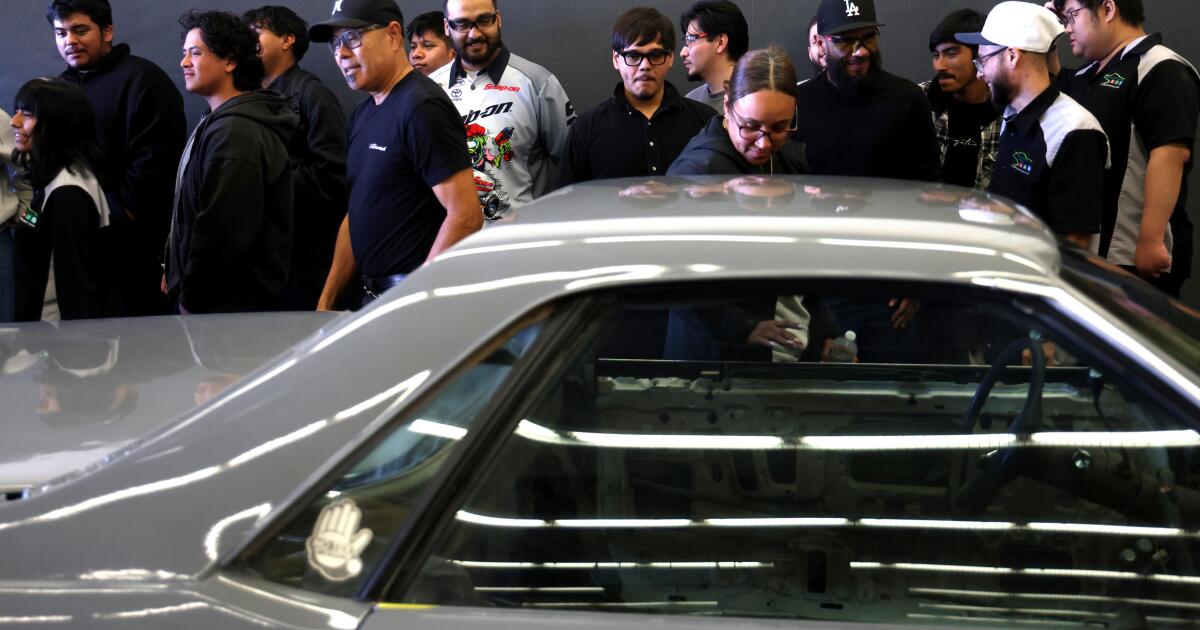
The workers’ uniforms are smudged with stains earned underneath a car, wrench in hand.
Their repair garage teems with an array of inoperable vehicles and twisted metal. One car’s wheels have been removed; another sports a mangled fender.
Here, the labor is free — and the mechanics are earning college credits.
Los Angeles Trade-Technical College offers the largest community college auto repair program in the region, turning out graduates ready to work at dealership service centers, independent shops and the fleet departments of municipalities, among other areas.
The college has offered the training for decades, and its Automotive and Related Technology program has evolved with industry changes — including the advent of fuel injection, airbags and the rise of electric vehicles.
-
Share via Close extra sharing options
Community college students basically fix your car for free
Other local community colleges have auto programs, including Santa Monica College and El Camino College. But with more than 1,000 students, Trade-Tech’s program — which offers certificates and associate of science degrees — stands out for its size, said Jess Guerra, director of the college’s Transportation Workforce Institute, which includes the automotive program.
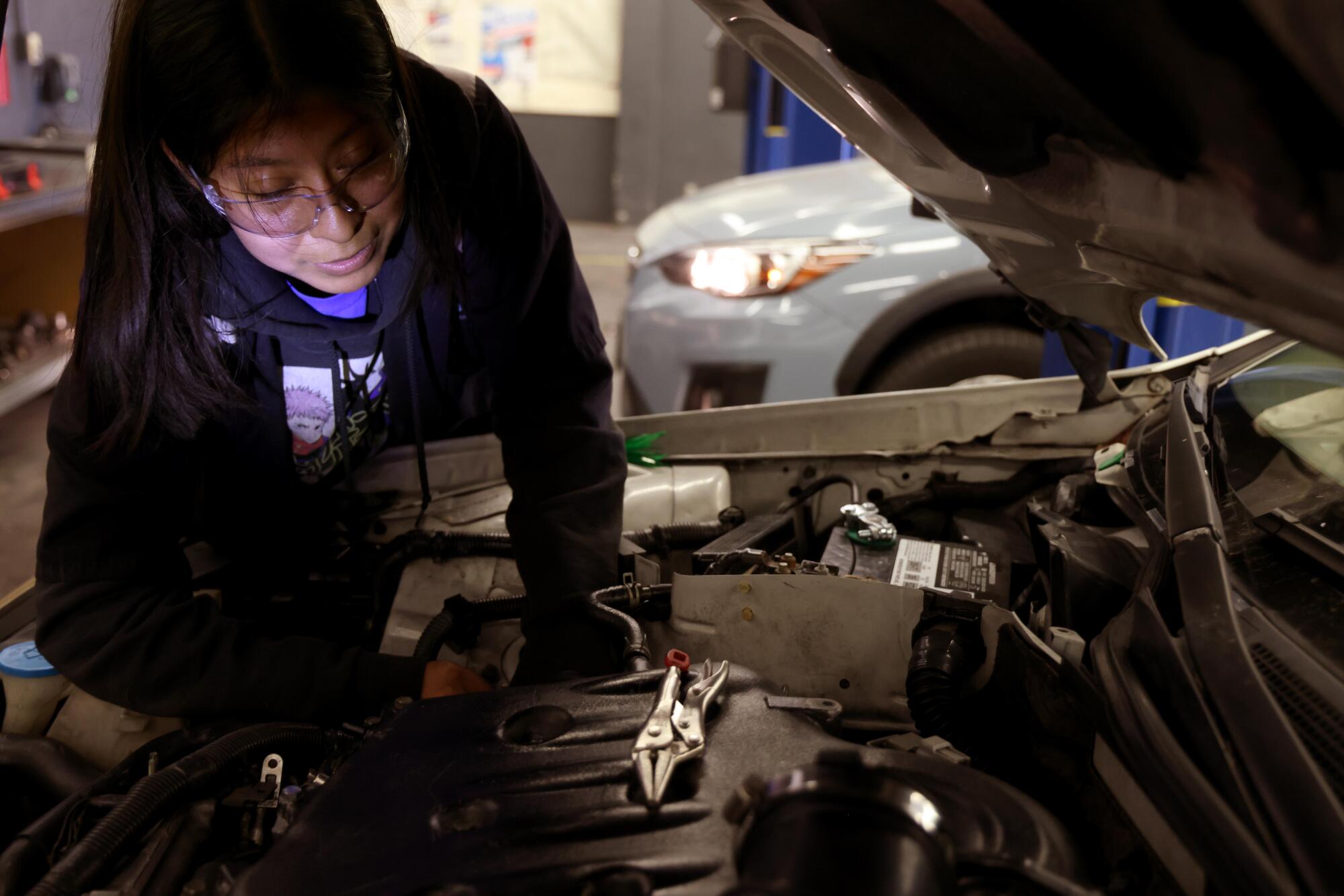
L.A. Trade-Tech student Virginia Morales, 22, works on an engine.
“One thing that makes us unique is the scale — we are the biggest in Los Angeles by a long shot,” he said. “Most community colleges may have two faculty teaching automotive, some have one, some have no full-time faculty. Just in automotive, I have seven.”
As the rising cost of four-year universities has led many to question the value of higher education, training for high-demand trades has been growing. An American Staffing Assn. survey conducted by the Harris Poll and released in June found that 33% of U.S. adults would recommend to high school seniors that they attend vocational or trade school.
In late 2024, Gov. Gavin Newsom unveiled a plan to create more well-paying jobs for Californians in part by beefing up access to work-based learning at the high school and collegiate level. And in April, President Trump issued an executive order seeking to prepare Americans for “high-paying skilled trade jobs of the future.” Among its goals is the creation of more than 1 million apprenticeships.
Trade-Tech’s automotive program exemplifies the renewed interest in hands-on career training. The program has grown in recent years, enrolling 1,134 students in fall 2024, up 34% from fall 2022, when it had 846 students.
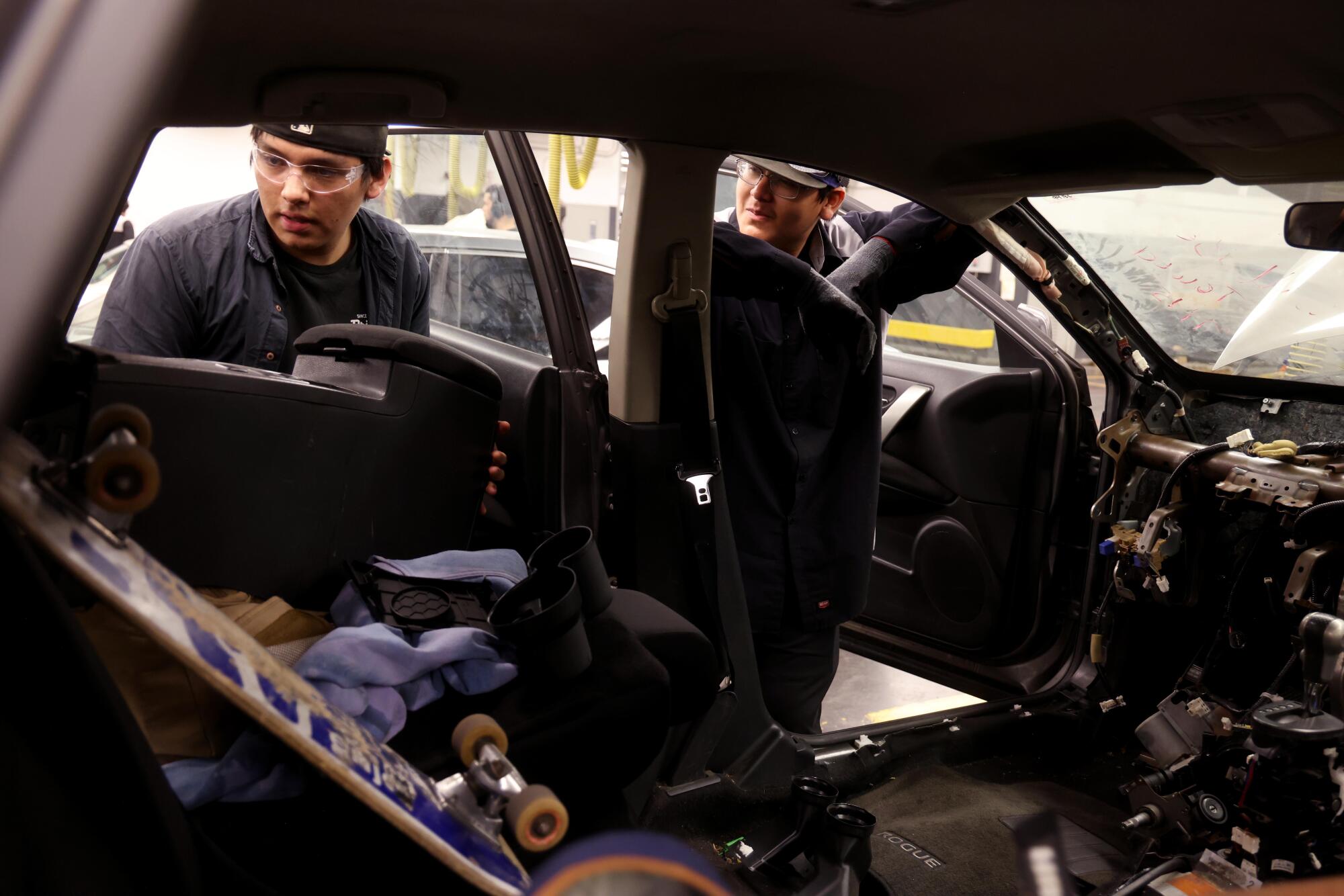
Trade-tech students Kenny Rea-Cruz, 20, left, and Jonathan Sepulveda, 18, assess a car before working on it in an automotive class.
In a unique offering, Trade-Tech automotive students work on privately owned cars. People interested in the service can fill out a form on Trade-Tech’s website — vehicles must be from the 2000 model year or newer, and the requested work must align with the topics being taught at the time, among other rules. People who participate are not charged for the work — but pay for parts.
“The turnaround is not as fast as you would get at a regular shop, because this is being done as part of a learning experience,” Guerra said. “A job that you might get back in a day at a shop, it might take us two days.”
There are typically waiting lists for some of the more labor-intensive work, such as the rebuilding of a transmission.
Guerra said that the instructors make sure that the work is done correctly and that vehicles are returned to customers in tip-top shape. “It’s no different really than if you’d taken it to an actual repair shop,” he said.
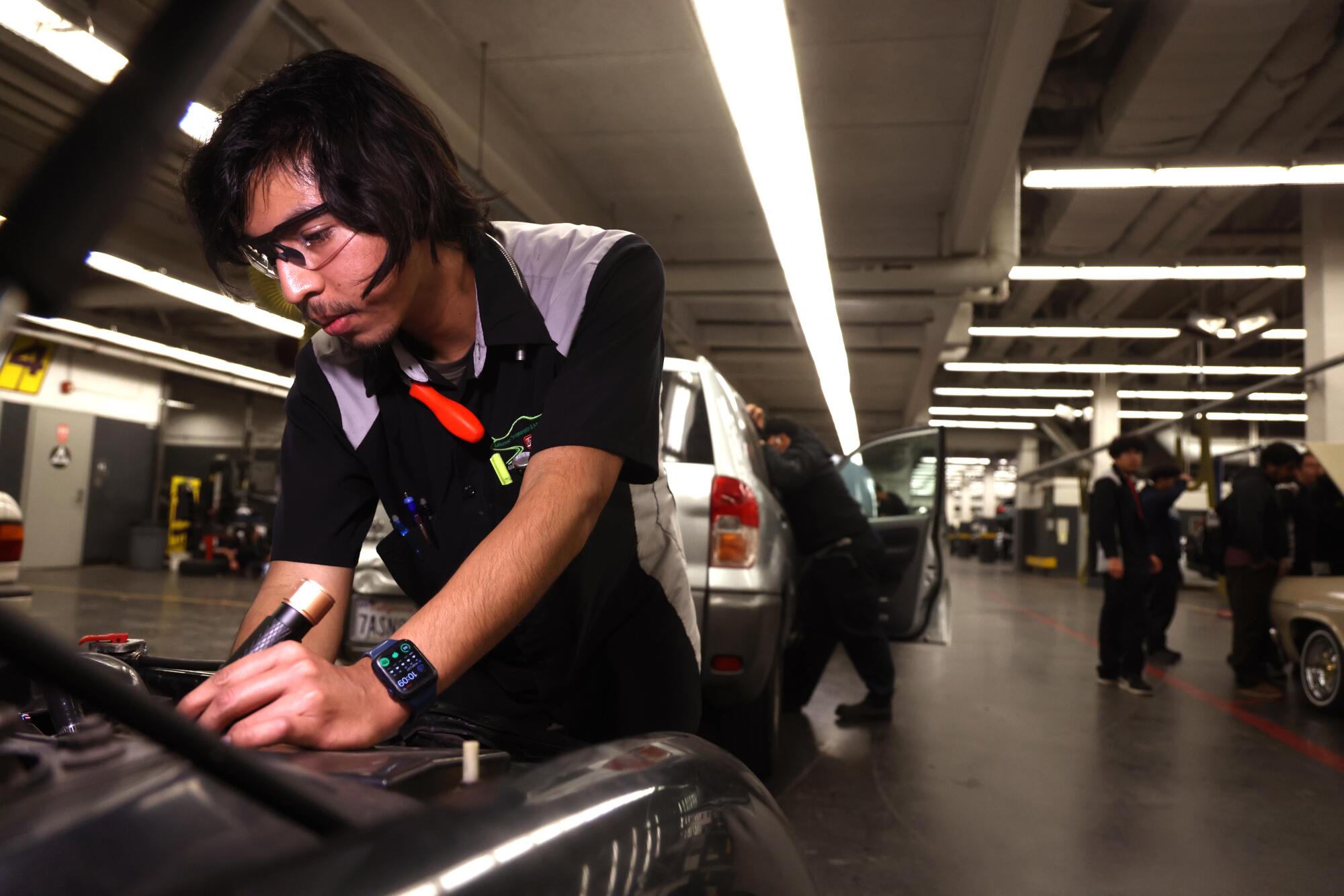
Trade-Tech student Nelson Raymundo looks for leaks in the engine of his Infiniti.
Graduates work at the service departments of local BMW, Volkswagen and Toyota dealerships, among other locales. One former student, Andrea Corona, 39, said her time at Trade-Tech helped her land a job as a technician at Volkswagen of Downtown L.A. — a role she’d held for about a decade.
She said the hands-on experience servicing cars from the public helped prepare her for the job at the dealership.
“It was really important, actually,” said Corona, who grew up in South L.A. “It is what got me here — the hands-on helps a lot.”
Changing with the times
There was a time when working on a car was an analog experience. Now vehicles are rolling computers, teeming with electronics and other complex systems. When they break, repairs can get complicated quickly.
Trade-Tech has adapted, offering a certificate in hybrid and EV technology — and the program has a collection of such vehicles on which students are able to work.
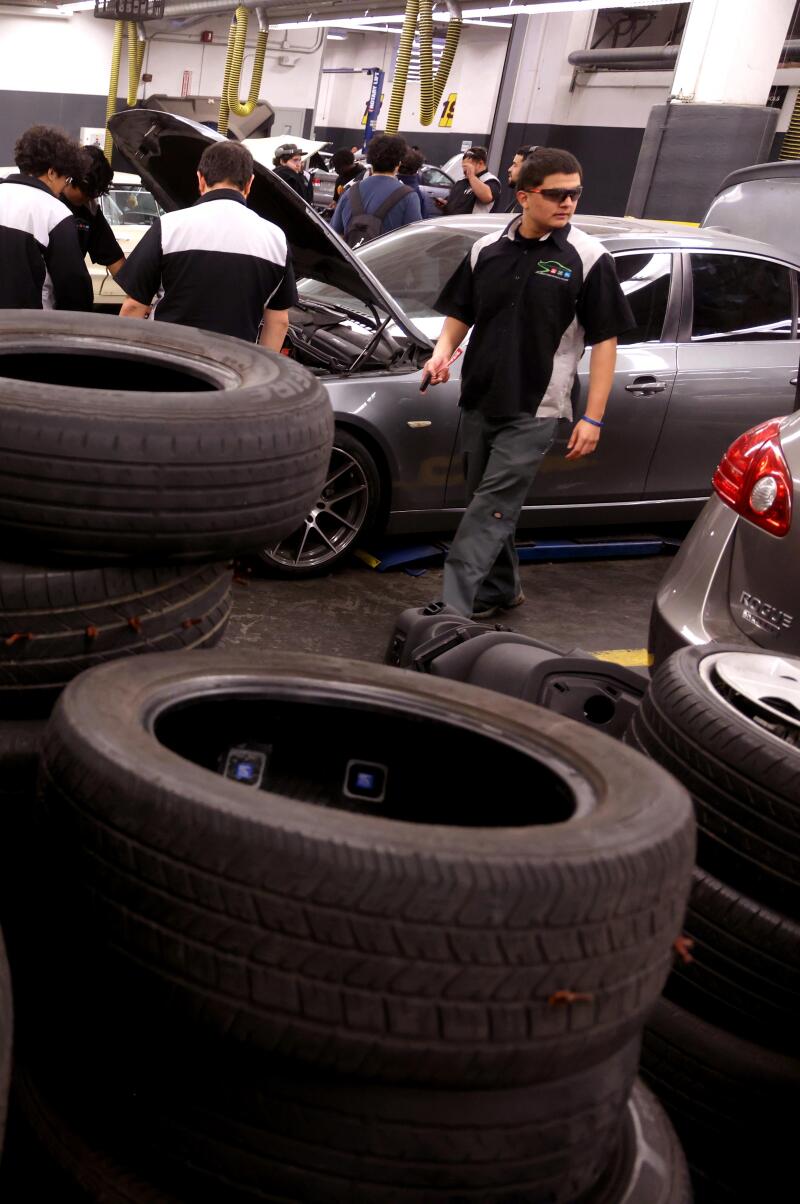
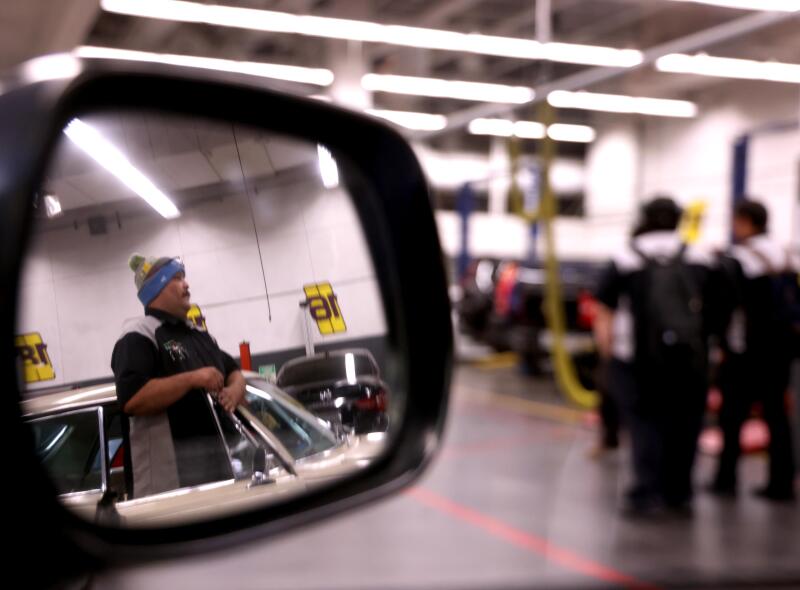
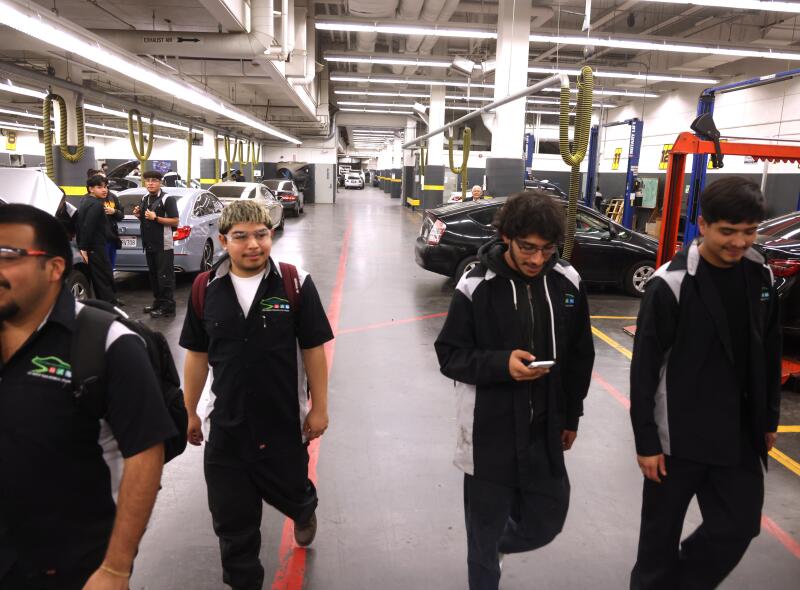
1. Students participate in the Auto Technician training program at Los Angeles Trade Technical College in downtown Los Angeles on December 11, 2025. 2. Student Jose Quinonez, 32, reflected in a side view mirror, participates in the Auto Technician training program at Los Angeles Trade Technical College in downtown Los Angeles on December 11, 2025. Quinonez hopes to follow in his father’s footsteps who runs his own automotive shop in Los Angeles. 3. Students finish for the day after participating in the Auto Technician training program at Los Angeles Trade Technical College in downtown Los Angeles on December 11, 2025.
“The school is trying to keep up with that technology and teach what to expect in the field,” former student Christopher Hernandez, 36, said. He graduated in 2012 with a certificate from the automotive program and has worked for 13 years at Volkswagen of Downtown L.A.
Hernandez, who grew up in Lincoln Heights, said he had considered a few other community colleges, among them Pasadena City College and Citrus College, before settling on Trade-Tech.
“We always had possibilities of work to do in [different] vehicles, so we could learn and get better skills,” Hernandez said. “If you’re willing to put in the effort … you can make the best of it.”
The automotive program is part of the school’s Advanced Transportation & Manufacuring pathway. It offers several associate of science degrees, including one in automotive and related technology, and another in collision repair. As a baseline, tuition is $46 per unit, and earning an associate’s degree can cost about $2,000 to $3,500, depending on the coursework. Students can apply for financial assistance through programs and scholarships.
Guerra, who has worked at Trade-Tech for 20 years, said he’s run into past students at repair shops and service centers in L.A. “We get to see students come in here at square one … and then [they] are the people in charge” at automotive facilities, he said. “That for me is the most rewarding part of this job.”
Collegial car vibes
For many of the program’s students, the schooling offers a chance to professionalize their passion. And, on occasion, show off their rides.
On one of the last days of the fall semester, students brought their own cars to the shop. They are permitted to do so when the schedule allows and the work aligns with what is being taught. Some students — like the owner of a pristine 1960s Chevrolet Impala — entertained a crowd of oglers with their immaculate engine bays and pristine paint jobs.
Others, like Nelson Raymundo, were taking advantage of some free time to work on their cars.
Raymundo, 21, got into cars during middle school. Around then, his father sold an inoperable Dodge Dart. He had wanted to work on the vintage ride and was disappointed to see it go.
Raymundo, who grew up in West L.A., resolved to learn about car mechanics: “I had no knowledge. I was bummed out. So I was like, ‘You know what? I want to get in here, work in cars, and fix it.’”
He enrolled in the Trade-Tech program in fall 2023 and has taken classes on brakes, suspension and engine theory, among other topics. On one of the final days of the semester, Raymundo peered into his Infiniti J30’s engine bay, searching for the issue that had troubled the car.
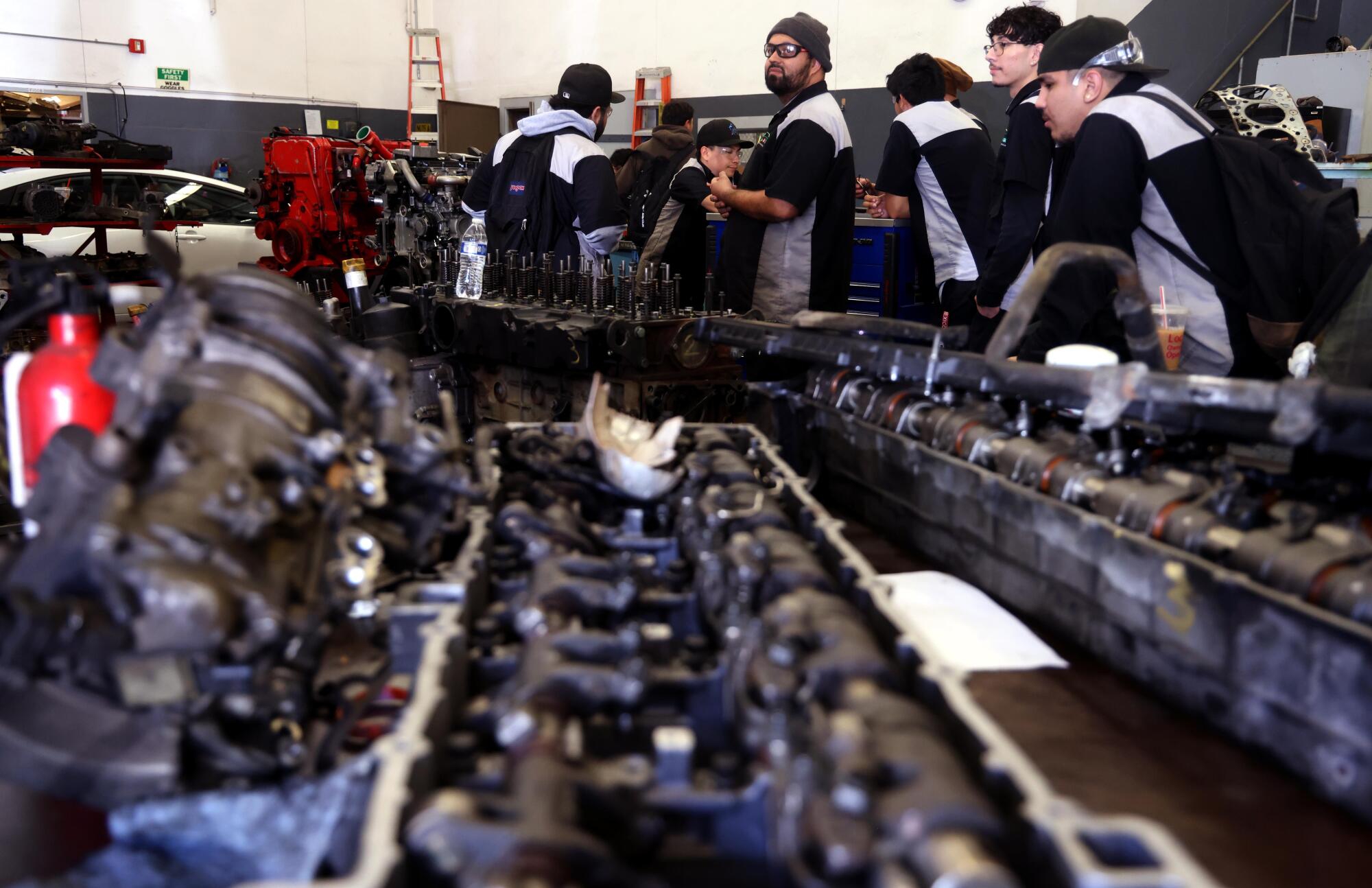
Students stand behind diesel engines that they worked on as part of the automotive program at Los Angeles Trade-Technical College.
It was another of his dad’s old rides, and had been in the family for more than 30 years. Before long, he was confidently diagnosing the vehicle’s issue: a loose throttle body cable.
“Just a basic visual inspection,” he explained. “… I feel a little bit accomplished.”
Nearby, Ricardo Hernandez was working on his Audi S3. He was taking a class on air conditioning systems, and his vehicle’s AC needed to be recharged.
“I decided to take advantage of it,” he said.
As visitors checked out the cars — some working, others not — the shop felt like more than just a classroom. Corona, the Volkswagen dealership technician, recalled that sort of vibe from her time at Trade-Tech.
“It was more like family,” she said.