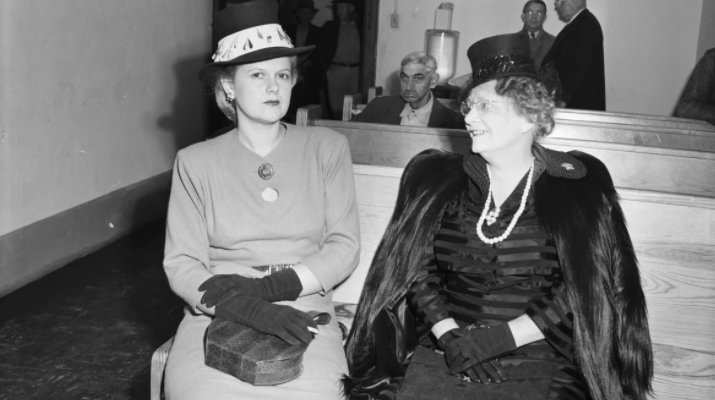
The events inside the home on Lindenwood Drive on the night of Nov. 11, 1945, were largely undisputed. Doris Bradshaw shot and killed her husband, Army 1st Lt. George Bradshaw.
Her motive, however, became the source of intrigue in a Fort Worth courtroom across two criminal trials in 1946.
Was she a ruthless killer — a “pistol-packing mama” who “reveled in the carnival of high living” and sought a financial payoff, as prosecutors claimed? Or a woman who acted in self-defense against an abusive husband, as Doris and her defense attorney, W.P. McLean, argued?
Twenty-four jurors across two trials struggled with that question while weighing a charge of murder with malice.
Doris and George Bradshaw married in Arizona in 1940. During World War II they lived in San Diego, Dayton, Ohio, — where George served as an Army airman — and twice in Fort Worth. The first stay came in 1943, when George worked at Convair. The couple returned in 1945 and settled into a house on Lindenwood Drive after first living on Spanish Trail.
They had three children: two daughters Doris brought from a previous marriage and a son, George III, born to the couple. Financial stability came from Doris’ inheritance from her grandmother. George, the son of a U.S. Navy captain, had worked in advertising sales and planned to open an industrial engineering office in Fort Worth, following his experience at Convair.
Court testimony suggested George liked to drink — and did not handle it well.
Sunday, Nov. 11 — Armistice Day — was cool and overcast, with temperatures in the low 50s. Fort Worth, like the rest of the country, was still basking in the glow of victory while reckoning with the war’s horrors. The day before, a 3-year-old child had been critically injured in a toy-gun accident. At TCU, trustees approved a $2 million campus expansion.
That evening, George picked up several acquaintances and brought them to the Lindenwood home for a night of drinking, according to news reports. Guests later testified that Doris played selections on her accordion while George recorded them on a home unit.
She was not rude to the guests, but when the group decided to head to a bar, Doris refused to go — and did not want her husband to go either.
“I’m sorry, dear,” she told him, according to testimony. “When you come home, the door will be locked.”
Margaret Cobb Turner, one of the guests, testified that shortly after, she heard the couple arguing in the bedroom. When she entered, Doris had retrieved George’s .32-caliber pistol from a telephone table drawer and was pointing it at him.
At the first trial, Doris testified that George sneered that she “hasn’t got the guts” to pull the trigger. She said he twisted her arm, shoved her into the bedroom, and spun her across the room.
“He was coming at me with an insane look in his eye that I recognized,” Doris told jurors after four hours on the stand. “All those experiences over the years came into my mind, and I knew he’d get me this time.”
She said she warned him not to come closer.
“He leaned forward … took a step toward me, and I — I guess the gun went off. I was deathly afraid of him.”
Doris testified to years of mistreatment and repeated threats on her life, including an incident the day George was inducted into the Army, when she said he struck her and threatened her with a gun.
Defense witnesses sought to corroborate her account. Former California neighbor Douglas A. Deeble testified in a deposition that Doris once arrived at his home hysterical, with two blackened eyes. Later that night, George arrived intoxicated, carrying a case of beer. Deeble’s wife testified to another incident. A third witnessed did the same.
Maj. William K. Beare, the autopsy surgeon, testified that the bullet’s downward trajectory indicated George was crouched and moving toward Doris when he was shot.
Prosecutors countered by highlighting inconsistencies. Doris initially told reporters the shooting was accidental and told detectives George had been teaching her to use the gun. They questioned her about a double-indemnity clause in his life insurance.
“I have enough to live on the rest of my life without any insurance policies,” Doris snapped.
The first trial ended in a 6–6 deadlock. At the second trial in June, jurors deliberated just 14 minutes before convicting Doris. At the request of both defense and prosecution, they assessed a two-year sentence and recommended suspension.
“No, it’s not consolation,” Doris said to the Fort Worth Star-Telegram. “My kids are still branded with a mother that was convicted.”
Later that month, Doris married for a fourth time. She was denied her husband’s Army life insurance but later reached a settlement naming her son, George III, as beneficiary — a result she said left her “tickled to death.”